
Levelling shop floors on the former Rookery
In the early 1970s the old Rookery area of narrow streets was cleared for a new market place and shopping centre. When a unit there is refitted, the floor is typically uneven from old fixings, adhesive and patching, and a new vinyl or LVT finish will show every flaw.
The work follows a clear sequence. We scrape away old adhesive and anything loose, fill cracks and holes, and prime with whatever suits the base, whether that is cement screed, concrete, calcium sulphate or a sound existing floor. Compound follows at the depth the unit needs, in fast drying grades so the shopfitters keep to their dates.
BS 8204 grades flatness with a 2m straightedge. Sheet finishes are often specified at SR1, with no more than 3mm under the edge; SR2 relaxes that to 5mm and SR3 to 10mm. A retail floor with sheet vinyl or LVT is normally levelled to SR1. We check the floor with a straightedge before pricing, so the depth of compound and the time it needs are known from the start.
The same applies to office refits in the town. If old tiles, paint or coatings must come off first, our floor preparation and shot blasting service strips the base.
Compound cannot save a Rookery shop floor that is cracked, hollow or crumbling. Then screed repairs come first.
Levelling where Newmarket houses meet extensions
A house built between 1945 and 1972, 27% of Newmarket's stock, may have an old solid floor that is sound but no longer flat. When a new extension is added and the wall between them removed, the two floors rarely meet perfectly. A thin skim of compound across both can join them into one level for a continuous finish.
Priming is essential. The new screed and the old floor may be different materials, and each needs a suitable primer so the compound bonds properly to both.
There are limits. Compounds are designed for about 2mm to 10mm, some for more. Pour them deep to cover for a floor that really wants screed and they can crack and come unstuck. A floor that is damp, hollow or moving must be dealt with first, and an older terrace floor without a damp proof membrane will usually need rebuilding, which is covered on the hand-laid screed page.
Timber floor sanding is not part of this service. The aim is a flat, sound base for whoever lays the finish.
How we price floor levelling in Newmarket
A fixed written price within 24 hours, once we know the area and the base. See our floor screeding cost guide.
Who levels your floor in Newmarket
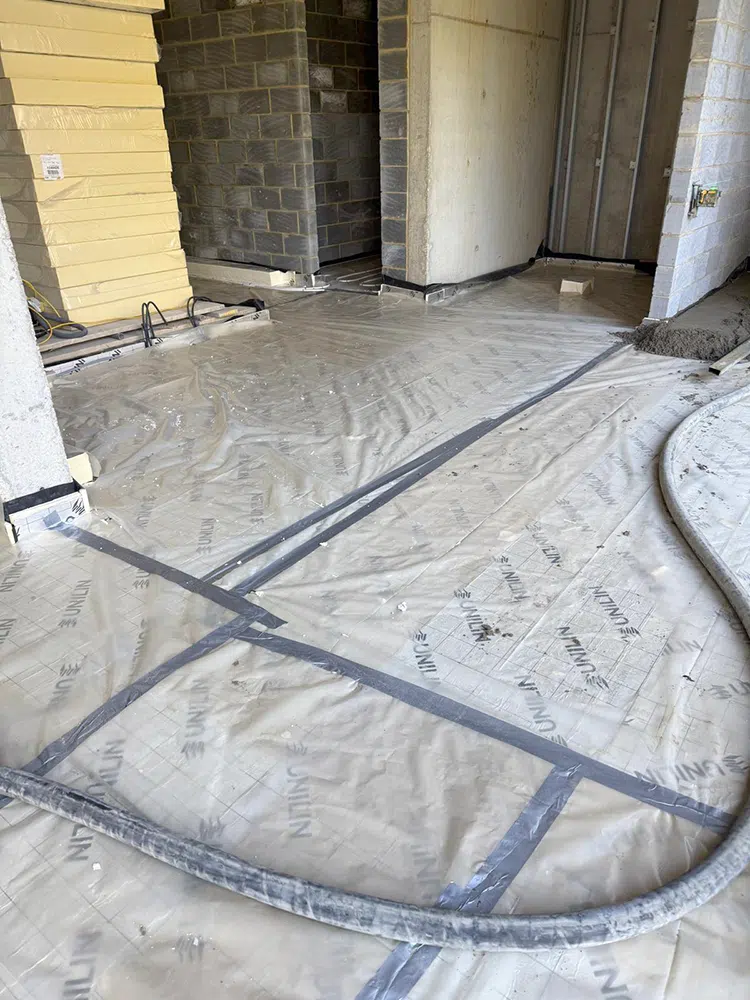
K & B Screeding’s own team, led by director Donatas Bardisevicius. Founded 2019, company 12298780.
See what customers say in our Google reviews and on our testimonials page.
Floor Levelling from Slough to Newmarket
Newmarket is about 66.6 miles north-east of our Slough base as the crow flies, with postcodes including CB8. The nearest towns to it are Soham (6.7 miles), Haverhill (11.2 miles), Ely (12.4 miles) and Cambridge (12.4 miles).
More on floor levelling, part of our screeding services. Not sure whether you need a thin compound or a full flowing screed? See self levelling screed explained.
