
Flat floors for Cambridge Science Park and Addenbrooke's
Cambridge Science Park, owned by Trinity College, and the Cambridge Biomedical Campus around Addenbrooke's, home to AstraZeneca's headquarters and Royal Papworth Hospital, house laboratory and clinical buildings. Floors there often need tight flatness tolerances, and where a lab or clinical room takes a sheet vinyl finish, every ripple beneath it shows.
Under BS 8204, a 2m straightedge is laid on the floor and the gap beneath it decides the class: within 3mm is SR1, within 5mm SR2 and within 10mm SR3. Sheet vinyl in a lab is the sort of thin finish that tends to ask for SR1. Self levelling compound, usually laid from about 2mm to around 10mm, is how an existing floor is brought within that tolerance. Fast drying products let the flooring contractor follow quickly, which matters when a lab is out of use.
Preparation is most of the job. Old adhesive, coatings and weak surface layers are removed, sometimes by concrete floor grinding, and cracks and hollows repaired. Next comes a primer picked for the base, since old tiles, concrete, calcium sulphate and cement screed all take different ones. Compound that goes down without it often comes away.
Where an existing floor is too damaged or too far out for compound, it needs a new screed or screed repairs first. If that is the case, you will hear it from us before any compound is poured. Our levelling is for bases before new flooring; it does not include resin, polished concrete or wood floor sanding.
Levelling older floors in Cambridge houses
In a terraced house or an inter-war semi, the ground floor may be decades old and dished, patched or out of line with a newer extension. Before LVT or large format tiles go down, compound brings it back to one flat plane, so the new finish does not telegraph every old patch and crack. The join between the original floor and an extension screed is a frequent place for a step or ridge, and compound feathered across it removes that.
Primers matter as much at home as in a lab. A calcium sulphate extension floor, for example, must have its laitance sanded off and a compatible primer applied first, as our anhydrite flow screed page explains.
Know when compound is not enough. A dip deeper than the compound's range, a hollow sounding screed or a floor that flexes needs repair or a new screed, because deep compound can crack and debond. A sound floor that just needs a skim can also take a thin coat of latex screed. If you are outside the city, we also offer floor levelling in Ely.
How we price floor levelling in Cambridge
A fixed written price within 24 hours, once we know the area and the base. See our floor screeding cost guide.
Who levels your floor in Cambridge
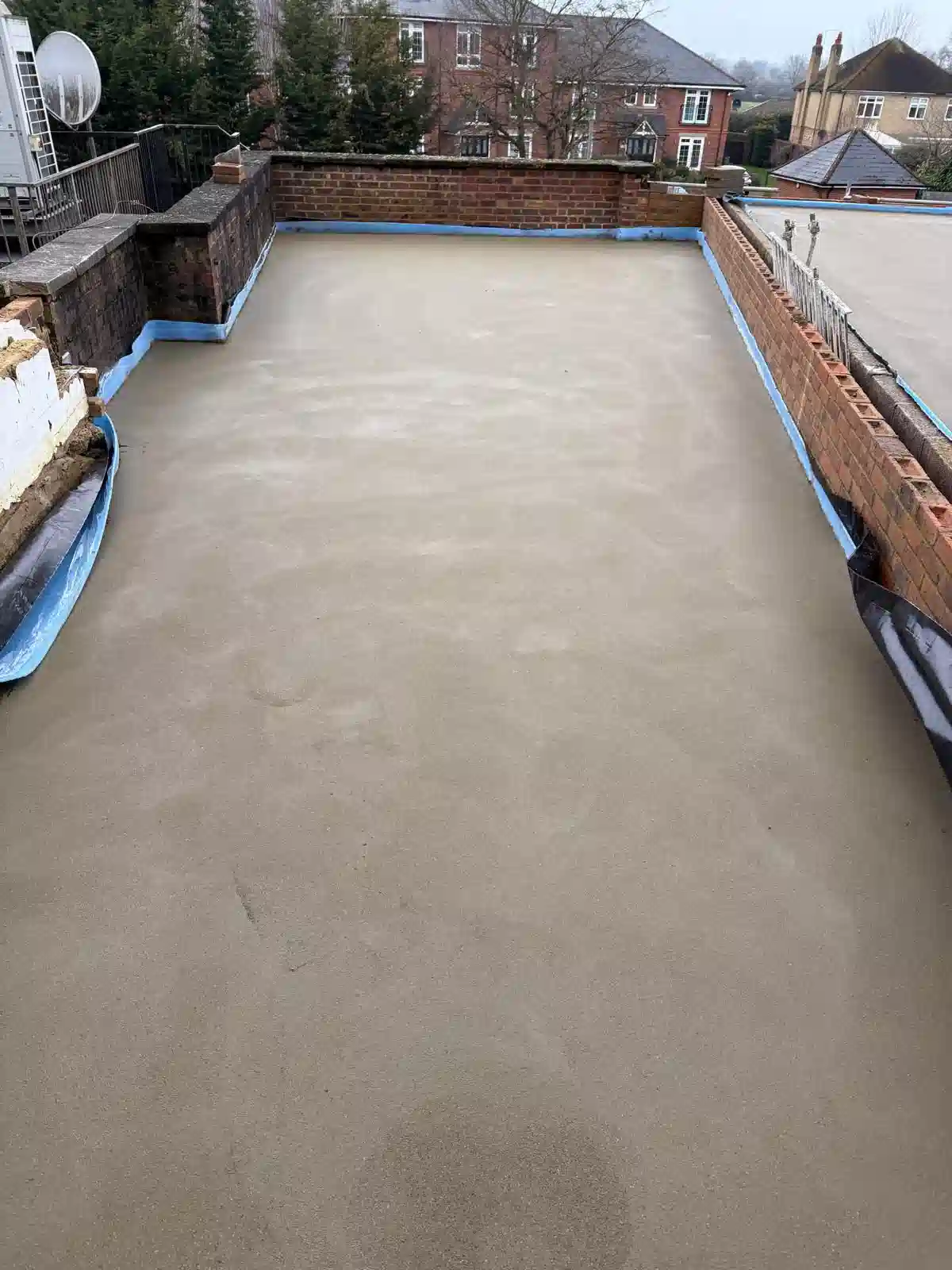
K & B Screeding’s own team, led by director Donatas Bardisevicius. Founded 2019, company 12298780.
See what customers say in our Google reviews and on our testimonials page.
Floor Levelling from Slough to Cambridge
Cambridge is about 56.9 miles north-east of our Slough base as the crow flies, with postcodes including CB2, CB4, CB1 and CB3. The nearest towns to it are St Ives (11.6 miles), Royston (12.4 miles), Newmarket (12.4 miles) and Soham (12.8 miles).
More on floor levelling, part of our screeding services. Not sure whether you need a thin compound or a full flowing screed? See self levelling screed explained.
