
Where pumped screed suits Cambridge floors
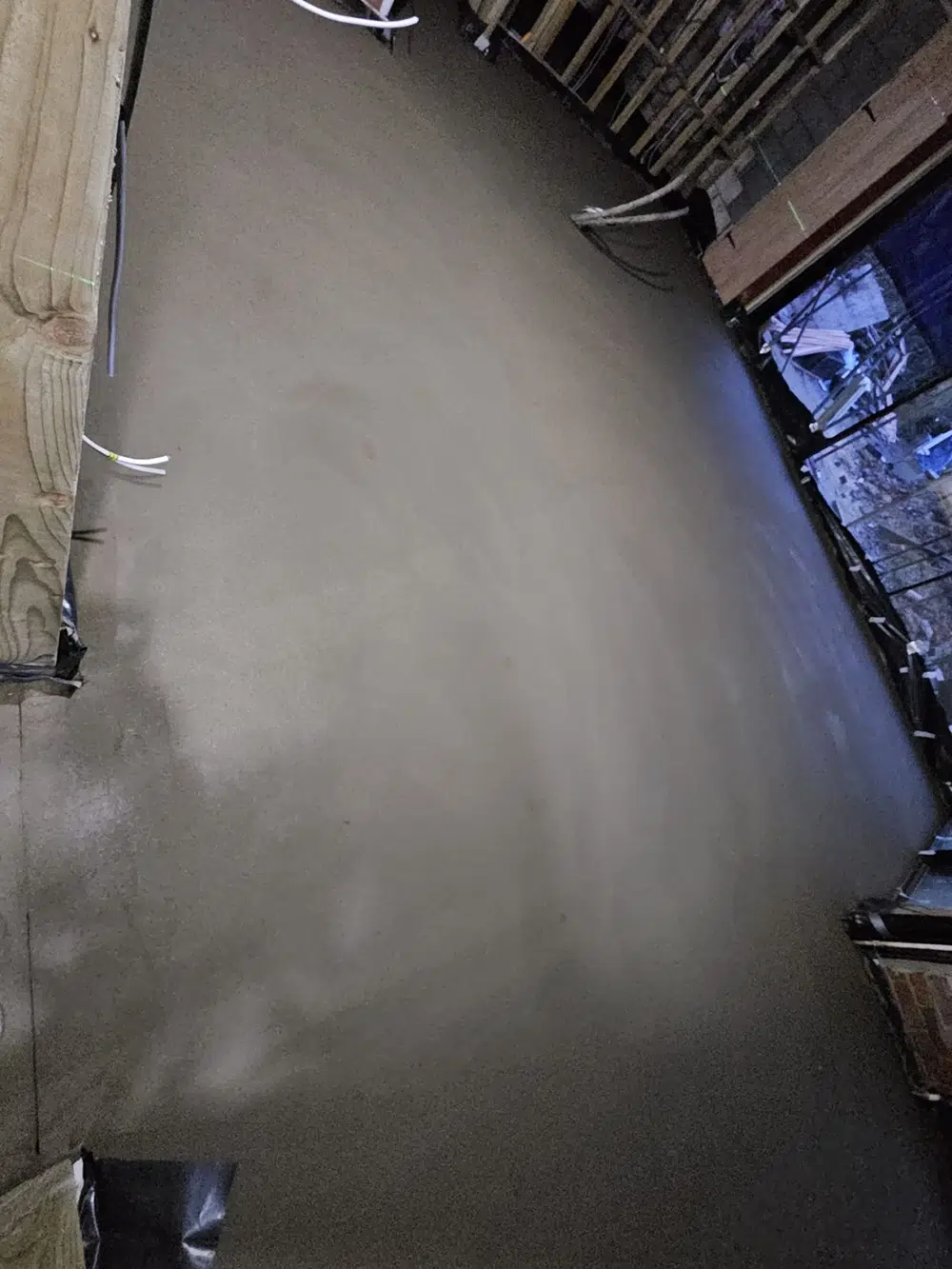
This screed is batched away from the house, brought in by lorry and sent along a hose to wherever the floor is, where it settles out level. There is no hand trowelling across the whole floor, so a large area is covered in a day and the finish is flat and dense. Getting the surface within SR1 or SR2 is not difficult, and that is the standard large tiles, engineered boards and LVT call for.
A typical Cambridge use is the ground floor extension on an inter-war or post war semi. The new floor must meet the existing one exactly, and a self-levelling screed poured to a set depth makes that simpler across a wide knock-through room. Over insulation in a home it starts from about 35mm deep, rising to about 40mm on commercial floors, which leaves space for thicker insulation within the same finished height.
New homes and flats are the other fit, since any floor laid over insulation or wet heating can be poured this way. We pump screed across the city, including Trumpington, Great Kneighton, Clay Farm, Darwin Green and Eddington. The screed flows under and around pipes with no voids, which our Cambridge underfloor heating screed page covers in detail.
Liquid screeds come in calcium sulphate and cement based forms, both pumped and self-levelling, and we choose the one that suits the room. Weighing it against a hand-laid floor? See how liquid and sand and cement screeds compare.
Pumping into Romsey Town streets and upper floors
Nothing heavy comes indoors; the pump stays in the street and only the hose goes in. That is useful in Cambridge, because it means screed can reach a rear extension behind a Victorian house in Romsey Town, or a flat above ground level, without barrows going through the house.
The practical questions are where the lorry can stand and how the hose gets to the room. On a street of houses with no front drive, the pump may have to sit at the kerb while the hose runs through the hall or down a side passage. Parking controls can affect the timing. Tell us about all of this when you ask for a price, with photos if you can, and we will plan the route before the day.
Once poured, the floor is left undisturbed for 24 to 48 hours before foot traffic. Flooring waits longer, and so do heavy loads such as kitchen units, because drying runs at about a day per millimetre for the first 40mm, then slower. For a job outside the city, see liquid screed in St Ives.
Liquid Screed prices in Cambridge
Liquid screed: £24 to £31 per m² supplied and laid (MyJobQuote, August 2026), so £960 to £1,240 for 40 m². MyJobQuote does not say whether these figures include VAT. See our floor screeding cost guide or screed calculator.
Who lays your liquid screed in Cambridge
K & B Screeding’s own team, led by director Donatas Bardisevicius. Founded 2019, company 12298780.
See what customers say in our Google reviews and on our testimonials page.
Liquid Screed from Slough to Cambridge
Cambridge is about 56.9 miles north-east of our Slough base as the crow flies, with postcodes including CB2, CB4, CB1 and CB3. The nearest towns to it are St Ives (11.6 miles), Royston (12.4 miles), Newmarket (12.4 miles) and Soham (12.8 miles).
More on liquid screed, part of our screeding services.
