
Where a pumped floor makes sense in March
Liquid screed is at its most useful where the floor is large and open. Think of a detached house with a new kitchen and family room across the back, a conservatory being turned into a heated room, or a whole ground floor on a new plot. Left to spread, the mix settles flat enough for SR1 or SR2 with little fuss, and so little shrinkage happens as it sets that the joint count drops well below a hand-tamped floor's.
New housing is the obvious fit. Part of the former Whitemoor marshalling yards, once the largest in Britain, is now housing, and the South East March allocation has a concept plan for about 650 homes. Homes on the South East March site are likely to use underfloor heating, and a pumped screed flows around the pipes and covers a whole ground floor in one visit.
Flats are fewer here than in a city, at 9% of homes, but an upper floor is where a pump earns its keep: the hose runs up the stairs instead of a team carrying sand and cement by hand.
Depth is modest. Floating in a house, liquid starts near 35mm thick, against roughly 65mm of sand and cement. Thirty millimetres saved is often what lets a March extension finish flush with the back door sill of the original house. Both cement based and calcium sulphate versions exist, and the March anhydrite grades page is where the calcium sulphate side gets explained.
Getting the hose into a March house
Mixer and pump are kept outdoors throughout. One hose snakes in through the handiest door, over dust sheets, so carpets and skirting escape the mess. Plenty of March homes are detached with a driveway, and those are simple. On older streets where cars park on the road, the pump may need a space kerbside, so let us know about parking bays, narrow lanes or shared access when you ask for a price.
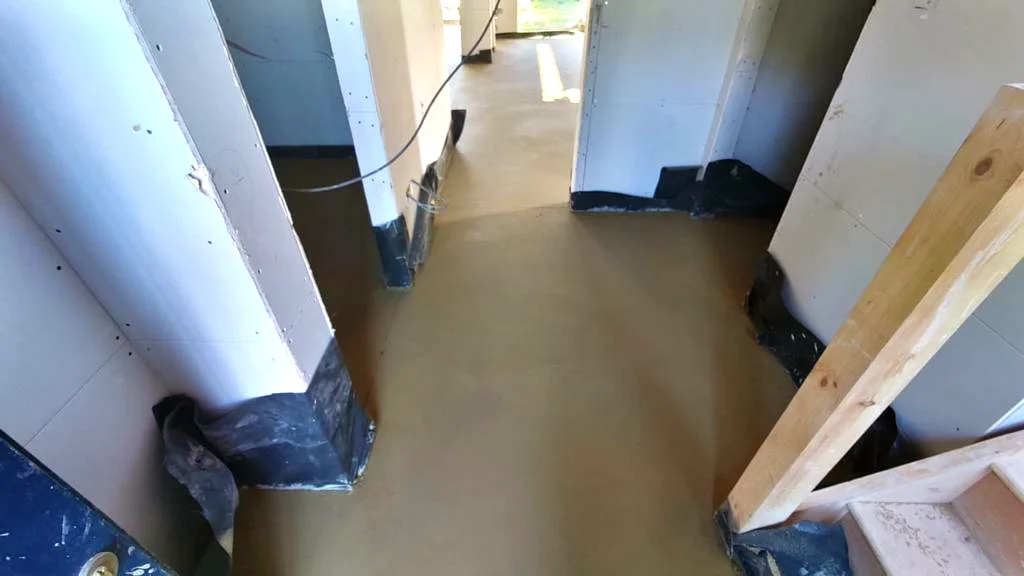
The room itself has to be prepared before the pour. Foam edge strip lines each wall. Polythene sheeting covers the insulation boards, seams taped, and every doorway gets a dam. All of that is gone over again by our team before the hose starts, and should your builder have left those layers out, our insulation and membrane fitting fills the gap.
Footprints are fine early; floorboards and vinyl are another story. Before a covering goes down, a moisture reading must come in under the limit the flooring manufacturer prints; the rule of thumb is a millimetre a day for the first 40mm, slower after. Read drying times for screed for more.
Liquid Screed prices in March
Liquid screed: £24 to £31 per m² supplied and laid (MyJobQuote, August 2026), so £960 to £1,240 for 40 m². MyJobQuote does not say whether these figures include VAT. See our floor screeding cost guide or screed calculator.
Who lays your liquid screed in March
K & B Screeding’s own team, led by director Donatas Bardisevicius. Founded 2019, company 12298780.
See what customers say in our Google reviews and on our testimonials page.
Liquid Screed from Slough to March
March is about 76.8 miles north-north-east of our Slough base as the crow flies, with postcodes including PE15. The nearest towns to it are Chatteris (6.5 miles), Whittlesey (9.1 miles), Ely (12.6 miles) and Peterborough (14 miles).
More on liquid screed, part of our screeding services.
