
Relaying tired floors in older March houses
March's Victorian and inter-war homes often have solid floors that are tired, cracked or damp, sometimes with no membrane at all. Strip the old coverings during a renovation and the straight answer is generally to break up the slab, lay insulation boards and a DPM, then screed afresh.
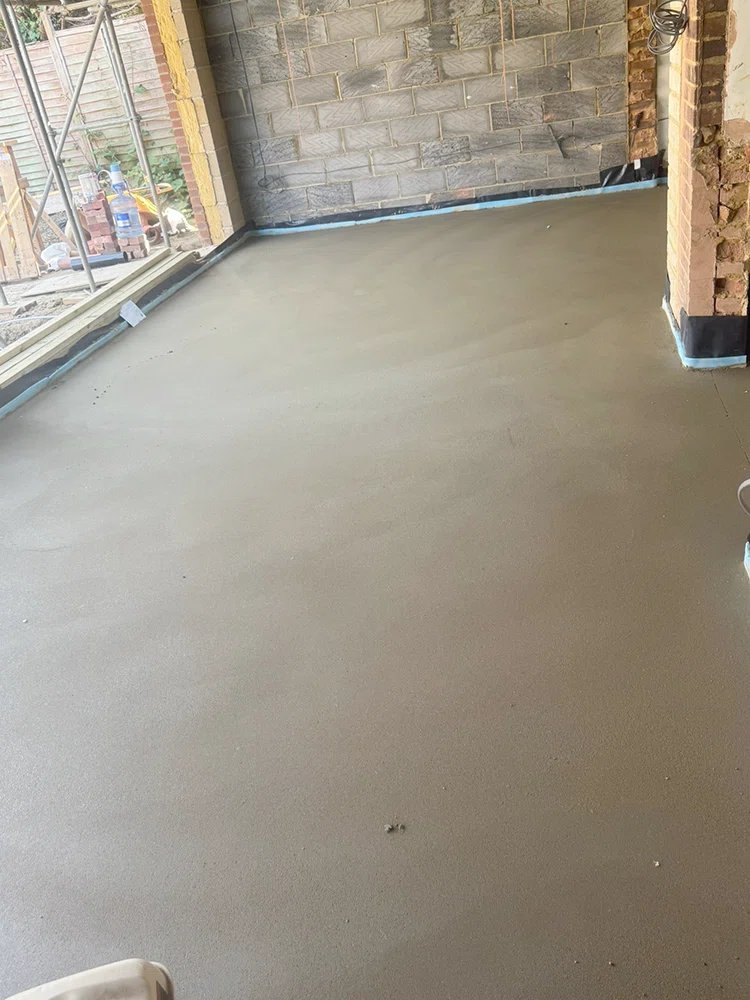
Sand and cement is the traditional choice for that. It is mixed on site, compacted by hand and finished with a float, so it copes with the short, odd-shaped rooms and changes of level that older houses throw up. It also bonds well where needed and gives a cement substrate that suits tiled floors.
Thickness follows the way the floor is built up. A domestic floating screed on insulation goes in at roughly 65mm, a commercial one at 75mm. Bonded onto old concrete in sound condition, 25 to 40mm deep is normal; see bonded screeds for the cases where that approach holds up.
Patience is the price with this method, because a liquid screed dries noticeably faster. Reckon on roughly 40 days to dry the first 40mm, then slower again, so a Victorian March house with a 65mm floor waits weeks before engineered wood or other fussy finishes. Short on time? Published prices for a rapid drying cement screed are £20 to £28 per m², with the ordinary mix at £18 to £25.
Wet rooms, garages and falls in March
Some floors should not be calcium sulphate at all. Walk-in showers with no tray, and full wet rooms, call for cement based screed, sloped by hand to carry water off toward the gully. That is careful hand work, and it is exactly where sand and cement comes into its own.
Garages come next, and they bring their own problem. A detached house with an integral or linked garage may be turned into a study, a playroom or a bedroom, and the old concrete floor usually sits well below the house. Insulation boards, polythene and a screed lift that concrete up to hallway height, so nobody trips on a step into the new room. For each layer in order, read screeding a garage conversion floor.
A workshop, or a utility room holding heavy appliances, may need loading early; fibre reinforcement or a stronger cement mix handles that, the fibres adding around £1 to £3 per m². We will tell you plainly if a thinner or quicker product would do the same job.
Sand and Cement Screed prices in March
Sand and cement screed: £18 to £25 per m² supplied and laid (MyJobQuote, August 2026), so £450 to £630 for 25 m². MyJobQuote does not say whether these figures include VAT. See our floor screeding cost guide or screed calculator.
Who lays your sand and cement screed in March
K & B Screeding’s own team, led by director Donatas Bardisevicius. Founded 2019, company 12298780.
See what customers say in our Google reviews and on our testimonials page.
Sand and Cement Screed from Slough to March
March is about 76.8 miles north-north-east of our Slough base as the crow flies, with postcodes including PE15. The nearest towns to it are Chatteris (6.5 miles), Whittlesey (9.1 miles), Ely (12.6 miles) and Peterborough (14 miles).
More on sand & cement screed, part of our screeding services.