
Relaying cracked screeds in Huntingdon terraced homes
Terraced houses are a large part of Huntingdon, and in some of them the existing screed is the weak point. It may be cracked, hollow where it has lost its bond, or uneven enough to show through new flooring. Before a new floor goes down, it is worth finding out which.
A tap test and a straightedge tell most of the story. A floor that is solid but out of true can be put right with compound. If sections are hollow or crumbling, those areas are cut out and relaid. If the whole floor has failed, or there is no damp protection underneath, the answer is to dig out and rebuild with a membrane, insulation and a new screed.
Rebuilt as a floating floor over insulation in a house, the sand and cement goes in at 65mm. Where the new layer is bonded to a sound concrete base, 25 to 40mm is usual, which helps when height is limited by doors and thresholds. Fibres can be added to resist cracking, at £1 to £3 per m² extra in published 2026 UK figures.
Homes built before 1919 make up 8% of Huntingdon. Floors of that age may have no membrane at all, and a traditional screed is the natural match for their small rooms and stepped thresholds.
For partial failures, see screed repairs; for work on the base itself, see floor preparation.
Huntingdon wet rooms, garages and bonded toppings
Some jobs need a cement screed wherever the house is. Wet rooms and walk-in showers top the list. Calcium sulphate screeds lose strength when they stay wet, so a floor falling to a drain is laid in sand and cement, with the falls shaped by hand as it goes down, then tanked once it has cured.
Garage conversions are next. Converting a Huntingdon garage means raising its floor to meet the house, and laying a damp membrane and insulation first. Depths for that job are in our garage floor screeding guide.
Bonded screeds are the third. If a concrete slab is sound but wants a fresh, level surface, 25 to 40mm of sand and cement is bonded straight onto it once it has been prepared and primed. That bonded option is £12 to £18 per m² (trade2base, June 2026) on published 2026 UK figures.
Being hand-laid, it dries slower than pumped screed, close to a day per millimetre for 40mm and slower after, so the programme has to make room. For open-plan extensions, the liquid screed option in Huntingdon is usually quicker to lay and to walk on.
Sand and Cement Screed prices in Huntingdon
Sand and cement screed: £18 to £25 per m² supplied and laid (MyJobQuote, August 2026), so £450 to £630 for 25 m². MyJobQuote does not say whether these figures include VAT. See our floor screeding cost guide or screed calculator.
Who lays your sand and cement screed in Huntingdon
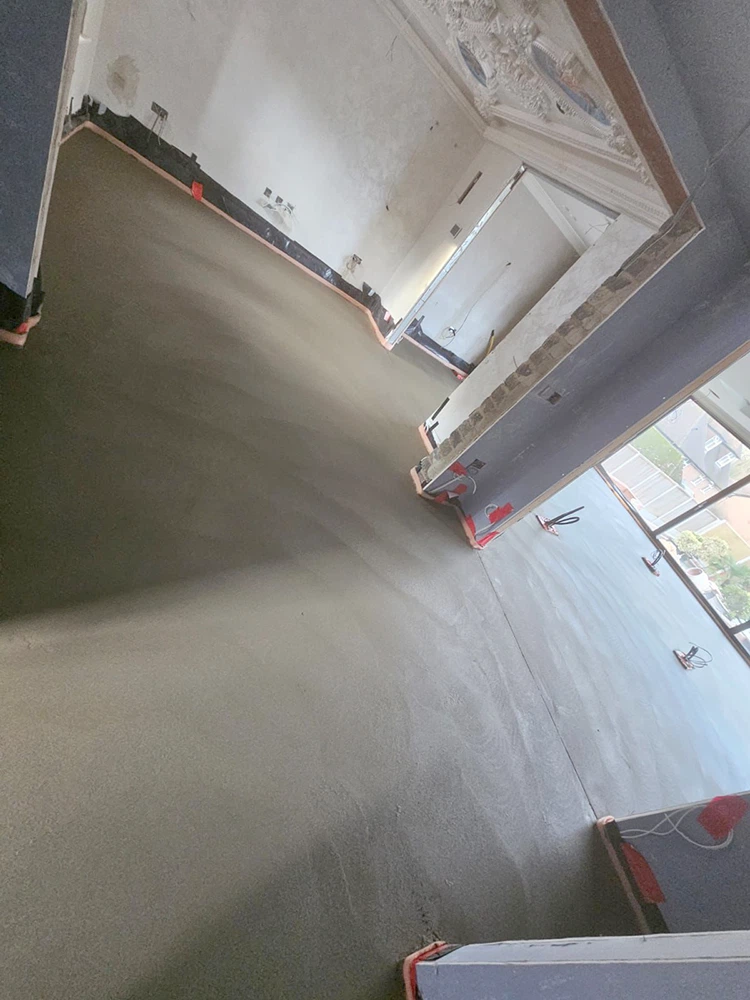
K & B Screeding’s own team, led by director Donatas Bardisevicius. Founded 2019, company 12298780.
See what customers say in our Google reviews and on our testimonials page.
Sand and Cement Screed from Slough to Huntingdon
Huntingdon is about 58.6 miles north-north-east of our Slough base as the crow flies, with postcodes including PE29 and PE28. The nearest towns to it are St Ives (4.7 miles), St Neots (8 miles), Chatteris (13.2 miles) and Sandy (14.6 miles).
More on sand & cement screed, part of our screeding services.
