
Relaying older and riverside floors in St Ives
Only 7% of St Ives homes were built before 1919, and terraces make up 24% of the housing. Take an older terrace or cottage whose solid ground floor has cracked, dropped or no longer keeps damp out: patches on a floor like that seldom hold. The lasting fix is to break it out and build it back up properly, starting with a compacted base, then a damp proof membrane and insulation, with fresh screed as the top layer.
Sand and cement suits that kind of rebuild. We mix it on site, batch by batch, so a narrow hall, a little kitchen and a back room can each be laid at the depth that room needs. Over insulation in a house, a floating screed goes down at 65mm. Bonded directly onto a sound concrete base, it can be as thin as 25 to 40mm. Our guide to screed depths sets out how those numbers are arrived at.
Near the river, damp tips the decision. In those lower lying parts of St Ives, calcium sulphate should not be laid where a floor might get wet, while a cement based screed copes in wet areas. The membrane deserves as much care as the screed, and our insulation and membranes service puts the layers underneath in place first.
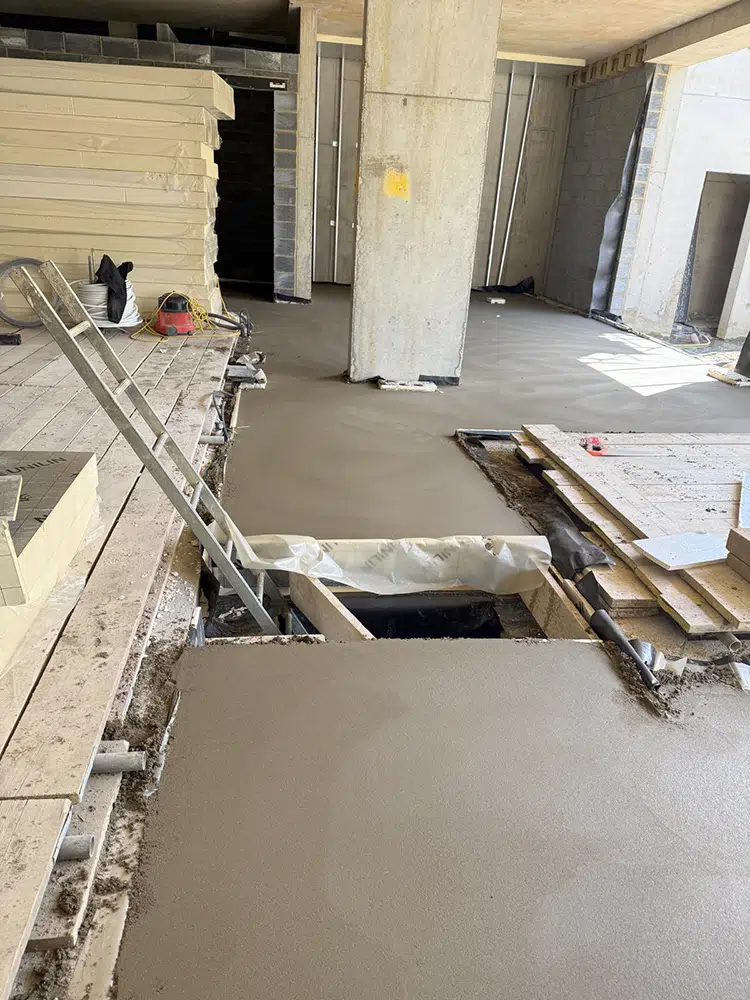
Once it is spread, the screed is compacted by hand and floated off until it is dense and level. It takes longer to dry than a liquid screed, so when you relay a floor in an older St Ives house, build that drying time into the plan before the flooring is booked.
Garages, wet rooms and small jobs in St Ives
Turning a garage into a room is one of the commonest reasons to choose sand and cement. The garage slab nearly always sits below the floor of the house, so it has to be brought up with insulation and screed until it meets the hall. For the full build-up, read our guide to screeding a garage conversion. If the old slab is cracked or uneven, we check it first and decide how much of it can stay.
A wet room or walk-in shower needs its floor to fall gently towards the drain. A hand-laid screed can be formed to that slope, and once dry it will take tanking and tiles. It is also the right base when a floor has to bear load early, before a liquid screed would be ready.
On price, 2026 UK figures give £18 to £25 per m² for sand and cement screed. Adding fibres, which help stop cracking in thinner or heated floors, costs a further £1 to £3 per m². If your programme is tight, a faster drying sand and cement screed shortens the wait before the tiler can start.
For one or two rooms in a St Ives semi or terrace, laying by hand often works out cheaper, because there is no pump to set up and the material arrives in loads sized for a small job.
Sand and Cement Screed prices in St Ives
Sand and cement screed: £18 to £25 per m² supplied and laid (MyJobQuote, August 2026), so £450 to £630 for 25 m². MyJobQuote does not say whether these figures include VAT. See our floor screeding cost guide or screed calculator.
Who lays your sand and cement screed in St Ives
K & B Screeding’s own team, led by director Donatas Bardisevicius. Founded 2019, company 12298780.
See what customers say in our Google reviews and on our testimonials page.
Sand and Cement Screed from Slough to St Ives
On the map, St Ives sits north-north-east of Slough, about 59.9 miles from our base in a straight line (postcodes including PE27), next to Huntingdon (4.7 miles), Chatteris (10.6 miles), St Neots (10.6 miles) and Cambridge (11.6 miles).
More on sand & cement screed, part of our screeding services.