
Full floor build-ups near Sandy's Market Square
Some 13% of Sandy's homes were built before 1919. Sandy stayed a village until the 20th century and only became a market town in 1925. Properties near the Market Square and St Swithun's Church may need their ground floors rebuilt from the base up.
The usual reason is damp. With no membrane below, damp from the ground creeps up through an old solid floor and into whatever sits on it. Replacing it means breaking out the old floor, digging to the required depth, laying a membrane and insulation, then screeding over the top. The membrane and insulation layer is covered on our insulation and membranes page.
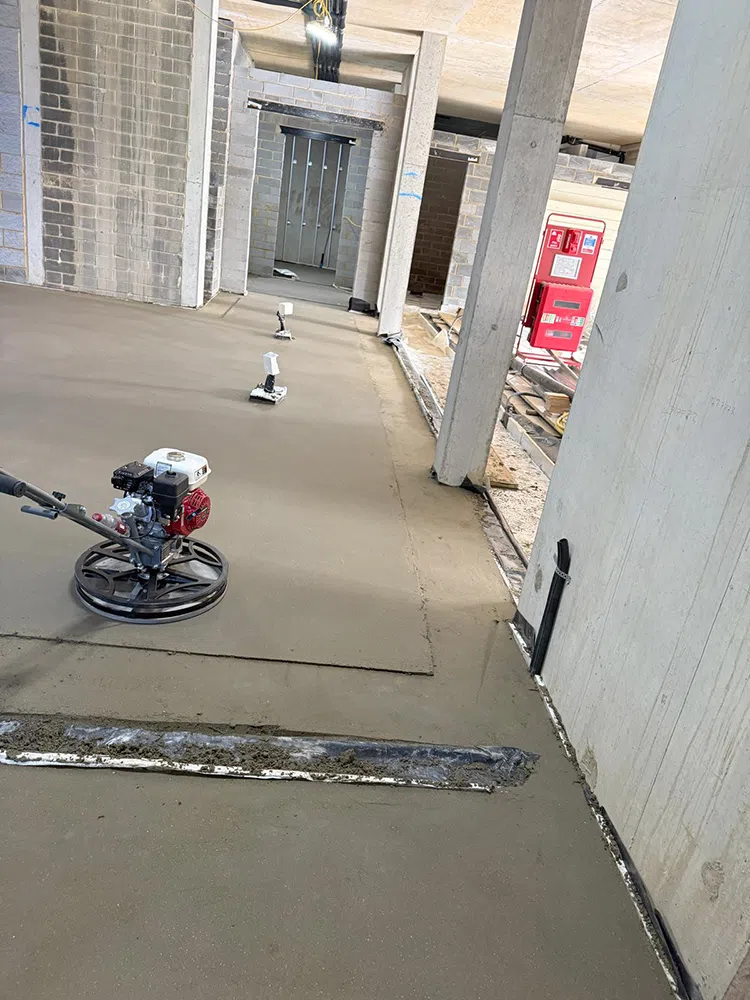
A traditional mix suits that rebuild. We mix it on site room by room, wheel it in through narrow old doorways, tamp it down by hand and trowel it to a dense, level finish. There is no pump or hose to accommodate, which helps where there is nowhere to park one.
The base underneath sets the depth. Floating over new insulation in one of these older houses, it wants about 65mm. Over an existing slab that is still sound, with the screed bonded to it, 25 to 40mm is enough. Commercial floors go to 75mm.
The mix can be adjusted too. Fibres can go into the mix to help it resist cracking, at £1 to £3 more per m², while a rapid drying additive lets the flooring go down sooner, as our quick drying screed page explains.
Kitchen refits, wet rooms and garages in Sandy
Away from the centre, the overspill-era houses around Fallow Field and Ivel Park bring a different sand and cement job. When a kitchen is refitted, the ground floor underneath is often found to be cracked or uneven, and a section of it is dug out and relaid.
The post-war stock adds more of the same. About 24% of the town's homes were built between 1945 and 1972, and their original floors are now of an age where patch repairs stop working.
A wet room is another job for a traditional mix. The floor there has to fall towards the outlet, and a hand-trowelled mix is how that fall gets formed. Cement stands up to water where calcium sulphate would not, so it is the base to put under a walk-in shower.
Garage conversions often need the floor raised to meet the house, with insulation underneath, and a traditional screed handles the depth well. We take you through that job in our guide to garage conversion floors.
Against all that, you wait longer for it to dry out than you would with liquid. Homes further north are covered on our St Neots page for hand-laid floors.
Sand and Cement Screed prices in Sandy
Sand and cement screed: £18 to £25 per m² supplied and laid (MyJobQuote, August 2026), so £450 to £630 for 25 m². MyJobQuote does not say whether these figures include VAT. See our floor screeding cost guide or screed calculator.
Who lays your sand and cement screed in Sandy
K & B Screeding’s own team, led by director Donatas Bardisevicius. Founded 2019, company 12298780.
See what customers say in our Google reviews and on our testimonials page.
Sand and Cement Screed from Slough to Sandy
As the crow flies, our yard in Slough is about 44 miles from Sandy, which lies to the north-north-east. Postcodes here include SG19, and Biggleswade (3.1 miles), St Neots (6.9 miles), Bedford (7.7 miles) and Stotfold (8.2 miles) are close by.
More on sand & cement screed, part of our screeding services.
