
Heated knock-throughs in Sandy's overspill-era homes
When a Sandy house built in the 1970s to 1990s has its kitchen, dining room and living room opened into one, the floor usually has to be replaced to take heating. Height is the constraint. The new floor must meet existing thresholds, the stairs and any rooms left untouched, so every millimetre of insulation and screed is planned.
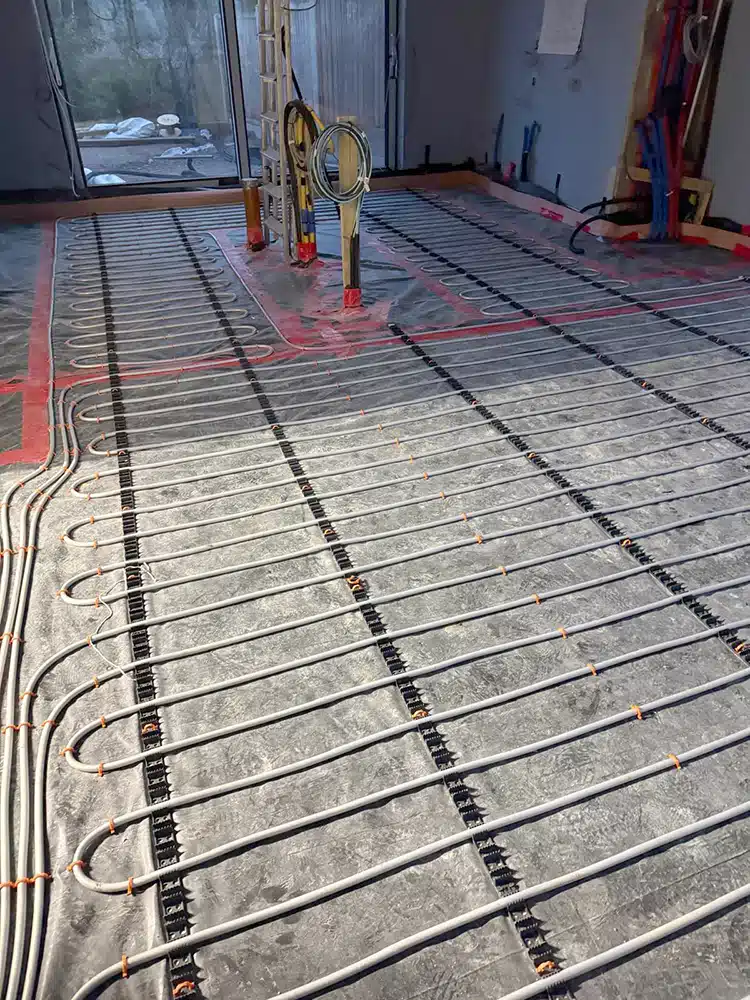
That is why thin screeds are common. Pumped liquid can sit just 25mm or more above the pipes, which keeps the floor to roughly 45 to 50mm, whereas a sand and cement mix wants about 45mm of cover and a deeper build overall. In a knock-through where height is tight, pumped liquid screed in Sandy usually fits the space better, and it flows fully around the pipes with no air pockets, so heat spreads evenly.
Detached houses make up 24% of Sandy's homes, and larger ground floors in those can take heating across several rooms in one pour, with joints planned between zones. Where a whole ground floor is being replaced, the pipes, screed and flooring should be chosen together, because a thick stone tile and a thin LVT behave differently over heating.
On the day we first go over the edge strip, membrane and insulation, and supply whatever is missing. In a Sandy knock-through, the heating engineer lays the loops and pressure checks them ahead of our visit, and that side of things is theirs rather than ours. Depths for each kind of build-up are listed in our screed thickness guide.
Commissioning underfloor heating in a Sandy home
A heated floor is only as good as its first few weeks. A new screed still contains a lot of water, and heating it hard and fast drives that out too quickly, which can crack or curl the surface.
The start date depends on the material. A calcium sulphate floor can normally be warmed once about 7 days have passed. If the knock-through was screeded in sand and cement, leave the heating off for three full weeks, 21 days, as a minimum. From there the system is brought up gradually, starting with a low flow temperature and raising it in small steps, then held and eased back before the floor finish goes down. The exact temperatures are set by your heating engineer, and we talk you through the schedule before we leave.
Done properly, commissioning doubles as drying, so a heated floor is often ready for its finish sooner than an unheated one.
If the finished screed ends up slightly out of flat where it meets older floors, a thin coat of compound deals with it, as described on our floor levelling page for Sandy. For projects to the west, see underfloor heating screed in Bedford.
Underfloor Heating Screed prices in Sandy
Liquid screed over underfloor heating: £20 to £35 per m² supplied and laid (trade2base, June 2026), so £700 to £1,230 for 35 m². trade2base gives these figures excluding VAT. See our floor screeding cost guide or screed calculator.
Who lays your underfloor heating screed in Sandy
K & B Screeding’s own team, led by director Donatas Bardisevicius. Founded 2019, company 12298780.
See what customers say in our Google reviews and on our testimonials page.
Underfloor Heating Screed from Slough to Sandy
As the crow flies, our yard in Slough is about 44 miles from Sandy, which lies to the north-north-east. Postcodes here include SG19, and Biggleswade (3.1 miles), St Neots (6.9 miles), Bedford (7.7 miles) and Stotfold (8.2 miles) are close by.
More on underfloor heating screed, part of our screeding services.