
Underfloor heating screed for Fairfield and Stotfold Park extensions
Some 18% of Stotfold's homes were built in 2015 or later, and owners of these and slightly older houses are now adding extensions and opening up ground floors. Heating in the floor is a common part of that plan, and the screed is what makes it perform.
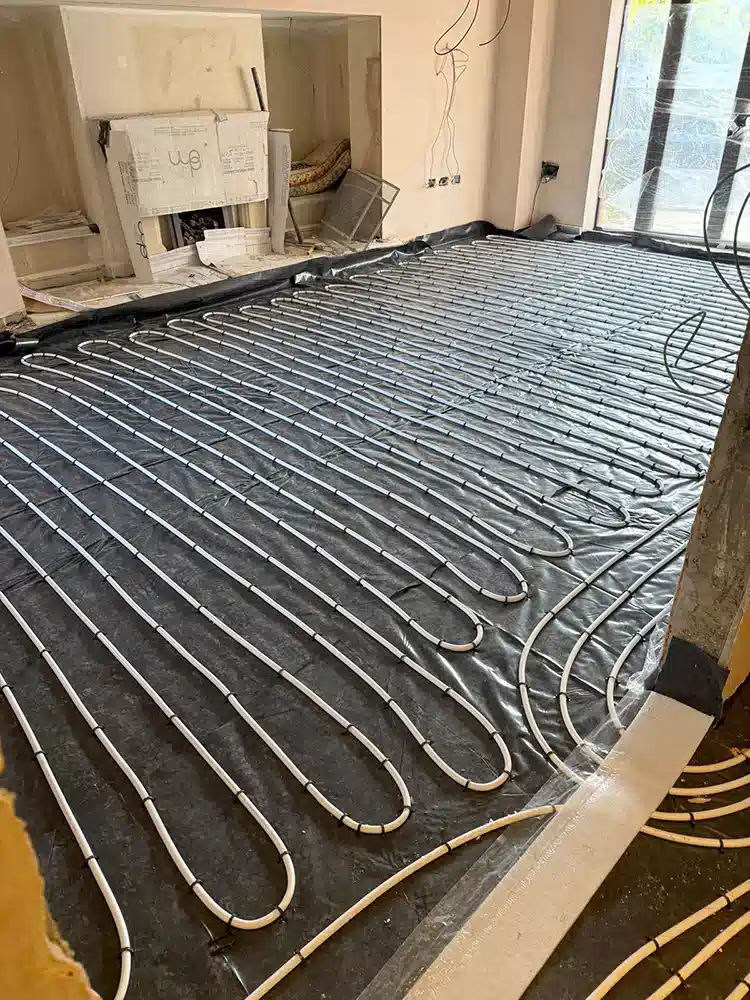
Pipe cover is the first rule. Liquid screed wants 25mm or more above the pipework, so the floor finishes around 45 to 50mm thick. Sand and cement asks for nearer 45mm on top, which adds to the total depth. When a Stotfold Park extension must line up with the existing floor next door, that difference often picks the screed for you, and our screed thickness guide lays out the depths.
Flowing screed has a practical edge over pipes. It runs into every gap round the pipes and leaves no air pockets, so warmth travels evenly and the room heats up sooner. Our page on pumped liquid screed in Stotfold covers how it gets into the room. If a calcium sulphate grade appears on your drawings, read the Stotfold anhydrite flow screed page for what that involves.
On arrival we go round the edge strip and look over the insulation and membrane, and can bring any missing pieces. Fitting the pipes is outside what we do. Your heating engineer lays them and pressure tests the system before we arrive, and the pour is booked once that is done.
Heating up a new Stotfold floor safely
The first weeks after the pour decide how well a heated floor performs for years. Fresh screed still holds a lot of water, and forcing it out with high heat can crack or curl the surface.
Timing depends on the material. A calcium sulphate floor will generally take gentle heat after about 7 days. Give sand and cement a minimum of 21 days. Then the heating is commissioned gradually, starting with a low flow temperature and raising it in small steps over several days, before holding it and easing back ahead of the floor finish going down. The temperatures and timings are your heating engineer's to set, and we go through them with you at handover.
Used like this, the heating also dries the screed, which often means flooring can go down sooner than on an unheated floor.
Larger houses tend to have more heating zones. Some 13% of Stotfold's homes are in council tax bands F to H, and bigger ground floors need joints planned between zones before the pour. For homes a few miles south, see underfloor heating screed in Hitchin.
Underfloor Heating Screed prices in Stotfold
Liquid screed over underfloor heating: £20 to £35 per m² supplied and laid (trade2base, June 2026), so £700 to £1,230 for 35 m². trade2base gives these figures excluding VAT. See our floor screeding cost guide or screed calculator.
Who lays your underfloor heating screed in Stotfold
K & B Screeding’s own team, led by director Donatas Bardisevicius. Founded 2019, company 12298780.
See what customers say in our Google reviews and on our testimonials page.
Underfloor Heating Screed from Slough to Stotfold
Stotfold is about 37.9 miles north-north-east of our Slough base as the crow flies, with postcodes including SG5 and SG15. The nearest towns to it are Baldock (2.6 miles), Letchworth (2.7 miles), Hitchin (5 miles) and Biggleswade (5.1 miles).
More on underfloor heating screed, part of our screeding services.
