
Retrofitting underfloor heating in post-war Letchworth homes
Ground floors in post-war houses were not designed to take a heated screed. Adding underfloor heating means finding depth for insulation, pipes and screed while keeping the finished floor level with the rest of the house. Leave out the insulation and a good share of the warmth disappears into the ground under the house rather than heating the room.
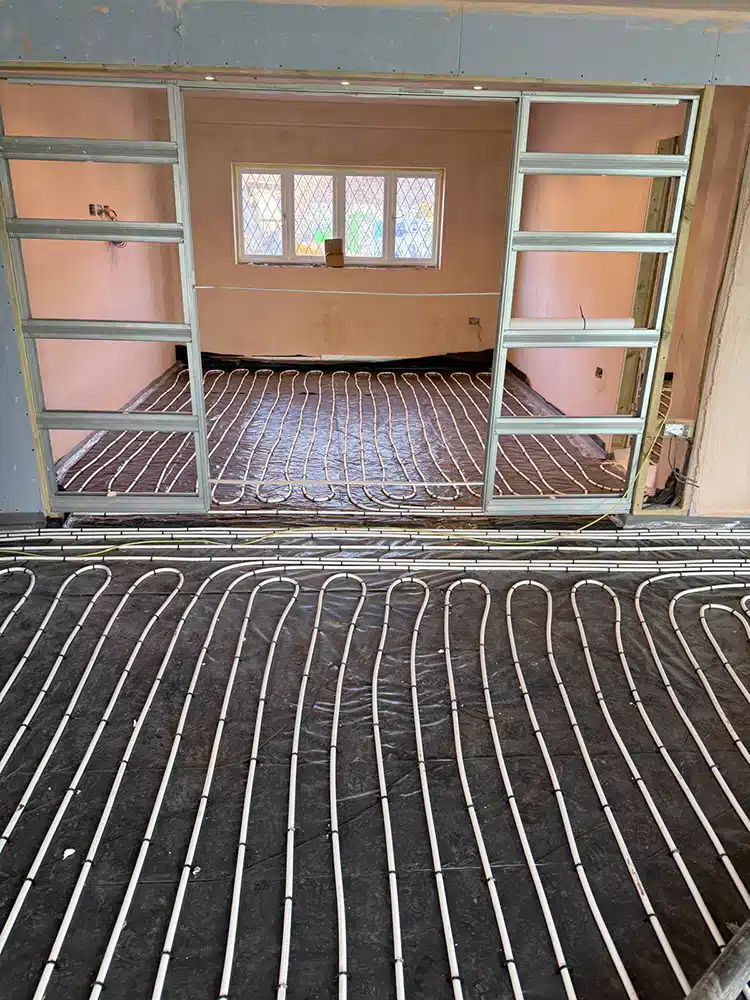
In practice that usually means the old slab comes out. That gives room for a proper build-up: insulation, a membrane, edge strip around the walls, the pipes clipped down by your installer, then the screed. Where digging out is not possible, a thinner system and a liquid screed keep the rise to a minimum.
Pipe cover sets the depth. With liquid screed there must be 25mm or more above the pipes, which puts the whole layer at around 45 to 50mm. Sand and cement needs about 45mm of cover and a deeper overall section, which is harder to fit into an existing house. Because it flows, liquid screed wraps each pipe without leaving voids, which lets heat travel evenly and brings the room up to temperature sooner.
Some houses need more than a screed. If the edges of the old slab are damp or the ground is uneven after digging, sort that first. We can lay the insulation and damp membrane first, and our guide to how thick screed should be lists the depth for each type of build-up.
Commissioning a heated Letchworth floor step by step
The first time the heating runs under new screed, it has to warm up gently. Turn it straight up to full and the screed can crack, taking the new flooring with it.
Timing starts with the material. Calcium sulphate will usually accept heat about 7 days after it is poured, whereas sand and cement has to be left cold for 21 days at the very least. The flow temperature is then raised a little each day, held at working temperature, and brought down again before the floor covering is laid. We write the schedule down for you and your heating engineer, who operates the system, so nobody is working from different dates.
Extensions are simpler than retrofits, because the depth is designed in from the start. A heated kitchen extension on one of the post-war estates can take a pumped screed that fills around the pipes in a single visit, and our liquid screed for Letchworth extensions page covers access and flatness.
As a guide to cost, liquid screed laid over heating pipes is £20 to £35 per m² on 2026 published prices. For a nearby comparison, see underfloor heating screed in Stevenage.
Underfloor Heating Screed prices in Letchworth
Liquid screed over underfloor heating: £20 to £35 per m² supplied and laid (trade2base, June 2026), so £700 to £1,230 for 35 m². trade2base gives these figures excluding VAT. See our floor screeding cost guide or screed calculator.
Who lays your underfloor heating screed in Letchworth
K & B Screeding’s own team, led by director Donatas Bardisevicius. Founded 2019, company 12298780.
See what customers say in our Google reviews and on our testimonials page.
Underfloor Heating Screed from Slough to Letchworth
On the map, Letchworth sits north-north-east of Slough, about 35.5 miles from our base in a straight line (postcodes including SG6), next to Baldock (2 miles), Stotfold (2.7 miles), Hitchin (2.9 miles) and Stevenage (5.3 miles).
More on underfloor heating screed, part of our screeding services.
