
Pipe cover and floor height in Baldock houses
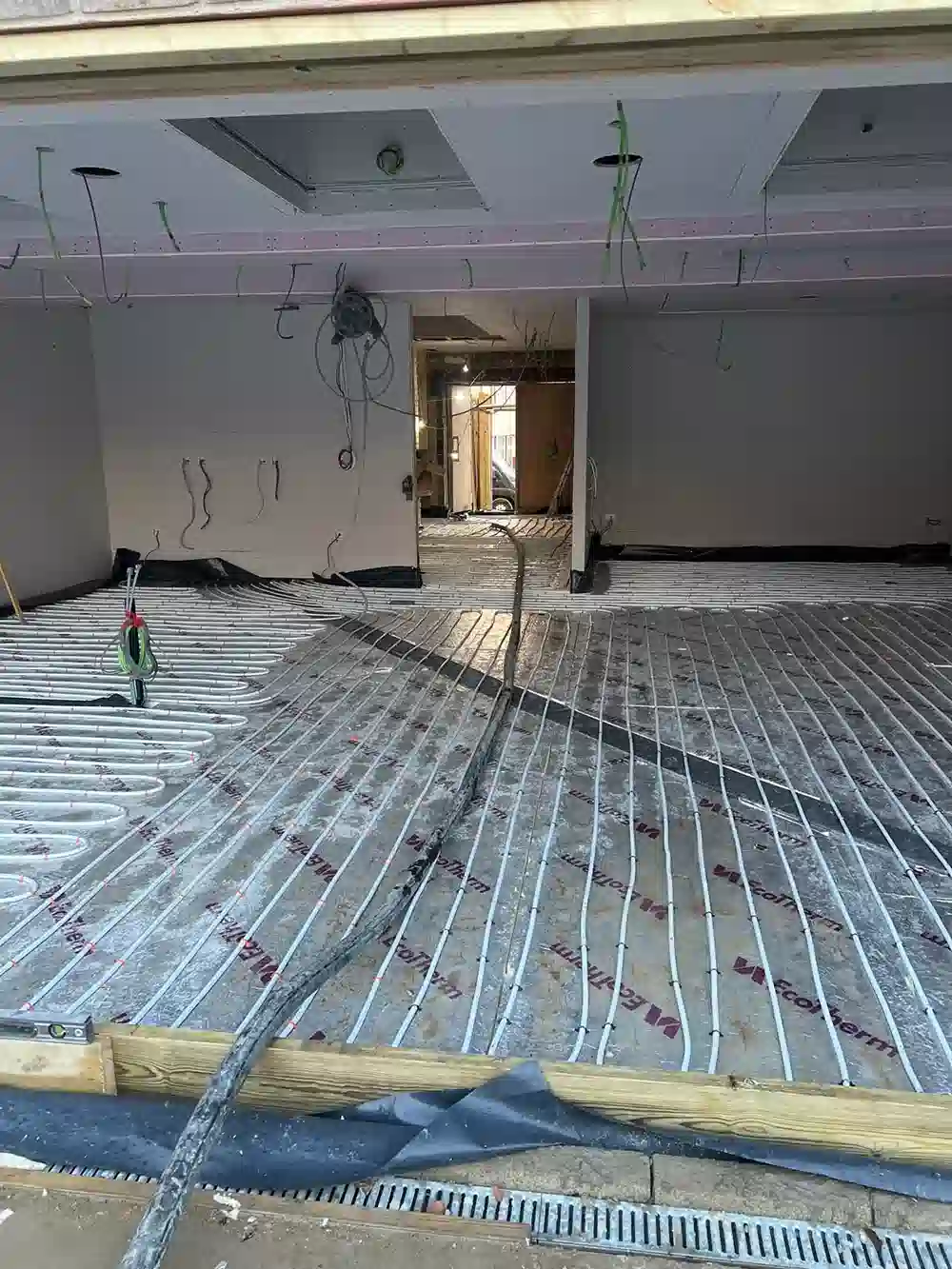
How well the heating performs depends on the screed wrapped around the pipes. The screed has to surround every pipe with no air pockets, spread the heat evenly and be deep enough above the pipes to carry furniture and foot traffic without cracking.
Liquid screed wants a covering of 25mm or more over the pipework, which normally takes the finished layer to 45 to 50mm. Because it flows, it fills fully under and around each pipe and warms up quickly. With sand and cement, cover of about 45mm is needed, so the floor is thicker overall. The guide to screed thickness puts both sets of figures next to each other.
In a new extension there is usually room to design the build-up from scratch. Putting pipes into a room that is already lived in takes more working out. Homes built between 1945 and 1972 make up 20% of Baldock, and in a house of that era the original floor may leave little height to play with once insulation, pipes and screed are stacked up. The thinner section of flowing liquid screed often makes the difference, because it keeps the new floor level with doorways and the rest of the house.
Garden rooms add another variation. A heated garden room is often a lightweight structure, so its floor build-up, insulation and edge detail need planning before the screed goes in.
Switching the heating on in a new Baldock floor
Before the pour, your installer should pressure test the pipes and leave the system full and under pressure. Insulation, membrane and edge strip must all be in place; we check them on arrival, and our insulation and membranes team can supply them if they are missing.
After the pour, patience matters. With a calcium sulphate pour, the system can usually be started at around 7 days; a cement screed must wait at least three weeks. Either way, the heat goes on gradually: low flow temperature to begin with, raised in small steps over days, following the heating manufacturer's commissioning schedule. Running it at full heat straight away risks cracking the screed and harming the pipes.
Once the screed is dry and commissioned, it gives a flat base suitable for tiles, LVT and engineered wood. The 2026 UK figures published for a heated floor finished in liquid screed are £20 to £35 per m², and where a Baldock floor lands in that range comes down to its area, depth and access. Over in Hitchin, our page on heated floor screeding in Hitchin covers the same work.
Underfloor Heating Screed prices in Baldock
Liquid screed over underfloor heating: £20 to £35 per m² supplied and laid (trade2base, June 2026), so £700 to £1,230 for 35 m². trade2base gives these figures excluding VAT. See our floor screeding cost guide or screed calculator.
Who lays your underfloor heating screed in Baldock
K & B Screeding’s own team, led by director Donatas Bardisevicius. Founded 2019, company 12298780.
See what customers say in our Google reviews and on our testimonials page.
Underfloor Heating Screed from Slough to Baldock
As the crow flies, our yard in Slough is about 37.2 miles from Baldock, which lies to the north-north-east. Postcodes here include SG7, and Letchworth (2 miles), Stotfold (2.6 miles), Hitchin (4.8 miles) and Stevenage (6.1 miles) are close by.
More on underfloor heating screed, part of our screeding services.
