
Rebuilding older Baldock ground floors by hand
Once an original solid floor cracks, drops or loses its damp protection, a patch will not hold for long. In most cases it pays to break it out, excavate deep enough for insulation, put a membrane down and screed over the top. Sand and cement suits this work because it is mixed to suit each room and each depth, so a narrow hall and a back room with an odd threshold can be handled in the same visit.
The interwar years account for 16% of Baldock's homes. Houses of that age often have solid ground floors laid with little or no insulation, and a renovation is the chance to change that.
In a house, screed laid floating on insulation goes down at about 65mm, rising to 75mm in commercial premises. It is compacted, ruled off and then trowelled or power floated to a dense, level finish ready for tiles or other coverings. If you need the layers below supplied and fitted as well, our insulation and membrane work covers it.
The older buildings along the High Street that have become flats or shops are a different case. Their floors are often sound but uneven, and a thin layer bonded straight to the existing base is enough. A bonded screed is laid 25 to 40mm thick on a primed, prepared surface, so it adds little height at doorways and stairs.
In each case the aim is a solid base that will not crack under the finish.
Wet rooms, garages and slow drying in Baldock
Anywhere water is involved, a cement screed laid by hand is the right choice. Calcium sulphate screeds should not go into areas that may get wet, so a Baldock wet room, a utility with a floor drain or an ensuite shower area is laid in cement. A hand-laid screed can also be shaped with a slight slope down to the drain, something a self-levelling screed will not do.
Garages are another common use. Turning a Baldock garage into a room means building its floor up, insulation included, until it sits flush with the rooms next door. The guide to screeding a garage floor shows the layers involved. A cement screed also takes load earlier and gives a cement substrate where a flooring maker asks for one.
The trade-off is drying. Count on roughly a day for each millimetre up to 40mm, then longer, so at 65mm you are looking at weeks before a sensitive covering can be laid. When time is short, a faster drying screed mix with rapid drying additives cuts that wait, and fibres for crack resistance can go in for £1 to £3 per m² extra.
Sand and Cement Screed prices in Baldock
Sand and cement screed: £18 to £25 per m² supplied and laid (MyJobQuote, August 2026), so £450 to £630 for 25 m². MyJobQuote does not say whether these figures include VAT. See our floor screeding cost guide or screed calculator.
Who lays your sand and cement screed in Baldock
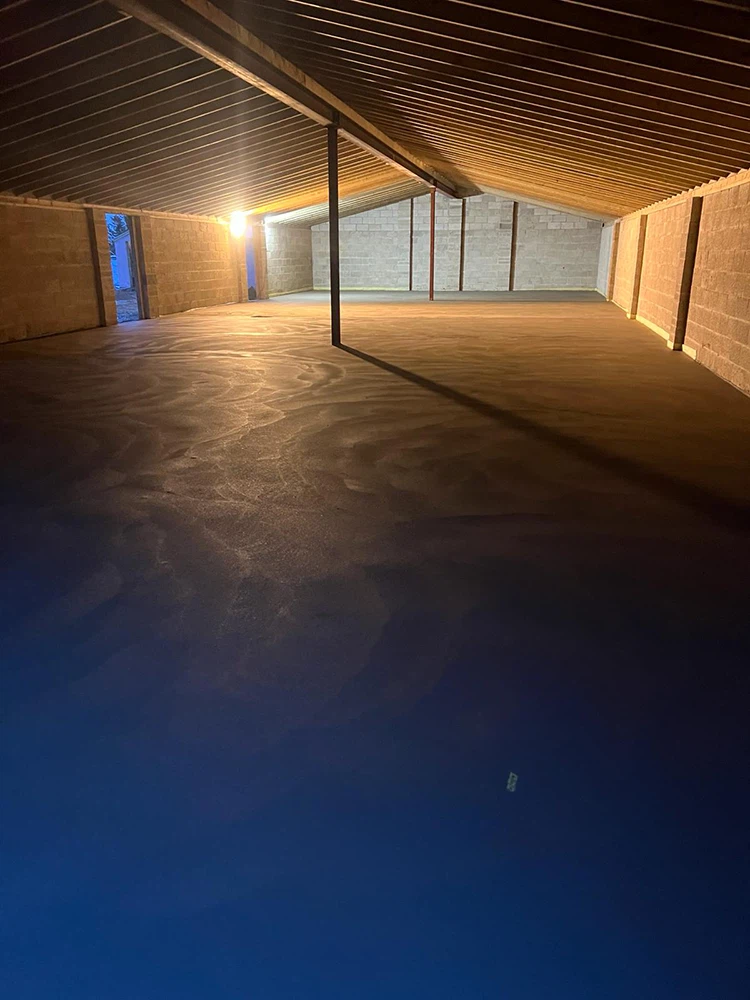
K & B Screeding’s own team, led by director Donatas Bardisevicius. Founded 2019, company 12298780.
See what customers say in our Google reviews and on our testimonials page.
Sand and Cement Screed from Slough to Baldock
As the crow flies, our yard in Slough is about 37.2 miles from Baldock, which lies to the north-north-east. Postcodes here include SG7, and Letchworth (2 miles), Stotfold (2.6 miles), Hitchin (4.8 miles) and Stevenage (6.1 miles) are close by.
More on sand & cement screed, part of our screeding services.
