
Relaying cracked screeds in Bedwell and Shephall terraces
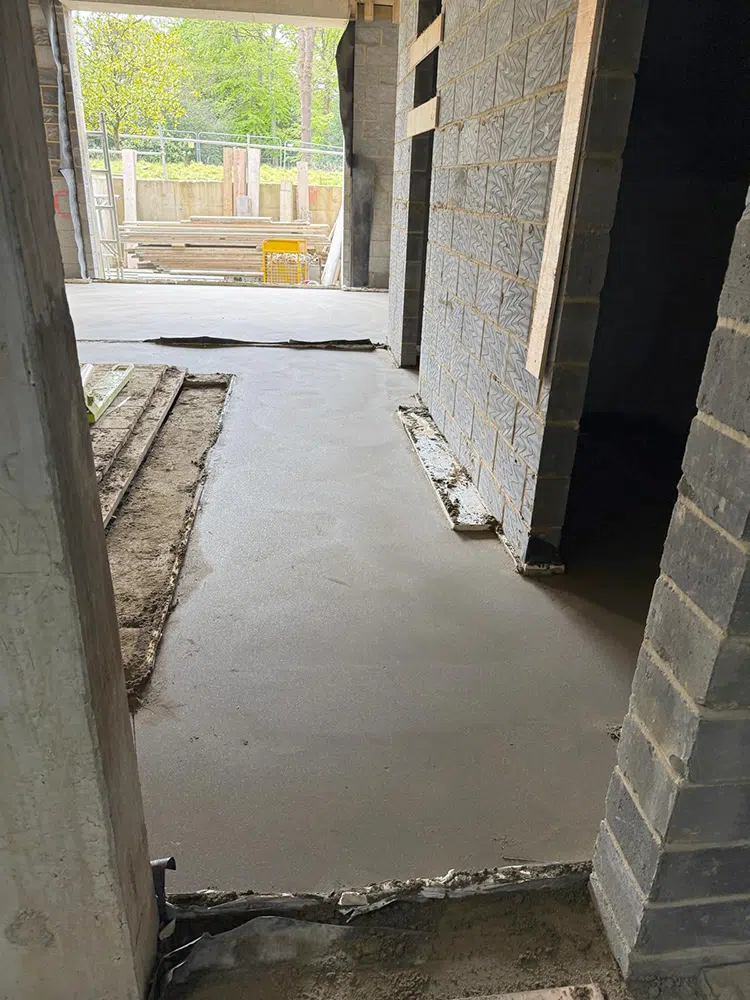
Houses from the 1950s and 1960s in Bedwell, Broadwater, Shephall and Chells were built with screeded ground floors, and several decades on, many of those original screeds have cracked. The problem often only shows when old floor tiles are lifted for a refit: the surface underneath is broken, loose in patches or out of level, and new flooring laid straight over it will not last.
A screed that is still hard but wavy can often just take compound. One that rattles, dusts or crumbles has to come out, and a fresh one goes in its place. A hand-laid sand and cement screed suits these houses because the job is usually one room or one floor at a time, with the new surface run to meet existing thresholds and the bottom stair.
Depth follows the build-up. A screed bonded directly to a sound concrete slab can be 25 to 40mm, which suits a relay where there is no insulation to add; our bonded screed page explains the preparation it needs. Add fresh insulation boards underneath and the screed above them needs about 65mm in a house. If the old floor has no insulation and you want to add some, check the height available first, because every extra layer raises the finished floor. Our depth guide for floor screeds lays out the build-ups in more detail.
A cracked screed can also be a sign of movement in the slab below, so that is checked before anything new goes down.
Garage conversions and wet rooms in Stevenage homes
Extensions and garage conversions on Stevenage houses need a new insulated slab matched to the existing floor level. The garage slab on these houses typically sits a step below the hall, so we raise it with insulation boards and a damp proof sheet before screeding up to meet the house. On a small single room like that, hand-laid sand and cement is often the economical choice, and the garage conversion floor guide walks through the stages.
Bathrooms and wet rooms are another reason to choose a cement screed. Sand and cement tolerates water, and the falls to a shower drain are formed in the screed itself, giving the tiler a true line.
Mixes can be adjusted. Fibres add £1 to £3 per m², and a quick drying additive helps where a tenant or buyer is waiting. Without extras, the 2026 published band for this method reads £18 to £25 per m², and the dig-out on a Bedwell terrace is priced on top. Its weak spot is patience: allow about a day for each millimetre up to 40, then longer per millimetre beyond, and book the flooring fitter with that in mind. If the room is wide and open, compare the cost with pumped liquid screed in Stevenage.
Sand and Cement Screed prices in Stevenage
Sand and cement screed: £18 to £25 per m² supplied and laid (MyJobQuote, August 2026), so £450 to £630 for 25 m². MyJobQuote does not say whether these figures include VAT. See our floor screeding cost guide or screed calculator.
Who lays your sand and cement screed in Stevenage
K & B Screeding’s own team, led by director Donatas Bardisevicius. Founded 2019, company 12298780.
See what customers say in our Google reviews and on our testimonials page.
Sand and Cement Screed from Slough to Stevenage
Stevenage is about 31.9 miles north-east of our Slough base as the crow flies, with postcodes including SG1 and SG2. The nearest towns to it are Hitchin (4.7 miles), Letchworth (5.3 miles), Baldock (6.1 miles) and Welwyn Garden City (6.8 miles).
More on sand & cement screed, part of our screeding services.