
Relaying solid floors in Hertford's period terraces
Terraced houses make up 30% of Hertford's homes, and the period terraces sit close to the centre, where the medieval street plan and timber-framed buildings still shape the town. Their ground floors are often old solid floors laid without a damp proof membrane, so nothing stops damp coming through.
The fix is methodical. We break up the old slab, lift it and lower the ground beneath. Then comes the membrane, lapped at the joins and turned up the walls, followed by rigid insulation boards and an edge strip. On top goes a floating sand and cement screed, 65mm deep in a house, finished flat and dense for tiles, stone or wood. Getting the depth right matters, because the new floor has to meet door thresholds and hearths that were set long ago. Measure twice here: a floor that finishes 10mm high can stop a period door from opening.
Hand-laid screed fits this work, since it is mixed a little at a time and placed room by room. It deals with narrow hallways, steps between rooms and awkward corners without a pump. If there is little height to play with and the slab underneath is solid, 25 to 40mm can be bonded straight to it; see bonded screed for when that is an option.
If heating pipes are going into the new floor, read about screed cover over heating pipes before the depth is fixed.
Wet rooms, garages and drying in Hertford homes
Whatever the age of a Hertford house, some rooms always need a cement based floor. Calcium sulphate is not suited to floors that could get wet, and a wet room or walk-in shower has to slope to its drain, so those rooms are laid in sand and cement.
Turning a garage into a room works much the same way. Garage slabs tend to sit below the house floor, so insulation and fresh screed lift the level to meet the rooms next door. A typical build-up is drawn out in our guide to garage floor screed. If a car will still use part of the space, a stronger mix can be specified for that area.
Drying is the slow part. Roughly a day goes by for each millimetre of the first 40mm, and more after that, so a 65mm cottage floor keeps the flooring waiting for weeks. Where a kitchen fitter is already booked and the date cannot move, a faster drying mix may help; see quick drying screed, priced at £20 to £28 per m² in published 2026 figures.
Sand and Cement Screed prices in Hertford
Sand and cement screed: £18 to £25 per m² supplied and laid (MyJobQuote, August 2026), so £450 to £630 for 25 m². MyJobQuote does not say whether these figures include VAT. See our floor screeding cost guide or screed calculator.
Who lays your sand and cement screed in Hertford
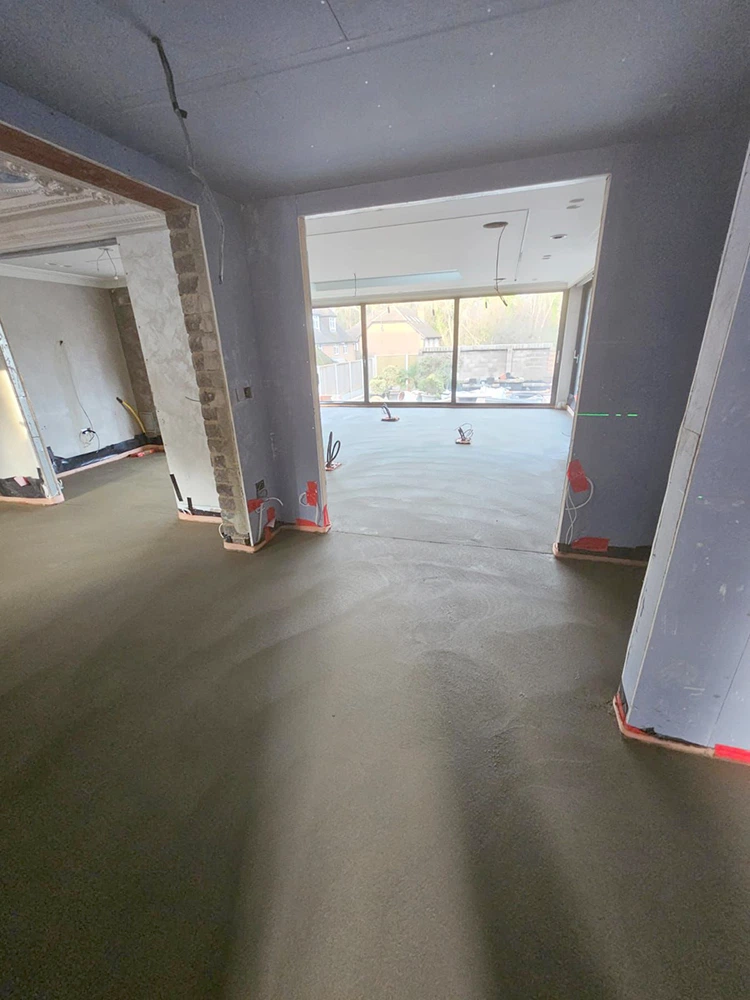
K & B Screeding’s own team, led by director Donatas Bardisevicius. Founded 2019, company 12298780.
See what customers say in our Google reviews and on our testimonials page.
Sand and Cement Screed from Slough to Hertford
Hertford is about 30.5 miles north-east of our Slough base as the crow flies, with postcodes including SG14 and SG13. The nearest towns to it are Ware (2.2 miles), Hoddesdon (3.8 miles), Welwyn Garden City (5.6 miles) and Hatfield (6.5 miles).
More on sand & cement screed, part of our screeding services.
