
Relaying tired floors in Waltham Cross terraces and semis
Each batch is mixed on site for the room and depth in hand, then tamped and trowelled flat by hand. That makes it well suited to the small rooms, short runs and fiddly doorways of the inter-war and post-war houses that make up so much of Waltham Cross.
The usual starting point is an old floor that has failed. When the original sand and cement has cracked across the room, sounds hollow underfoot or has lifted at the edges, patching only moves the problem. The failed layer comes up, the base is checked and a new screed goes down. If the damage is local, a repair to the existing screed may be enough.
How thick it goes is set by what is underneath. A floating layer on insulation is about 65mm thick in a house and about 75mm in commercial work. Bonded to sound concrete, it can drop to 25 to 40mm, which is handy where a threshold or low ceiling leaves little room. Why each figure applies is covered in our depth guide for screeds.
There are also rooms where calcium sulphate is ruled out and sand and cement is not. Wet rooms and showers with a fall to the drain, utility rooms and garages all suit a cement screed, and it can take load earlier. Mixing in fibres helps it resist cracking, and a rapid drying additive helps when other trades are waiting on the floor.
Garage conversions and wet rooms in Waltham Cross
Two jobs suit hand-laid screed particularly well. The first is a garage conversion, where the old garage slab is usually lower than the house and uneven. Raising it to match the house is a job for sand and cement, usually laid over a membrane and insulation. Our page on garage floor build-ups shows each layer in turn.
The second is a wet room. A screed laid to a fall carries water to the drain, and sand and cement copes with the damp conditions that rule out calcium sulphate. It can also be laid to fall in every direction toward a central gully.
Whatever the room, allow for slower drying than a liquid screed. Think of a millimetre a day through the first 40mm; a 65mm floor will need a good deal longer than that. Flooring waits for a moisture reading. In 2026 UK published figures, this kind of floor costs between £18 and £25 per m².
We work across Waltham Cross, including Holdbrook, and nearby towns too; see our page on traditional screed in Waltham Abbey.
Sand and Cement Screed prices in Waltham Cross
Sand and cement screed: £18 to £25 per m² supplied and laid (MyJobQuote, August 2026), so £450 to £630 for 25 m². MyJobQuote does not say whether these figures include VAT. See our floor screeding cost guide or screed calculator.
Who lays your sand and cement screed in Waltham Cross
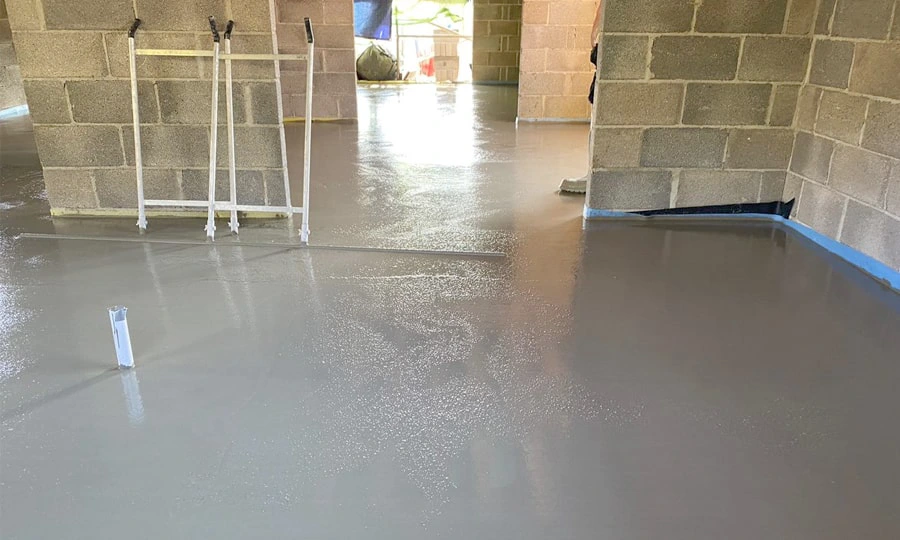
K & B Screeding’s own team, led by director Donatas Bardisevicius. Founded 2019, company 12298780.
See what customers say in our Google reviews and on our testimonials page.
Sand and Cement Screed from Slough to Waltham Cross
As the crow flies, our yard in Slough is about 28.4 miles from Waltham Cross, which lies to the east-north-east. Postcodes here include EN8, and Cheshunt (1.2 miles), Waltham Abbey (2.1 miles), Enfield (3.3 miles) and Loughton (4.8 miles) are close by.
More on sand & cement screed, part of our screeding services.
