
Replacing settled original floors in Potters Bar
Settlement shows up as a floor that slopes toward one wall, cracks along a line, or leaves a gap under the skirting. On an inter-war or early post-war floor it may also come with damp, because many were laid before membranes were routine. A new floor covering laid over either problem will not last.
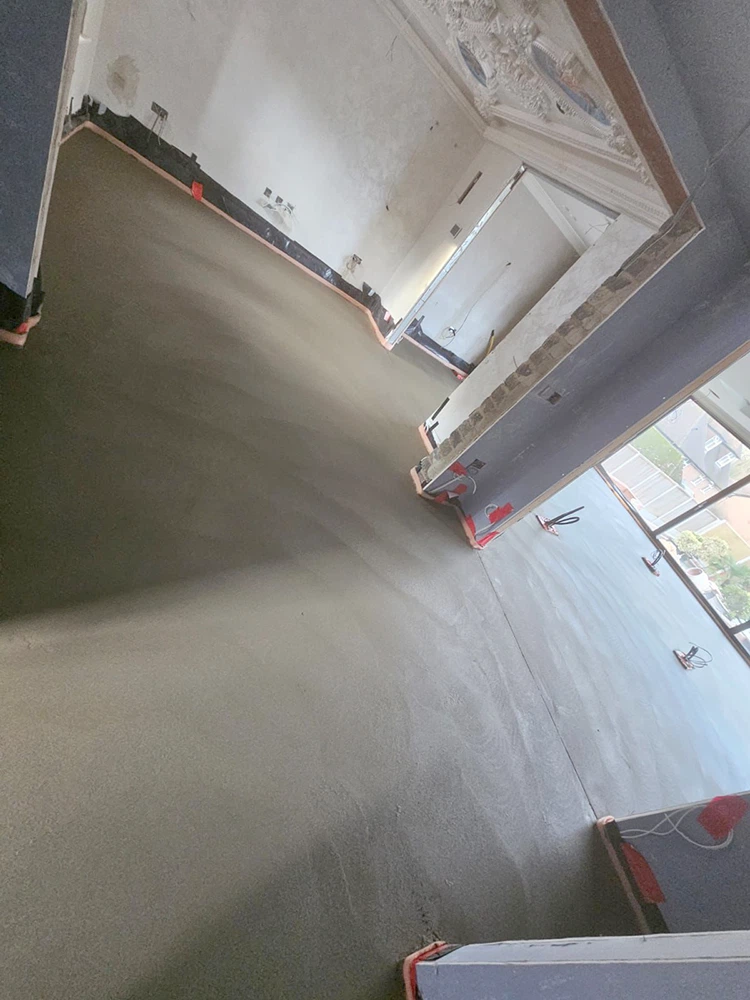
Replacing the floor starts with breaking it out to a depth that allows a proper build-up: a damp proof membrane, insulation to current standards and a floating screed about 65mm thick in a home. The finished level is taken from the rooms around it, so the new floor meets the hallway and the kitchen without a step. Getting that depth right is often the main challenge, and it is worked out before the digging begins.
For a dig-out job like this, hand-laid sand and cement makes sense. It is mixed on site and laid room by room, so it suits a floor replaced one room at a time. It is tamped down by hand and trowelled to a dense, flat finish that will take tiles, LVT or wood. It also works in bathrooms, wet rooms and utility areas, where a calcium sulphate screed should not be used, and it can form falls to a floor drain.
If the slab below is solid and just the top has broken up, a thinner bonded screed of 25 to 40mm can be all it needs. Our screed repairs service covers smaller patches of failed screed.
Garages and wet rooms in Potters Bar houses
Where a semi has an attached garage, converting it is a floor job too. Garage slabs tend to sit below the house floor with no insulation, so turning it into a room means adding a membrane and insulation, then enough screed to bring it level with the rest of the ground floor. Sand and cement handles that depth well, and our garage conversion floor guide explains the steps.
Wet rooms need falls. Hand-laid screed can be sloped towards the drain, which a self-levelling one will not do because it flows out flat. The screed goes under the tanking and tiles, so its shape sets how well the room drains.
The cost of hand laying is time. At roughly a day for each millimetre up to 40mm, and slower after, a 65mm floor in a semi can hold up the flooring for several weeks. Heating pipes, if fitted, must stay off for at least 21 days. Build that wait into the programme, and our guide to how long screed takes to dry shows how. On cost, the 2026 published range for a standard mix is £18 to £25 per m², or £20 to £28 if you want a fast drying one.
Sand and Cement Screed prices in Potters Bar
Sand and cement screed: £18 to £25 per m² supplied and laid (MyJobQuote, August 2026), so £450 to £630 for 25 m². MyJobQuote does not say whether these figures include VAT. See our floor screeding cost guide or screed calculator.
Who lays your sand and cement screed in Potters Bar
K & B Screeding’s own team, led by director Donatas Bardisevicius. Founded 2019, company 12298780.
See what customers say in our Google reviews and on our testimonials page.
Sand and Cement Screed from Slough to Potters Bar
As the crow flies, our yard in Slough is about 22.5 miles from Potters Bar, which lies to the east-north-east. Postcodes here include EN6, and Borehamwood (4.1 miles), Hatfield (5 miles), Enfield (5.6 miles) and Barnet (5.7 miles) are close by.
More on sand & cement screed, part of our screeding services.