
Older Barnet houses and hand-laid screed
Barnet's older houses went up long before anyone thought about insulated floors. If a solid ground floor has cracked, dropped or lost whatever damp protection it had, the fix is normally to break it out and rebuild it with insulation, a damp proof membrane and fresh screed. Sand and cement fits that sort of renovation well, since the mix can be laid as deep as each patch requires, worked around fiddly door openings and compacted one room at a time.
Conversions make up the other big group. A house split into flats gives every unit a bathroom and kitchen of its own, and the floors between neighbours frequently need an acoustic layer. Hauling sand and cement up a communal stair is hard graft, yet there is no pump to park, which counts for a lot where a parking bay is hard to get.
The build sets the depth. Where it floats on insulation, allow about 65mm in a house or flat and about 75mm in commercial space. Bonded straight onto a sound concrete base, 25mm to 40mm can be enough. For how those numbers are arrived at, read our guide to screed depths.
Sand and cement also copes with loads early on and will take fibres or rapid drying additives. If the builder's dates are squeezed, faster drying screed mixes shorten the gap before flooring. Terraced houses make up 15% of Barnet's homes, and on those narrow plots a small pour laid by hand makes more sense than setting up a pump.
Wet rooms, garages and falls in Barnet homes
A wet room is one floor where an anhydrite mix would be a mistake. Walk-in showers, wet rooms and utility rooms where a leak is possible want a cement based screed, and laying sand and cement by hand means the fall to the drain is shaped as we go. A Barnet conversion with several new bathrooms often comes down to that point alone.
Garage conversions are the other job it suits. To turn a garage into living space, the floor has to come up, insulation and a membrane go in, and the finished surface has to line up with the rest of the house. Sand and cement handles that change in depth comfortably, and screeding a garage floor takes you through the build-up step by step.
The price of all this is drying time. Roughly one day for each millimetre up to 40mm, then slower again, leaves a 65mm floor weeks short of most coverings rather than days. Book the tiler and flooring fitter to suit.
And if the floor you already have is solid but just uneven, a whole new screed could be overkill. A thin coat of compound may get it flat; see levelling an existing Barnet floor.
Sand and Cement Screed prices in Barnet
Sand and cement screed: £18 to £25 per m² supplied and laid (MyJobQuote, August 2026), so £450 to £630 for 25 m². MyJobQuote does not say whether these figures include VAT. See our floor screeding cost guide or screed calculator.
Who lays your sand and cement screed in Barnet
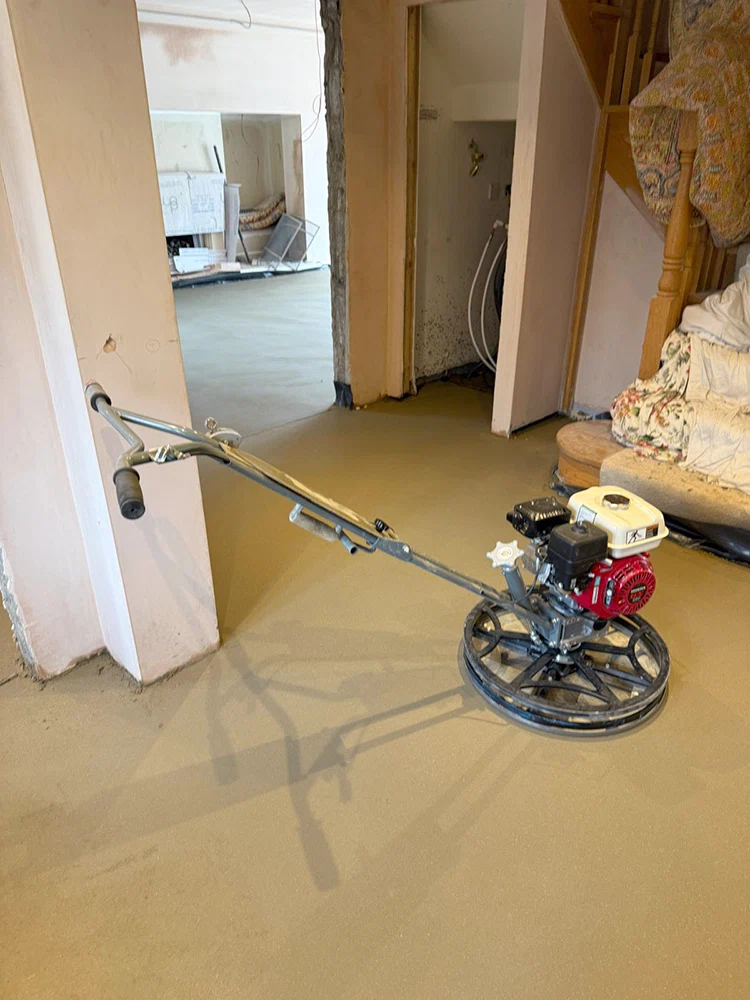
K & B Screeding’s own team, led by director Donatas Bardisevicius. Founded 2019, company 12298780.
See what customers say in our Google reviews and on our testimonials page.
Sand and Cement Screed from Slough to Barnet
Barnet is about 19.9 miles east-north-east of our Slough base as the crow flies, with postcodes including EN5, N11, HA8 and NW11. The nearest towns to it are Haringey (4 miles), Borehamwood (4.4 miles), Brent (4.7 miles) and Camden (5.2 miles).
More on sand & cement screed, part of our screeding services.
