
Relaying old floors in Borehamwood's post-war terraces
Terraced houses are 29% of Borehamwood's homes, and together with the semis they make up much of the town's post-war housing. Screeds in these houses have had decades of use. The signs of failure show once a carpet is lifted: cracks that open further each year, patches that sound hollow when tapped, and a surface too uneven for tiles or click flooring.
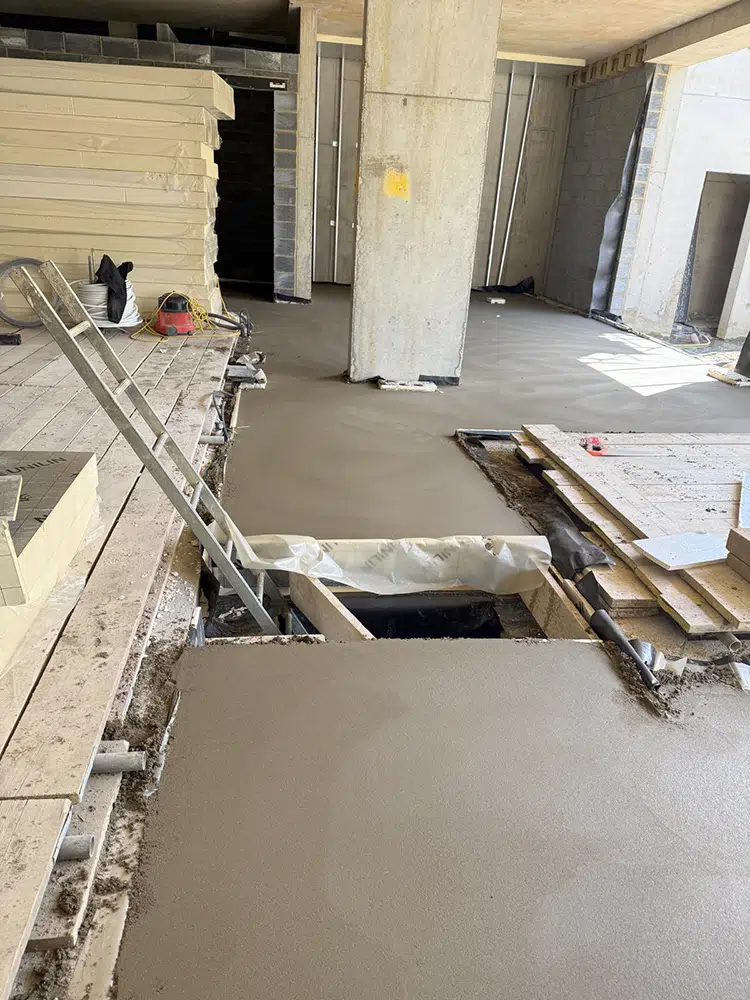
When the damage is widespread, patching rarely lasts. The old screed is broken out, the slab beneath is checked, and a new sand and cement screed is mixed on site and laid to the depth the room needs. Bonded to a slab that is still sound, the new screed needs only 25 to 40mm. Laid floating over insulation, a domestic screed is 65mm, which is often the depth needed to bring an old floor up to the level of a newer extension.
Sand and cement also handles the rooms a calcium sulphate screed cannot. Bathrooms and wet rooms need a cement substrate, and a shower floor laid to falls is formed by hand with a rule, not poured. Small rooms, hallways and awkward shapes are quicker by hand too, because there is no pump to set up.
Where the damage is local rather than general, screed repairs may be enough. For extra crack resistance, fibres can be added to the mix, which published figures put at £1 to £3 per m² on top; see fibre reinforced screed.
Garages, wet rooms and drying times in Borehamwood
Garage conversions are a familiar way to add a room to a semi, and the floor is usually the first problem. A garage slab often sits below the house floor and has no insulation in it, so to bring it up flush with the hallway we build insulation, a membrane and a 65mm floating screed on top. The garage floor screeding guide walks through those layers one by one.
Where a floor will carry weight early, such as a workshop or a garage still used for a car, a cement screed is the right substrate, and a higher strength mix is available when the use is heavy.
The trade-off is drying. Hand-laid cement screed takes about a day for every millimetre up to 40mm, and longer for each millimetre after that, so a 65mm floor may need two to three months before timber or vinyl can go on. Quick drying additives shorten that wait, and published figures price a fast drying mix at £20 to £28 per m²; see quick drying screed. Without additives, published prices for plain sand and cement run from £18 up to £25 per m². On a small or awkward floor, where setting up a pump would be overkill, that keeps it good value.
Sand and Cement Screed prices in Borehamwood
Sand and cement screed: £18 to £25 per m² supplied and laid (MyJobQuote, August 2026), so £450 to £630 for 25 m². MyJobQuote does not say whether these figures include VAT. See our floor screeding cost guide or screed calculator.
Who lays your sand and cement screed in Borehamwood
K & B Screeding’s own team, led by director Donatas Bardisevicius. Founded 2019, company 12298780.
See what customers say in our Google reviews and on our testimonials page.
Sand and Cement Screed from Slough to Borehamwood
As the crow flies, our yard in Slough is about 18.4 miles from Borehamwood, which lies to the east-north-east. Postcodes here include WD6, and Potters Bar (4.1 miles), Bushey (4.2 miles), Barnet (4.4 miles) and Watford (5.4 miles) are close by.
More on sand & cement screed, part of our screeding services.
