
Heated extensions on Borehamwood semis and terraces
Semi-detached houses make up 27% of Borehamwood's homes, and a heated rear extension is one of the natural ways to enlarge them. Heating in the floor frees wall space in an open kitchen, but it only works well if the screed over it is right.
Start with depth above the pipes. With liquid screed that means 25mm or more over the top of each pipe, normally a total of 45 to 50mm. Hand-laid sand and cement needs more, around 45mm above the pipe tops. Skimp on it and cracks can follow the line of the pipes; overdo it and the kitchen is slow to warm up or cool down.
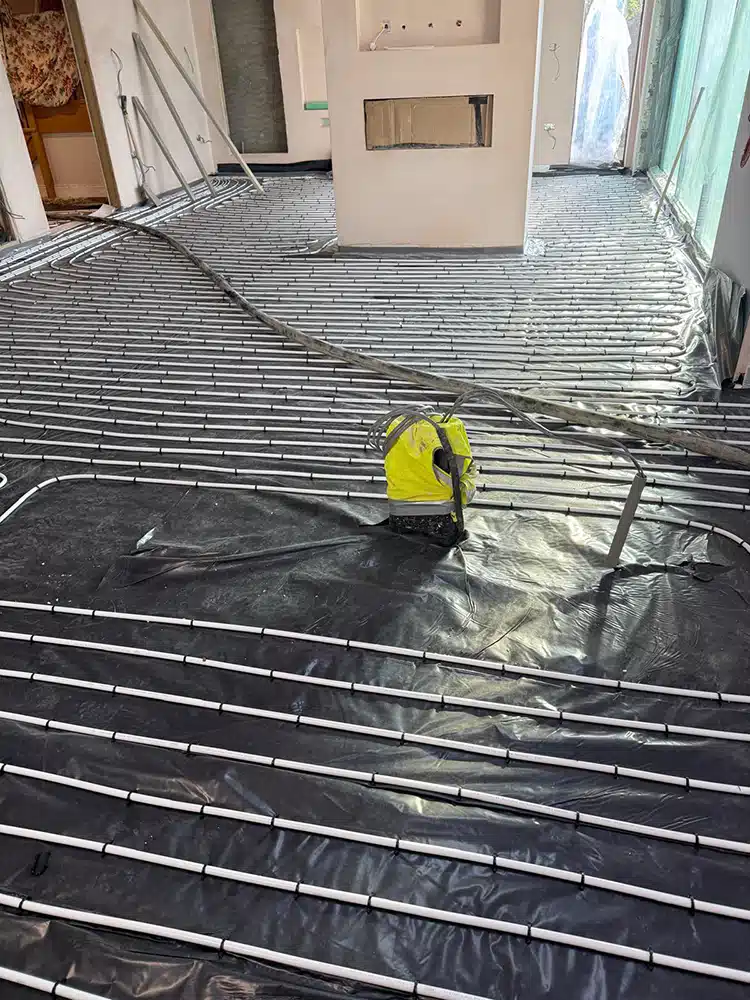
Encapsulation is the second. The screed has to surround every pipe with no air gaps, because trapped air insulates the pipe from the floor. A flowing screed does this by its nature. With sand and cement, the floor layer has to work the mix carefully in around each pipe.
Floor height often decides a retrofit, where heating goes into an older room rather than a new extension. Existing thresholds and the step to the garden limit how deep the build-up can be, and the thinner liquid option is often the only one that fits. Before any screed goes in, we look over the insulation boards, the membrane and the edge strip, and if you still need them, our insulation and membranes service can supply them.
Because the extension floor has to line up with the house, the join can be finished with a thin coat of levelling compound before tiles or LVT go down.
Switching the heating on in a Borehamwood new build
New homes are often handed over with the heating screed already down, but owners building their own extension have to plan the start-up themselves. How soon they can do it comes down to which screed was laid.
With calcium sulphate, warming can normally begin about 7 days from the pour. Sand and cement is slower; keep the heating off for at least the first 21 days. In both cases the heating is brought up gradually, in stages, rather than switched straight to full temperature, and the heat-up follows the screed maker's schedule. Rushing it risks cracking and curling at the edges.
Commissioning the heating is also a way of drying the floor. Run properly, it takes a calcium sulphate screed towards the moisture level the flooring needs much sooner than air drying alone. Even so, nobody should lay tiles, LVT or engineered wood in that kitchen until a hygrometer shows the screed is inside the limit the flooring manufacturer gives.
Our screed thickness guide shows how pipe cover fits into the total depth, and the Borehamwood liquid screed page covers the pour itself. For liquid screed over heating pipes, published 2026 prices are £20 to £35 per m².
Underfloor Heating Screed prices in Borehamwood
Liquid screed over underfloor heating: £20 to £35 per m² supplied and laid (trade2base, June 2026), so £700 to £1,230 for 35 m². trade2base gives these figures excluding VAT. See our floor screeding cost guide or screed calculator.
Who lays your underfloor heating screed in Borehamwood
K & B Screeding’s own team, led by director Donatas Bardisevicius. Founded 2019, company 12298780.
See what customers say in our Google reviews and on our testimonials page.
Underfloor Heating Screed from Slough to Borehamwood
As the crow flies, our yard in Slough is about 18.4 miles from Borehamwood, which lies to the east-north-east. Postcodes here include WD6, and Potters Bar (4.1 miles), Bushey (4.2 miles), Barnet (4.4 miles) and Watford (5.4 miles) are close by.
More on underfloor heating screed, part of our screeding services.
