Heated extensions on Pinner and Rayners Lane semis
Plenty of Harrow houses have room to extend. Semi-detached homes make up 37% of the stock and detached homes 11%, and houses with side or rear space can take a sizeable heated extension. The floor is usually a single open area, often a kitchen, dining and living space in one, which makes pipe cover and flatness the main concerns. Then there is the doorway into the old house: the new floor has to finish flush with it, so we start from that height and work the depth down from there.
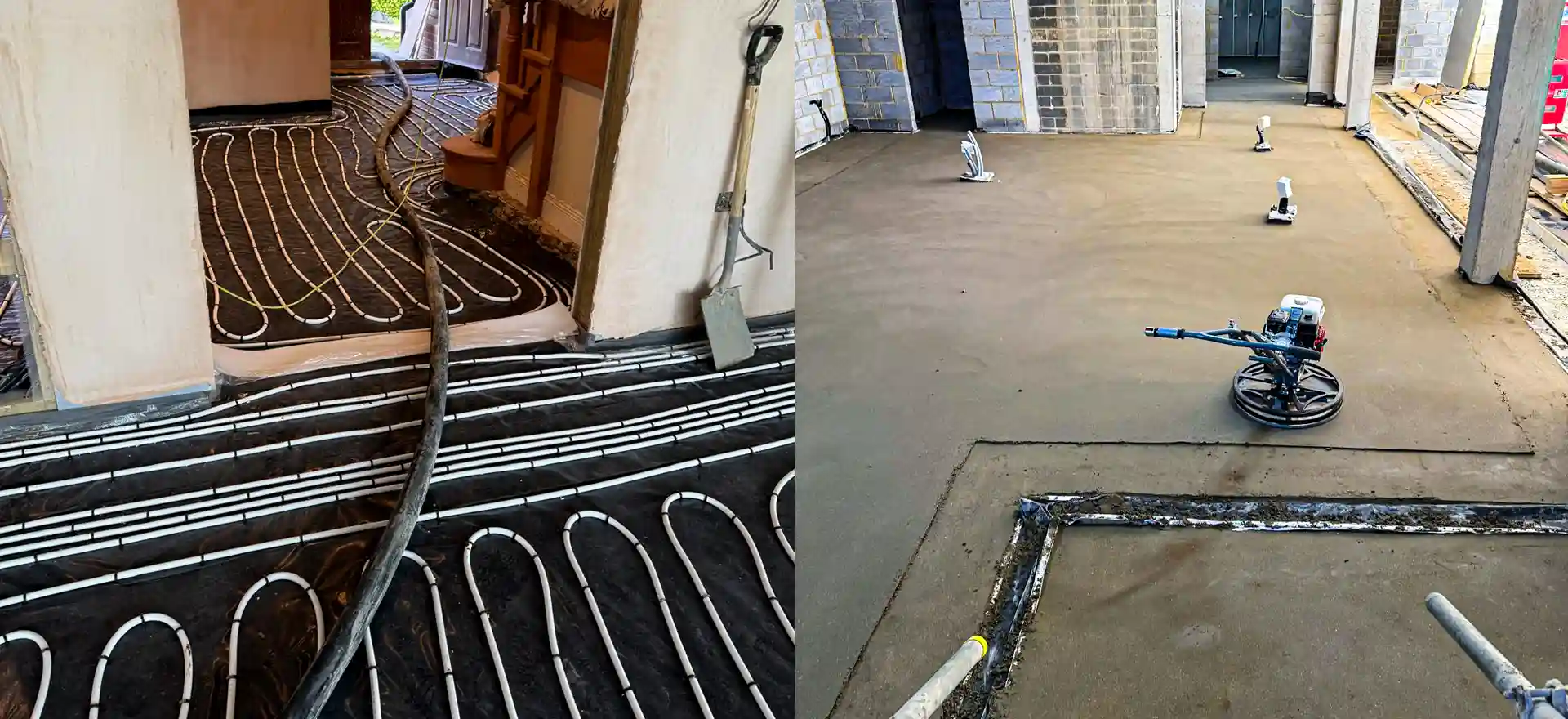
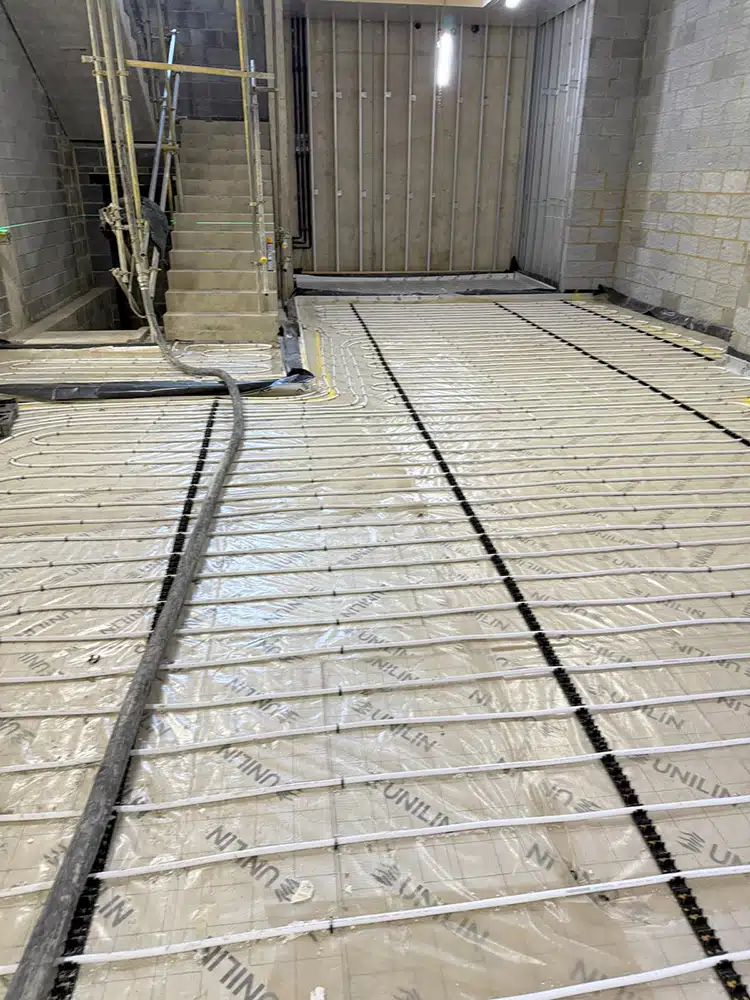
Poured liquid needs at least 25mm over the pipes, putting the finished screed at around 45 to 50mm. A traditional mix asks for nearer 45mm of cover, so the floor builds up thicker. Both go down on insulation and a membrane, and a perimeter edge strip gives the warm screed room to expand against the walls.
Liquid screed is often chosen here. Because it wraps each pipe completely, there are no trapped air gaps, the warmth spreads evenly across the room and the floor heats up quicker. That leaves a face true enough for tiles, LVT or engineered boards to go straight down. On a heated extension, a pumped liquid floor costs £20 to £35 per m² at 2026 UK prices.
We check the insulation, membrane and edge strip ourselves before the pump starts, or bring all three. Our insulation and membranes service explains that layer. For how the pump reaches a room at the back of the house, see pumped liquid screed in Harrow.
Ground floor refits in Harrow's inter-war homes
Not every heated floor in Harrow is new. A ground floor refit in an inter-war house often starts because the old concrete floor has cracked or settled. Taking it out gives the chance to put insulation and underfloor heating in at the same time.
Height is the constraint. Insulation, pipes and screed together must end up flush with the hall and with any room you are leaving alone. Digging out deep enough for it is part of the preparation, and our floor preparation service covers that groundwork.
The heating stays off for a while after the pour. A calcium sulphate floor can usually take heat from about day 7; a sand and cement one needs 21 days at the least. Your heating engineer then sets the commissioning steps, nudging the flow temperature up gradually over several days. Rushing it risks cracks and damage to the floor finish. We hand over clear guidance on the heat-up so the whole household knows not to turn the thermostat straight to full. A slow, even warm-up also shows whether every heating zone is working before the floor is covered. If your project is over in Watford, there is a page on heated floor screeds in Watford.
Heated floors in Wealdstone's Victorian and Edwardian terraces
Wealdstone is older than much of Harrow, with Victorian and Edwardian terraces that may need a new damp proof membrane before any screed goes down. Adding underfloor heating to one of those houses is possible, but it begins with the old floor coming out.
The membrane is not a detail. Without one, ground moisture can rise into the new floor, and a heated screed on a damp base will not perform or last. So the old floor is broken out, the ground prepared and a membrane laid and lapped up the walls. Insulation goes on top, then the heating engineer's pipes, then the screed.
Depth is the next question. A terraced hall and front room are fixed by the front door, the stairs and the floor in the next room, so the dig has to make space for the whole build-up. In a narrow terrace with a tight dig, the shallower cover a liquid screed needs over the pipes often decides the choice.
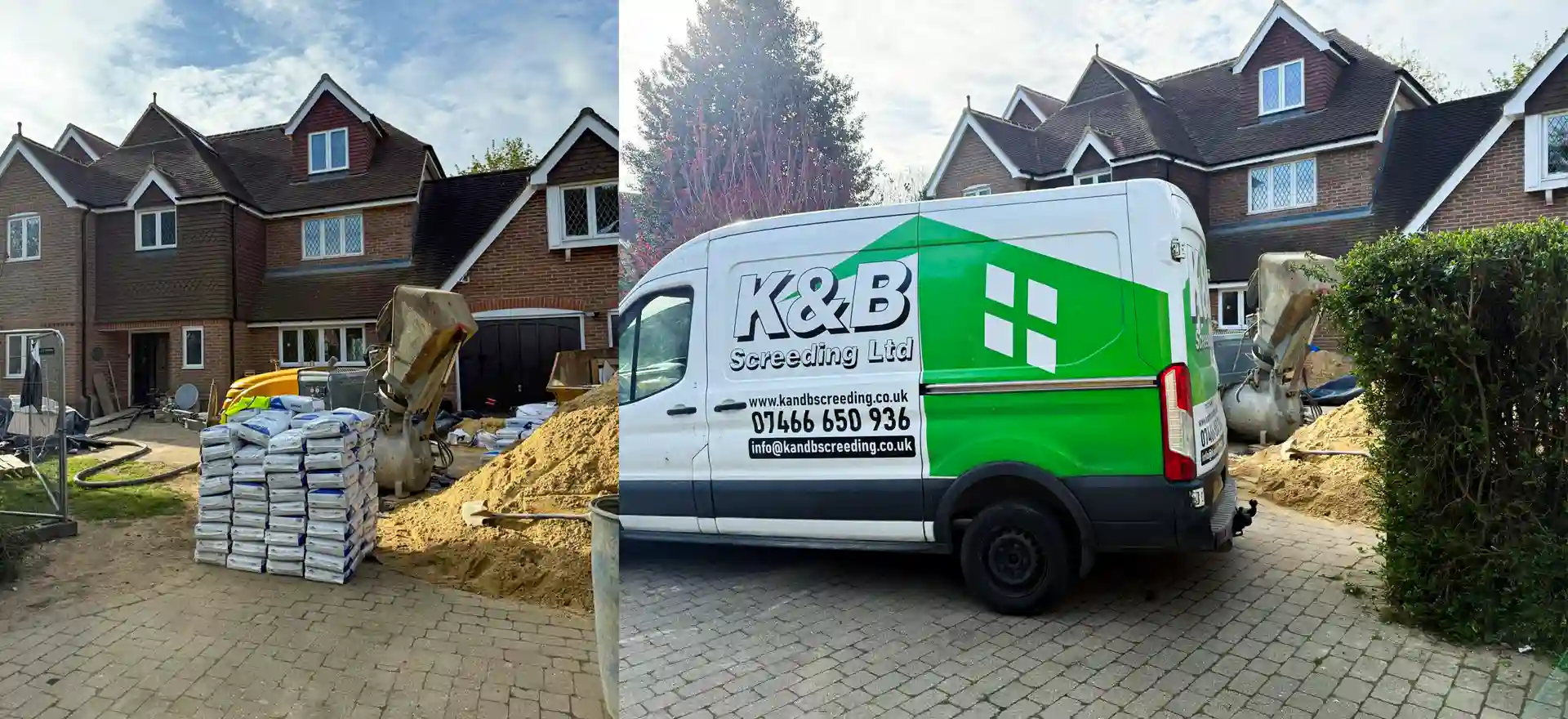
Access then shapes the pour. With no side access, the hose for a liquid screed runs through the front door and down the hall, and a hand-laid screed comes in by barrow the same way. Either way the route is protected first.
Older walls bring one more check. Where the new membrane meets the walls it should link up with the house's damp proof course, so an old or bridged damp course is worth having the builder look at before the floor goes in.
Underfloor heating screed prices in Harrow
Liquid screed over underfloor heating: £20 to £35 per m² supplied and laid (trade2base, June 2026), so £700 to £1,230 for 35 m². trade2base gives these figures excluding VAT. See our liquid screed cost per m² guide, the floor screeding cost guide or the screed calculator.
Who lays your underfloor heating screed in Harrow
K & B Screeding’s own team, led by director Donatas Bardisevicius. Founded 2019, company 12298780.
See what customers say in our Google reviews and on our testimonials page.
Underfloor heating screed from Slough to Harrow
Harrow is about 13.5 miles east-north-east of our Slough base as the crow flies, with postcodes including HA3, HA8, HA1 and HA5. The nearest towns to it are Bushey (3.8 miles), Brent (4.6 miles), Watford (5 miles) and Ealing (5.3 miles).
On Harrow streets where the screed lorry cannot park off the road, a suspension or dispensation comes from Harrow Council (parking suspensions and dispensations). We confirm on the quote whether it is needed. For an extension in Harrow, the floor usually needs building regulations approval, including Part L insulation in England. Local building control is Harrow Council Building Control.
More on underfloor heating screed, part of our screeding services. For every screed we lay locally, see floor screeding in Harrow.
Further reading: screed thickness guide and underfloor heating on a concrete floor.