
Wealdstone terraces and failed concrete floors in Harrow
Only 10% of Harrow's homes were built before 1919, and 17% are terraced houses, so Victorian and Edwardian floors are a minority of the borough's stock. Where they appear, as in Wealdstone's terraces, they may need a new damp proof membrane before any screed can be laid.
The inter-war semis of Rayners Lane, North Harrow and Pinner raise a similar problem from a different direction. Their old concrete floors have often cracked or settled, and a refit is the chance to replace them with an insulated build-up.
In both cases the process is similar. We break out what is there, prepare the ground beneath, then put down a membrane and insulation. Then the screed goes on. Sand and cement laid by hand fits this kind of rebuild: each batch is mixed on site to suit the room and depth, then compacted and power floated until it is dense and level. Over insulation in a house, the screed floats at 65mm thick; a commercial floor gets 75mm.
If the old slab turns out to be solid, bonding 25 to 40mm of screed directly onto it may do the job, at £12 to £18 per m² (trade2base, June 2026) on 2026 UK figures. A damaged slab may need repairs to the concrete before anything goes on top. For how deep each type of screed should be, see the screed thickness guide.
Garages, wet rooms and small rooms around Stanmore and Kenton
Garage conversions are a natural fit for sand and cement. Most garages are a step down from the house, so insulation, a membrane and screed build the floor up until it meets the hall. The guide to screeding a garage floor covers the steps.
A wet room or walk-in shower needs its floor sloping down to the drain, and a hand-trowelled screed can be shaped to exactly that slope. Unlike calcium sulphate, it is not weakened by water. Sand and cement is also the answer when the flooring calls for a cement base, or when the room must carry weight early.
For small rooms the numbers favour it too. Published 2026 UK figures put sand and cement at £18 to £25 per m², and on a small or awkward job there is no pump setup to pay for.
The cost is drying time. Drying runs at about a millimetre a day up to 40mm deep and slows after that, so a full-depth floor is weeks away from taking wood or LVT. A fibre reinforced mix adds toughness, and fast drying versions are available where the programme is tight.
Sand and Cement Screed prices in Harrow
Sand and cement screed: £18 to £25 per m² supplied and laid (MyJobQuote, August 2026), so £450 to £630 for 25 m². MyJobQuote does not say whether these figures include VAT. See our floor screeding cost guide or screed calculator.
Who lays your sand and cement screed in Harrow
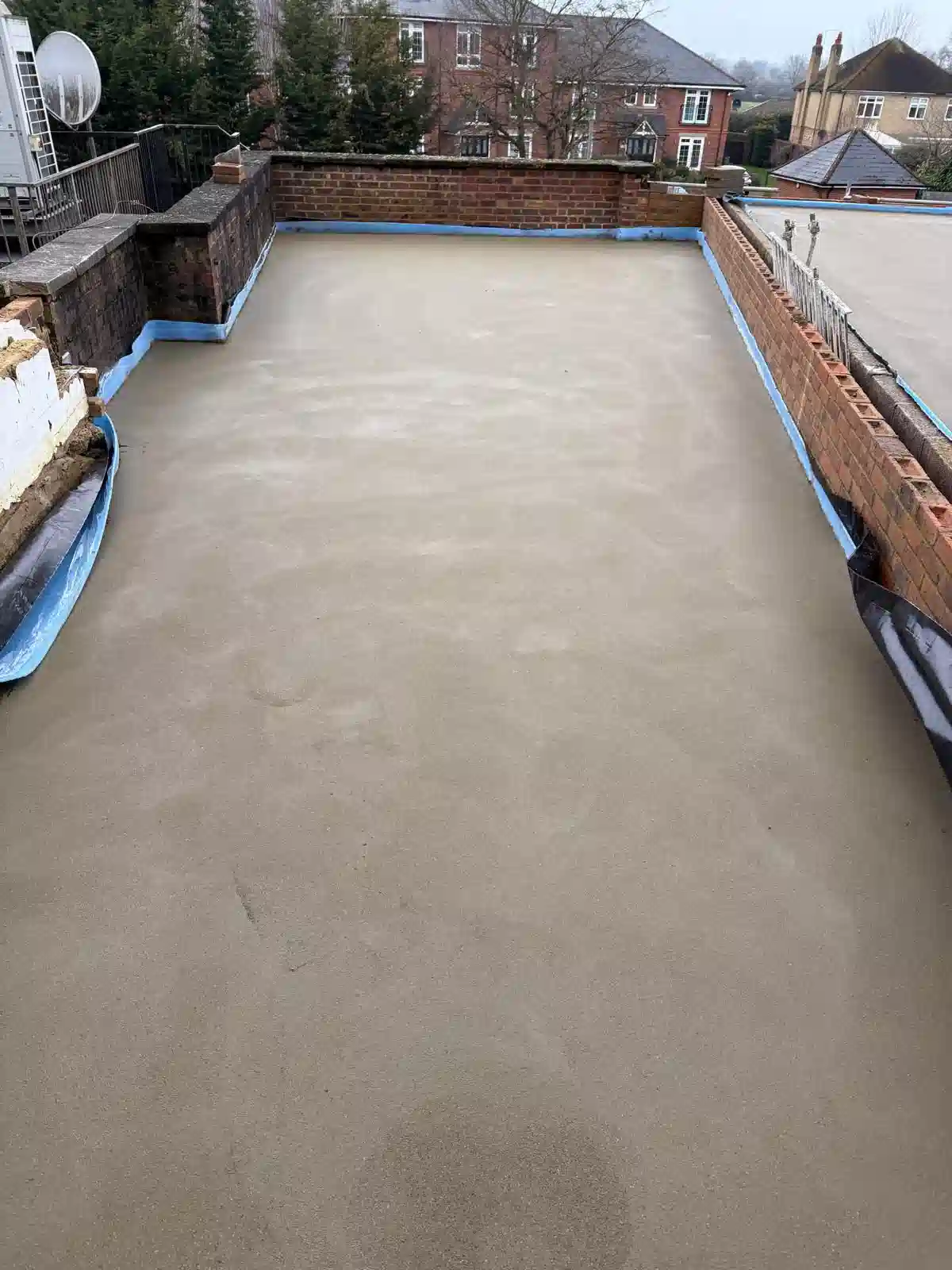
K & B Screeding’s own team, led by director Donatas Bardisevicius. Founded 2019, company 12298780.
See what customers say in our Google reviews and on our testimonials page.
Sand and Cement Screed from Slough to Harrow
Harrow is about 13.5 miles east-north-east of our Slough base as the crow flies, with postcodes including HA3, HA8, HA1 and HA5. The nearest towns to it are Bushey (3.8 miles), Brent (4.6 miles), Watford (5 miles) and Ealing (5.3 miles).
More on sand & cement screed, part of our screeding services.