
Rebuilding tired floors in older Rickmansworth houses
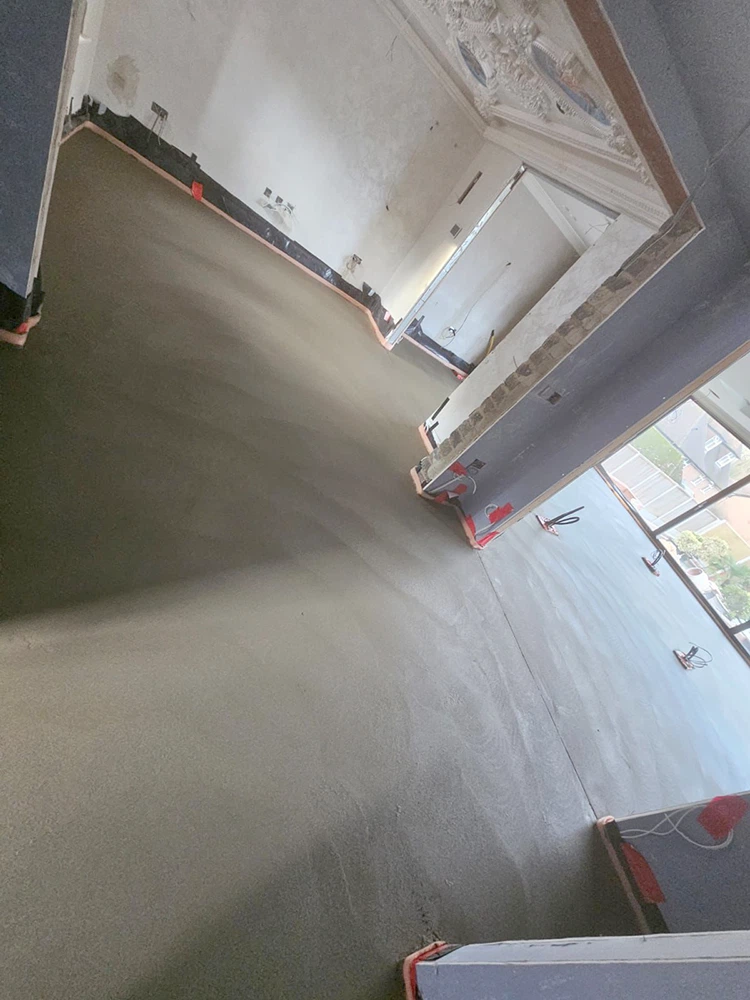
Rickmansworth grew in Victorian times and then fast through the 1920s and 1930s. Ground floors from either era may have cracked, dropped or lost what damp protection they once had, and new flooring put straight over them seldom lasts. The repair that holds is to take the old floor out, put down insulation and a damp proof membrane, and screed over the top.
For this kind of rebuild in an older Rickmansworth house, a traditional mix makes sense. We mix it on site to suit the depth of each room, compact it by hand and trowel it to a dense, level finish. A slim hallway, a cloakroom or a kitchen full of awkward corners is easier to control by hand than with a pumped pour and all its setup. On small areas it is also good value: published 2026 figures put it at £18 to £25 per m².
How deep it goes depends on how it is laid. Laid floating on insulation, a domestic floor typically needs 65mm, while commercial buildings call for 75mm. If the slab below is solid concrete, a bonded layer glued to it can be as slim as 25 to 40mm, which helps in a hallway where every millimetre of height counts. Whether a Rickmansworth hall slab is sound enough for that is a judgement covered under bonded screed service.
If a floor has to take load early or needs better crack resistance, fibres can go into the mix. Whether that extra £1 to £3 per m² pays off is covered on our fibre reinforced screed page.
Wet rooms and garages in Rickmansworth: cement matters
Even where the rest of a Metro-land house gets anhydrite, a couple of rooms are better off on cement. A wet room or walk-in shower is the obvious one. Prolonged moisture weakens calcium sulphate, so a tiled shower floor that gets soaked every day goes down in sand and cement. Laying by hand also means we can shape falls to the drain, something a self-levelling screed will not do.
Garage conversions are the other. Converted garages in Mill End or Batchworth tend to start with an uninsulated slab a step lower than the hallway next to it. Insulation topped with new sand and cement screed lifts it to the correct level, and the build-up is set out in our guide to garage floor screed for conversions.
Patience is the price. A hand-laid floor dries more slowly than a pumped one: allow roughly a day per millimetre up to 40mm, longer past that, and keep any heating off for 21 days at the very least. Set your flooring date around that. The same hand-laid method is available a few miles east as sand and cement screed in Watford.
Sand and Cement Screed prices in Rickmansworth
Sand and cement screed: £18 to £25 per m² supplied and laid (MyJobQuote, August 2026), so £450 to £630 for 25 m². MyJobQuote does not say whether these figures include VAT. See our floor screeding cost guide or screed calculator.
Who lays your sand and cement screed in Rickmansworth
K & B Screeding’s own team, led by director Donatas Bardisevicius. Founded 2019, company 12298780.
See what customers say in our Google reviews and on our testimonials page.
Sand and Cement Screed from Slough to Rickmansworth
On the map, Rickmansworth sits north-east of Slough, about 10.6 miles from our base in a straight line (postcodes including WD3), next to Chorleywood (2.5 miles), Watford (3.4 miles), Bushey (4.5 miles) and Harrow (6.3 miles).
More on sand & cement screed, part of our screeding services.