
Villas south of the High Street, floor by floor
The villas built south of the High Street from 1868 were not designed with insulated floors. Renovating one usually means removing old timber boards and joists, or breaking out a thin, damp solid floor, and digging down far enough to fit insulation, a membrane and a screed on top.
Sand and cement suits that work for practical reasons. It is mixed to suit each area, so a narrow hall, a front room and a step down to the kitchen can each be set at the right level. Over insulation, a house floor of this kind goes down at about 65mm. With the River Bulbourne and the Grand Union Canal in the valley, the membrane beneath is not an afterthought, and our insulation and membranes service can supply and fit it.
The interwar years produced 12% of Berkhamsted's homes, including the council houses at Gossoms End and west of Swing Gate Lane built after the First World War. Homes of that age often have solid floors with little insulation, and a renovation is the natural time to change that.
Northchurch needs a lighter touch. Where a building there is listed, any new floor should follow a careful, reversible approach, agreed before work starts. That may mean a thinner build-up or a different detail at the walls, and we price on the approved design.
Whatever the house, the result is a dense, level base that takes the finish without cracking.
Berkhamsted wet rooms, garages and terraces
Terraced houses are 21% of Berkhamsted's homes, and small rooms in terraces, with tight access through the front door, are where hand-laid screed is often the more economical choice. Nothing needs pumping; the mix simply comes through in barrows.
Wet areas need cement. A level-access shower floor, or a whole wet room, must slope down to its drain, and a hand-laid cement screed is formed to that fall with the trowel. Anywhere likely to get wet is no place for calcium sulphate screed.
Garage conversions follow the same logic: raise the floor, insulate it and meet the level of the house. A cement screed is also the answer when a floor must carry load early, or when the flooring manufacturer insists on a cement base.
It does take longer to dry than a flowing screed: around a day for every millimetre up to 40mm, then more slowly. Adding polypropylene fibres, as in a fibre reinforced screed, costs £1 to £3 per m² extra and improves crack resistance. If the house is in Chesham, see sand and cement screed in Chesham.
Sand and Cement Screed prices in Berkhamsted
Sand and cement screed: £18 to £25 per m² supplied and laid (MyJobQuote, August 2026), so £450 to £630 for 25 m². MyJobQuote does not say whether these figures include VAT. See our floor screeding cost guide or screed calculator.
Who lays your sand and cement screed in Berkhamsted
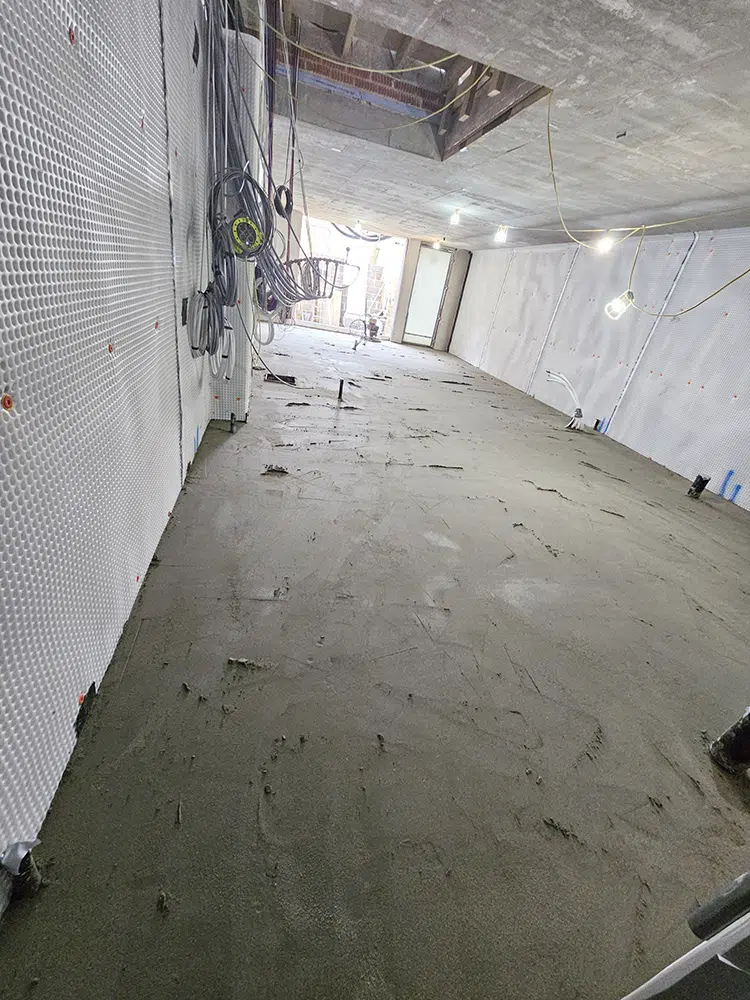
K & B Screeding’s own team, led by director Donatas Bardisevicius. Founded 2019, company 12298780.
See what customers say in our Google reviews and on our testimonials page.
Sand and Cement Screed from Slough to Berkhamsted
As the crow flies, our yard in Slough is about 16.3 miles from Berkhamsted, which lies to the north. Postcodes here include HP4, and Tring (4.3 miles), Hemel Hempstead (4.5 miles), Chesham (4.5 miles) and Amersham (6.2 miles) are close by.
More on sand & cement screed, part of our screeding services.
