
Relaying worn ground floors at Tithe Farm and Parkside
Parkside and Tithe Farm were laid out in the 1950s and 1960s, and the work on those estates is often re-screeding or levelling tired ground floors. Some old solid floors are simply uneven. Others have cracked, sunk in places or lost their damp protection, and those need more than a skim.
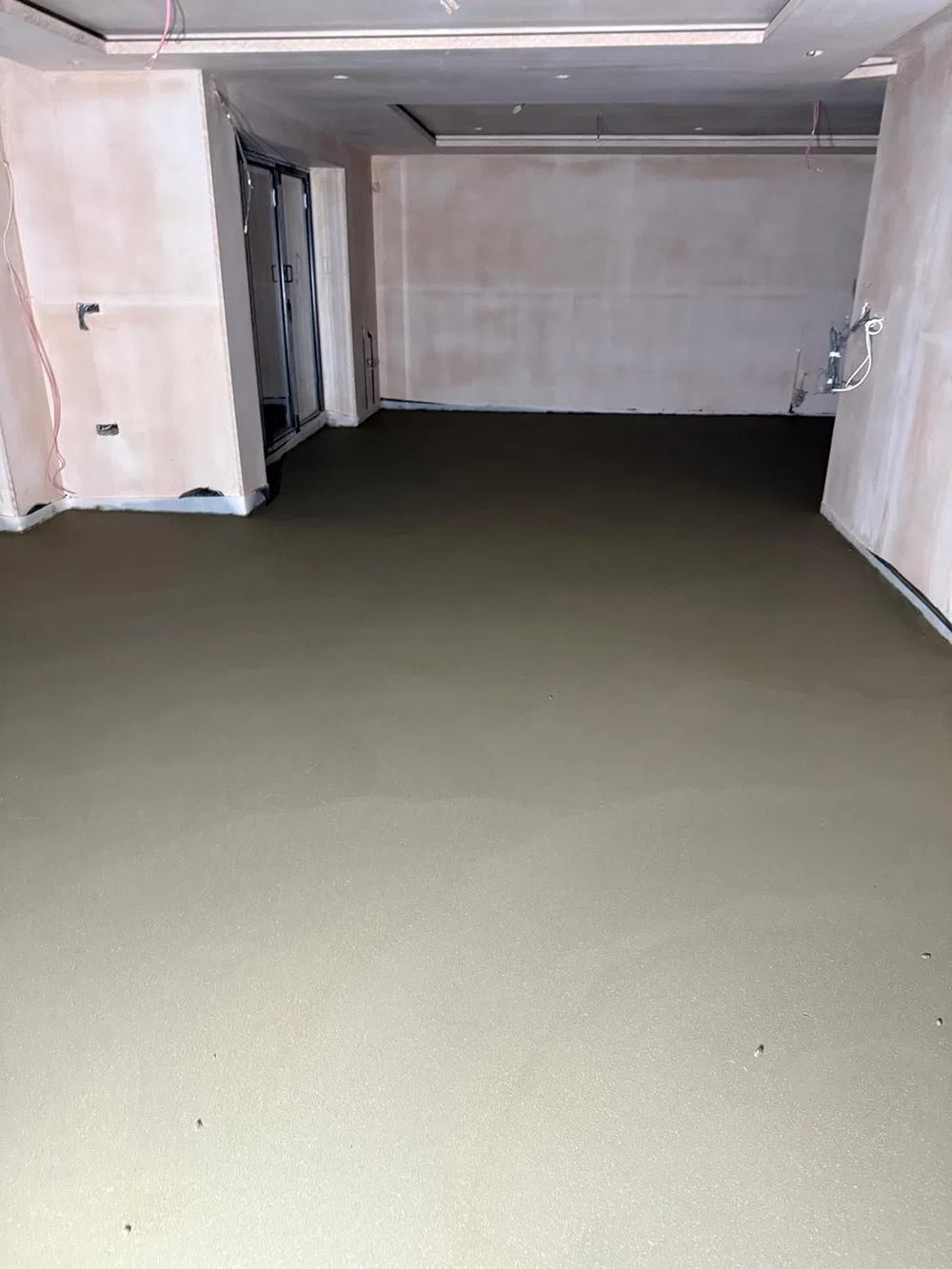
When one of those slabs has given up, we take it out, put down insulation and a damp proof membrane, then screed over the lot. Floating on insulation like that, a domestic sand and cement layer goes in at about 65mm deep. Sometimes the concrete itself is fine and only the old topping has crumbled; a 25 to 40mm layer bonded to the cleaned slab may then be enough. Getting the base right comes first, and our floor preparation service covers breaking out, cleaning and shot blasting.
On these post-war houses the hand-laid method has practical advantages. It is barrowed in and compacted by hand, so a narrow hallway, a step down to a kitchen or a room full of awkward corners is no obstacle. It can also be finished to meet an existing threshold exactly.
Genuinely old buildings are rare here. Only 1% of Houghton Regis homes were built before 1919, which means most older floors in the town belong to post-war homes rather than Victorian ones. For how depth is set for each kind of floor, see the screed thickness guide.
Houghton Regis wet rooms, garages and floors laid to falls
In a Houghton Regis semi or terrace, certain rooms call for cement whatever the rest of the house is getting.
Top of that list come wet rooms and walk-in showers. Calcium sulphate has no place where water may sit, so the floor there is cement based, hand trowelled with a fall down to the drain. The fall is formed in the screed itself, which is far more reliable than trying to build it up in tile adhesive.
Garages are another. Converting the garage next to a semi into a bedroom or office normally means lifting its floor, insulating it and bringing it level with the rest of the ground floor; our guide to screeding a garage floor sets out each layer.
Floors that will take load early, such as a utility room with heavy appliances, also suit sand and cement. Mixing in fibres cuts the risk of cracks for roughly £1 to £3 extra a square metre; see fibre reinforced screed for when that is worth paying.
The trade-off is drying. Each of the first 40mm takes about a day and the rest dries more slowly, so 65mm of screed needs weeks rather than days. If the flooring date cannot move, a fast drying mix is available at about £20 to £28 a square metre on 2026 prices.
Sand and Cement Screed prices in Houghton Regis
Sand and cement screed: £18 to £25 per m² supplied and laid (MyJobQuote, August 2026), so £450 to £630 for 25 m². MyJobQuote does not say whether these figures include VAT. See our floor screeding cost guide or screed calculator.
Who lays your sand and cement screed in Houghton Regis
K & B Screeding’s own team, led by director Donatas Bardisevicius. Founded 2019, company 12298780.
See what customers say in our Google reviews and on our testimonials page.
Sand and Cement Screed from Slough to Houghton Regis
On the map, Houghton Regis sits north of Slough, about 26.4 miles from our base in a straight line (postcodes including LU5), next to Dunstable (1.3 miles), Luton (4.7 miles), Leighton Buzzard (6.1 miles) and Flitwick (6.8 miles).
More on sand & cement screed, part of our screeding services.
