
Relaying tired concrete floors in Bletchley houses
Semi-detached houses account for 37% of Bletchley's homes and terraces another 25%. The town's housing grew with the overspill programme and the estates that followed, so many concrete ground floors have now had a long life. Some have cracked across, some have sunk near the walls, and some were never insulated.
The first step is breaking out the old concrete. Next comes a firm, compacted base, with insulation and a damp proof membrane over it and the new screed on top. Floating over that insulation in a house, the screed is about 65mm thick. If the slab is still solid and only its top has worn, a bonded layer of 25 to 40mm can be laid straight onto it once the surface is prepared; our bonded screed page covers that preparation.
Why sand and cement here rather than a pumped screed? In most Bletchley houses it comes down to how big the room is and how it is shaped. A single back room, a hallway or a kitchen in a terrace is quick to lay by hand, needs no pump, and allows the floor to be built up where the old one has dropped. It is also a cement base, which suits kitchens and utilities where water might end up on the floor.
For the pros and cons in more detail, see our liquid vs sand and cement guide. If you are unsure which suits your room, send a few photos and the measurements and we will say.
Garages, wet rooms and early loads in Bletchley
Where a Bletchley house has a garage, converting it into a room is a common way to add space. The floor usually sits lower than the house, so it needs raising, insulating and screeding to meet the hall. Our guide to garage floor screed sets out the build-up.
A wet room gets sand and cement for two reasons. The screed can be formed by hand to fall towards the drain, and a cement base is right for areas that get wet, which calcium sulphate is not.
This screed also takes load earlier than some alternatives, which matters when builders need to work on the floor. Fibres, at £1 to £3 per m² extra, help resist cracking in narrow rooms, and a faster drying mix, published at £20 to £28 per m², shortens the wait.
The main drawback is drying. A thick sand and cement floor takes longer to dry than a thin liquid one, so plan the flooring date with that in mind and keep the room ventilated while it dries, without forcing it with heaters.
Sand and Cement Screed prices in Bletchley
Sand and cement screed: £18 to £25 per m² supplied and laid (MyJobQuote, August 2026), so £450 to £630 for 25 m². MyJobQuote does not say whether these figures include VAT. See our floor screeding cost guide or screed calculator.
Who lays your sand and cement screed in Bletchley
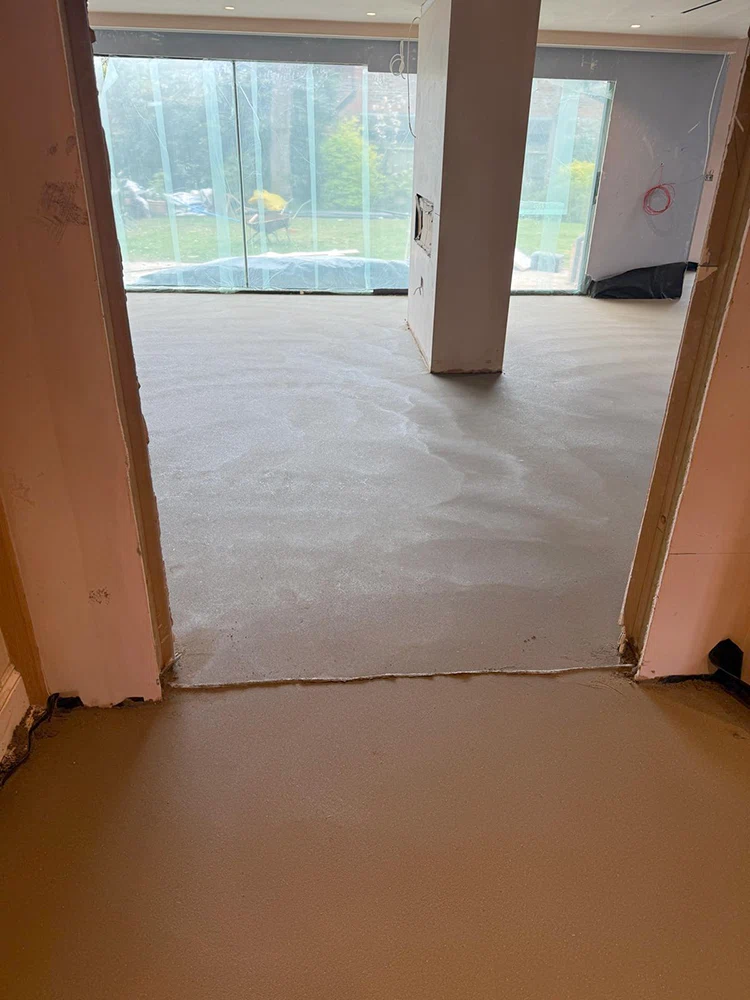
K & B Screeding’s own team, led by director Donatas Bardisevicius. Founded 2019, company 12298780.
See what customers say in our Google reviews and on our testimonials page.
Sand and Cement Screed from Slough to Bletchley
Bletchley is about 32.1 miles north of our Slough base as the crow flies, with postcodes including MK3, MK1, MK17 and MK2. The nearest towns to it are Milton Keynes (3.5 miles), Leighton Buzzard (6.2 miles), Newport Pagnell (6.5 miles) and Flitwick (10.4 miles).
More on sand & cement screed, part of our screeding services.
