
Grades and specifications for Bletchley apartments and plots
On the drawings for a Bletchley flat or house, the screed is named by a code under the European screed standard. The CA at the front means a calcium sulphate binder, C is followed by the compressive strength and F by the flexural strength, both in N/mm2.
Three grades come up again and again:
CA-C20-F4, for lightly used rooms in a house.
CA-C25-F5, the standard grade for most homes, apartments and offices.
CA-C30-F6, for floors that see heavy use.
Purpose-built flats account for 17% of Bletchley's homes. CA-C25-F5 over insulation is the usual grade for apartment floors like these, and we pour to the grade written on the drawings.
If a block needs a thinner floor or a quicker drying time, the specifier can choose an alpha hemihydrate product over a CA grade. They follow their own product data, so the depth and drying guidance on the sheet takes precedence over general figures.
The material shrinks very little, which allows large bays without many joints, even across the open living areas of a modern flat. On plot work, each house or apartment is poured in turn, so the sequence is agreed with the site manager in advance. Bays and joints are drawn up before the pour to suit the building's layout. Our anhydrite screed guide explains the chemistry, and for the pumping and site side of a flowing floor see our liquid screed page for Bletchley.
Laitance and moisture checks on Bletchley new builds
Drying leaves a weak skin, called laitance, on top of calcium sulphate screed. It must be removed before flooring. We sand that skin away when the floor has dried, then apply a primer made to work with calcium sulphate. Floor coverings laid over laitance are prone to fail.
A hygrometer gives the moisture reading. Moisture limits set by flooring manufacturers are often stricter for calcium sulphate than for a cement screed, so a surface that feels dry under your hand can still fail the test. On a busy site, flooring trades are often ready before the screed is, and the test result is what decides the handover date, not the calendar.
Drying can be sped up where there is underfloor heating. From about 7 days the heating can usually help force dry it, raised gradually.
There is one place this screed should not go: areas that may get wet. A bathroom, wet room or plant room gets a flowing screed with a cement base, or hand-laid sand and cement, in its place. Where the screed needs a final skim before thin flooring, a latex screed finish can follow the priming.
Anhydrite & Flow Screed prices in Bletchley
Liquid flowing screed (which includes anhydrite): £24 to £31 per m² supplied and laid (MyJobQuote, August 2026), so £960 to £1,240 for 40 m². MyJobQuote does not say whether these figures include VAT. See our floor screeding cost guide or screed calculator.
Who lays your anhydrite and flow screed in Bletchley
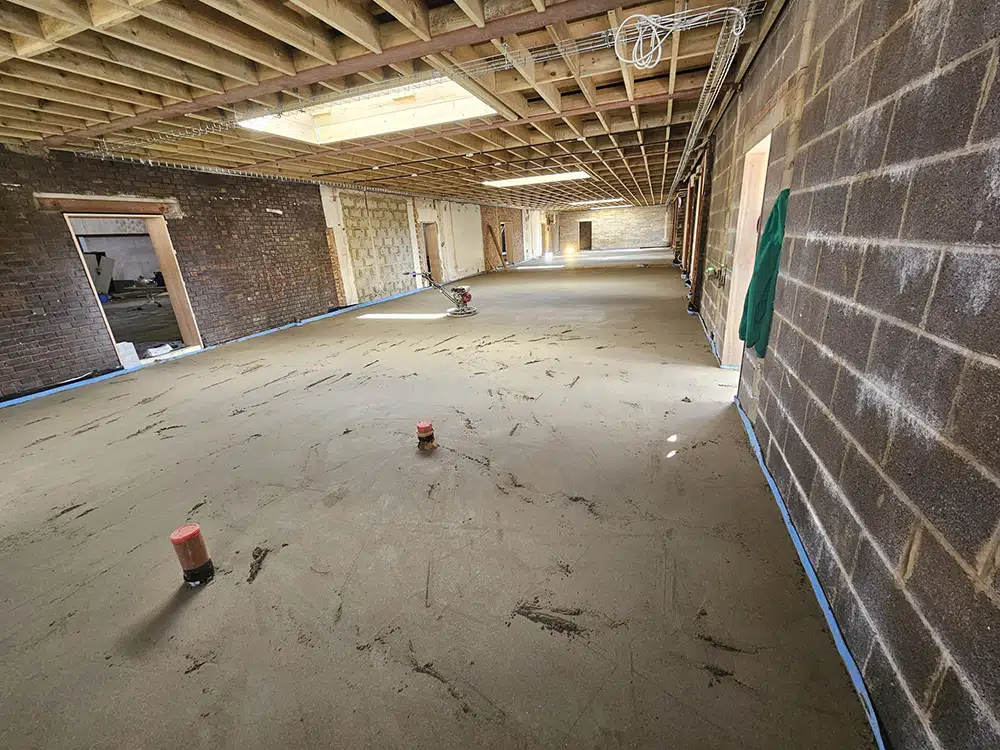
K & B Screeding’s own team, led by director Donatas Bardisevicius. Founded 2019, company 12298780.
See what customers say in our Google reviews and on our testimonials page.
Anhydrite & Flow Screed from Slough to Bletchley
Bletchley is about 32.1 miles north of our Slough base as the crow flies, with postcodes including MK3, MK1, MK17 and MK2. The nearest towns to it are Milton Keynes (3.5 miles), Leighton Buzzard (6.2 miles), Newport Pagnell (6.5 miles) and Flitwick (10.4 miles).
More on anhydrite screed, part of our screeding services.
