
Heated extensions on Bletchley's 1970s to 1990s estates
Bletchley has 20% of its homes from the 1973 to 1999 period, and extending one of those houses is a natural moment to put in a heated floor. It is the simplest case for underfloor heating: new insulation, new pipes and new screed, all at the right depth from the start.
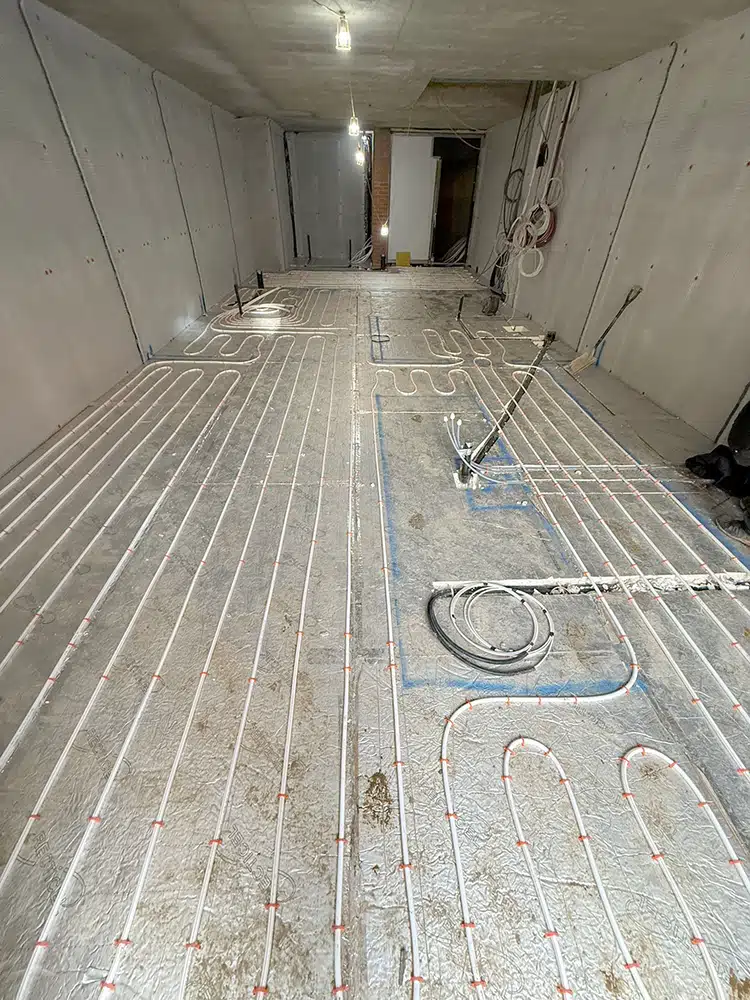
Get the cover above the pipes right and most of the job follows. Liquid screed has to cover them by at least 25mm, giving a finished floor of around 45 to 50mm. Packed by hand, sand and cement needs about 45mm of cover, which makes for a deeper floor, and that extra depth counts when an extension has to finish level with the original rooms. Poured liquid wraps each pipe without leaving air gaps, so the room warms faster and the heating runs more efficiently. For that reason, pumped liquid screed is the usual pick for a heated extension.
Joining up with the original house is harder. The new heated floor has to finish at the same level as the existing rooms, so the depth of insulation plus pipes plus screed needs working out before the slab is cast. If the old floors are uneven, levelling the old and new floors with compound brings them into line for a continuous finish.
The pipes need clipping down and pressure testing, the edge strip fixing and the membrane taping before any screed arrives. We go over each item on the morning of the pour.
Retrofits and newer homes around Bletchley
Some 13% of Bletchley's homes were built since 2015. In the newer districts, underfloor heating upgrades are part of the floor work, often alongside levelling before new coverings.
Retrofit in older houses is harder. The overspill-era houses were built with concrete floors and little spare height, so adding heating usually means lifting the floor. A thin liquid screed saves depth compared with sand and cement. The insulation and membrane go in as part of that new floor, and if you need them we can supply both through our insulation and membrane work.
The heat-up needs patience. Calcium sulphate will normally take heat after around 7 days, whereas sand and cement needs 21 days as a minimum. Start low and increase slowly. The drying time guide explains why heat applied too quickly cracks screed.
Flooring choice matters too. Tiles, LVT and engineered wood all work over a heated screed, but each has its own limit for moisture and surface temperature, so check the flooring maker's instructions before the heating goes on. We hand over the screed details your heating engineer and floor layer need, including the product, the depth over the pipes and the pour date, so the heat-up and the flooring can be planned around them.
Underfloor Heating Screed prices in Bletchley
Liquid screed over underfloor heating: £20 to £35 per m² supplied and laid (trade2base, June 2026), so £700 to £1,230 for 35 m². trade2base gives these figures excluding VAT. See our floor screeding cost guide or screed calculator.
Who lays your underfloor heating screed in Bletchley
K & B Screeding’s own team, led by director Donatas Bardisevicius. Founded 2019, company 12298780.
See what customers say in our Google reviews and on our testimonials page.
Underfloor Heating Screed from Slough to Bletchley
Bletchley is about 32.1 miles north of our Slough base as the crow flies, with postcodes including MK3, MK1, MK17 and MK2. The nearest towns to it are Milton Keynes (3.5 miles), Leighton Buzzard (6.2 miles), Newport Pagnell (6.5 miles) and Flitwick (10.4 miles).
More on underfloor heating screed, part of our screeding services.
