
Heating new rooms in Aylesbury's 1970s to 1990s homes
A house built in the 1970s, 1980s or 1990s is now old enough for a new kitchen, and often a rear extension to go with it. Heating the floor in that new space frees the walls for units and glazing, and it is simpler to fit in an extension than anywhere else in the house, because the slab is new and the builder can set the floor level to suit.
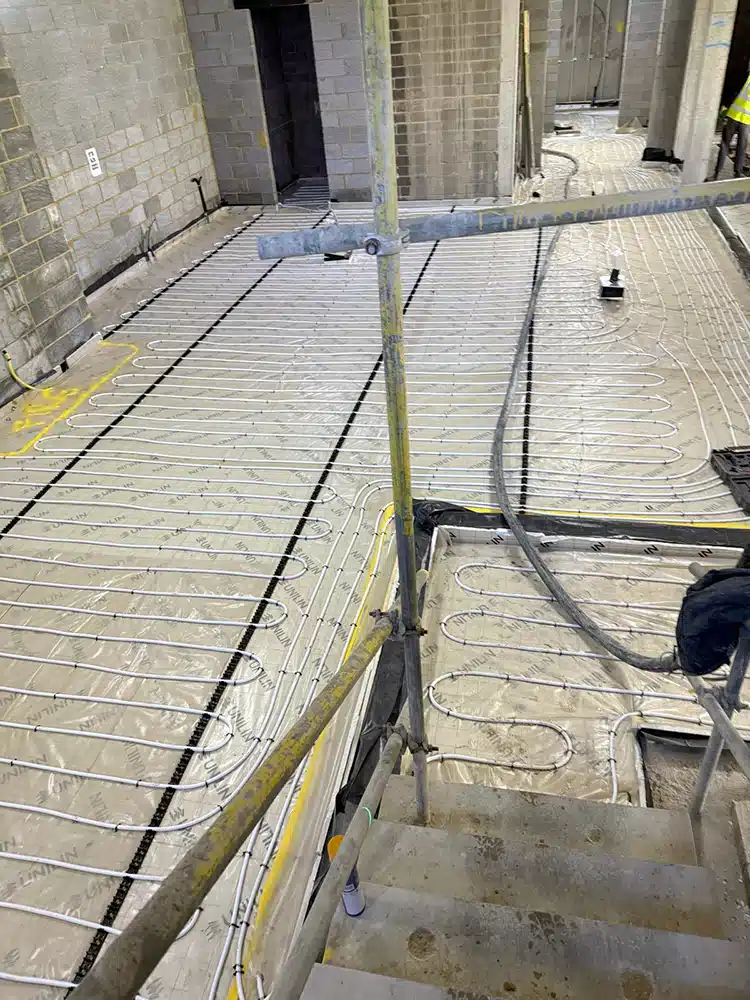
The screed must cover the pipes to the right depth and surround them fully, with no trapped air. Liquid screed flows between the pipes on its own and needs 25mm or more over the top, putting the total at 45 to 50mm in most cases; how it gets pumped in is on our Aylesbury liquid screed page. Sand and cement is packed down by hand between the pipes, with around 45mm above them.
Where the extension meets the existing house, the finished floor levels must match. A thinner liquid screed helps if the old floor is low. We check the heights before the pipes go down so there are no surprises at the doorway. Typical layer-by-layer depths are in our thickness guide for screeds.
Under the pipes, the build-up deserves the same attention as the screed. Insulation, membrane and edge strip all have to be there and intact. Where one is missing, our membrane and insulation fitting puts it right before the pour.
Heated plots on Berryfields and Kingsbrook
On the urban extensions, underfloor heating is often part of the house design, and plot screeding is usually liquid screed over the pipes. The build-up is set by the housebuilder's drawings, and we pour to that depth once the heating contractor has pressure tested the system.
The heating cannot be used straight away. Commissioning a calcium sulphate floor can normally begin about 7 days after pouring, whereas a sand and cement one must be left 21 days or more. The first firing should be gradual, raising the flow temperature in steps over several days, then holding it, before the floor is finished. A sudden full heat-up can crack the screed. Once the cycle is complete, the heating is turned down before the floor covering is laid, and the flooring maker's guidance then sets how the system is brought back up.
On a site, that schedule affects when flooring can go in and when the house can be handed over, so it is worth agreeing it with the site manager early. The site manager gets our written notes on what the screed needs. For heated floors further north-east, see underfloor heating screed in Leighton Buzzard.
Underfloor Heating Screed prices in Aylesbury
Liquid screed over underfloor heating: £20 to £35 per m² supplied and laid (trade2base, June 2026), so £700 to £1,230 for 35 m². trade2base gives these figures excluding VAT. See our floor screeding cost guide or screed calculator.
Who lays your underfloor heating screed in Aylesbury
K & B Screeding’s own team, led by director Donatas Bardisevicius. Founded 2019, company 12298780.
See what customers say in our Google reviews and on our testimonials page.
Underfloor Heating Screed from Slough to Aylesbury
As the crow flies, our yard in Slough is about 21 miles from Aylesbury, which lies to the north-north-west. Postcodes here include HP20, HP21, HP18 and HP19, and Tring (6.6 miles), Thame (8.7 miles), Leighton Buzzard (9.4 miles) and Berkhamsted (10.8 miles) are close by.
More on underfloor heating screed, part of our screeding services.
