
Heated extensions on Thame's later houses
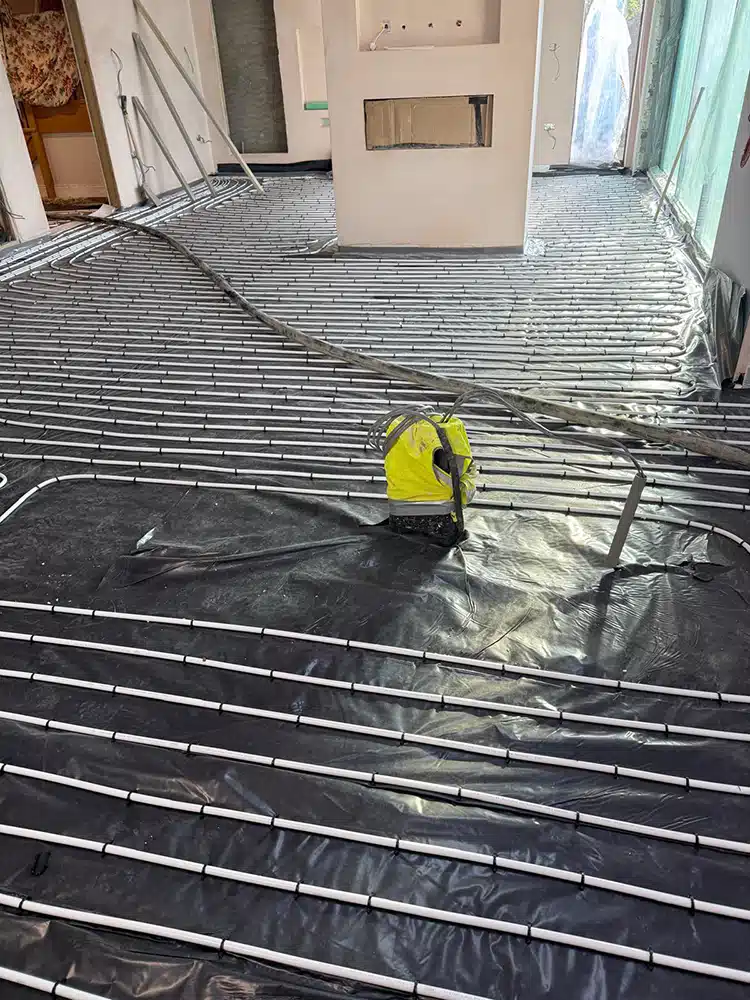
Underfloor heating works through the screed, so the screed decides how well it performs. In a Thame kitchen extension or garden room built onto a late 20th century house, the pipes are usually clipped to insulation boards, and the screed then has to wrap every pipe with no air pockets and reach the right depth above them.
Cover is the first figure to fix. With liquid screed the minimum is 25mm above the pipes, so most of these floors end up 45 to 50mm deep overall. Sand and cement wants more, around 45mm over the pipes. Skimp on it and cracks can follow the line of the pipes. Overdo it and the room is slow to warm up.
The choice between the two usually comes down to programme and finish. A pumped liquid screed over heating pipes flows under and around them without voids and dries to a flat surface, which helps with tiles, LVT and engineered wood. A hand-laid mix is sometimes preferred where the extension floor has falls or a wet area.
Whichever is chosen, we check the edge strip, membrane and insulation first, and the engineer's pressure test on the pipes should already be done. The edge strip matters more than it looks, because it lets the heated screed expand without cracking at the walls. Our insulation and membranes service covers that preparation where it is not already done.
Switching on the heating in a Thame home
Resist turning the heating on as soon as the floor is down. With calcium sulphate, a gradual warm-up can normally begin around day 7. Sand and cement has to wait a minimum of 21 days. In both cases the warm-up should be slow, raising the flow temperature in small steps, so the screed dries evenly rather than cracking. We leave clear commissioning notes so the heating engineer and whoever lives there follow one timetable.
Retrofitting into older houses is harder. Of Thame's homes, 19% were built between 1945 and 1972, and in houses of that age the existing floor rarely has spare height for insulation, pipes and 45mm or more of screed. Digging the old floor out is often the only way to fit the build-up without raising floor levels at the doors. A liquid screed, with its thinner cover, can help where every millimetre counts.
For drying times in more detail, the guide on how long screed takes to dry goes through each type. Heated floor screeding in High Wycombe works the same way.
Underfloor Heating Screed prices in Thame
Liquid screed over underfloor heating: £20 to £35 per m² supplied and laid (trade2base, June 2026), so £700 to £1,230 for 35 m². trade2base gives these figures excluding VAT. See our floor screeding cost guide or screed calculator.
Who lays your underfloor heating screed in Thame
K & B Screeding’s own team, led by director Donatas Bardisevicius. Founded 2019, company 12298780.
See what customers say in our Google reviews and on our testimonials page.
Underfloor Heating Screed from Slough to Thame
Thame is about 20.7 miles north-west of our Slough base as the crow flies, with postcodes including OX9. The nearest towns to it are Aylesbury (8.7 miles), Oxford (11.9 miles), Bicester (12.6 miles) and High Wycombe (12.9 miles).
More on underfloor heating screed, part of our screeding services.
