
Flat floors for Thame offices and refits
Office and industrial premises need level floors, and Thame has several substantial ones. Two head offices, for CPM Group and Travelodge, sit on the town's edge, while W. Lucy & Co. relocated to Thame from Oxford in 2005. When a floor in a building like these is refitted, the old covering comes up to reveal adhesive, patches and dips, and the new finish will show every one of them.
BS 8204 measures flatness by laying a 2m straightedge on the floor. The biggest gap allowed beneath it is 3mm for SR1, 5mm for SR2 and 10mm for SR3. Sheet vinyl and other thin finishes often need SR1, while LVT and large-format tiles want a floor near it. A levelling compound, laid over a properly primed base, is usually the quickest way to reach that class.
The primer under the compound is just as important. A cement screed, a calcium sulphate screed, an old concrete slab and a surface still carrying adhesive each need a different primer. Pick the wrong one and that is a frequent reason for compound lifting later. Where the base is contaminated or weak, it needs mechanical floor preparation such as shot blasting or grinding first.
Fast drying products keep a refit moving, which matters when an office or shop wants to reopen quickly. Under raised access flooring or racking, the base still needs to be level and sound, and whether a thin compound is enough depends on how far out it is.
Old cottages and extension joins in Thame
In the historic core, the reason to level rather than rebuild is usually the building itself. An 18th century cottage floor may be sound but undulating, and a thin compound brings it flat without adding the depth and weight of a full screed. Damp control has to be settled first, because a compound will not cure a floor that is letting moisture through.
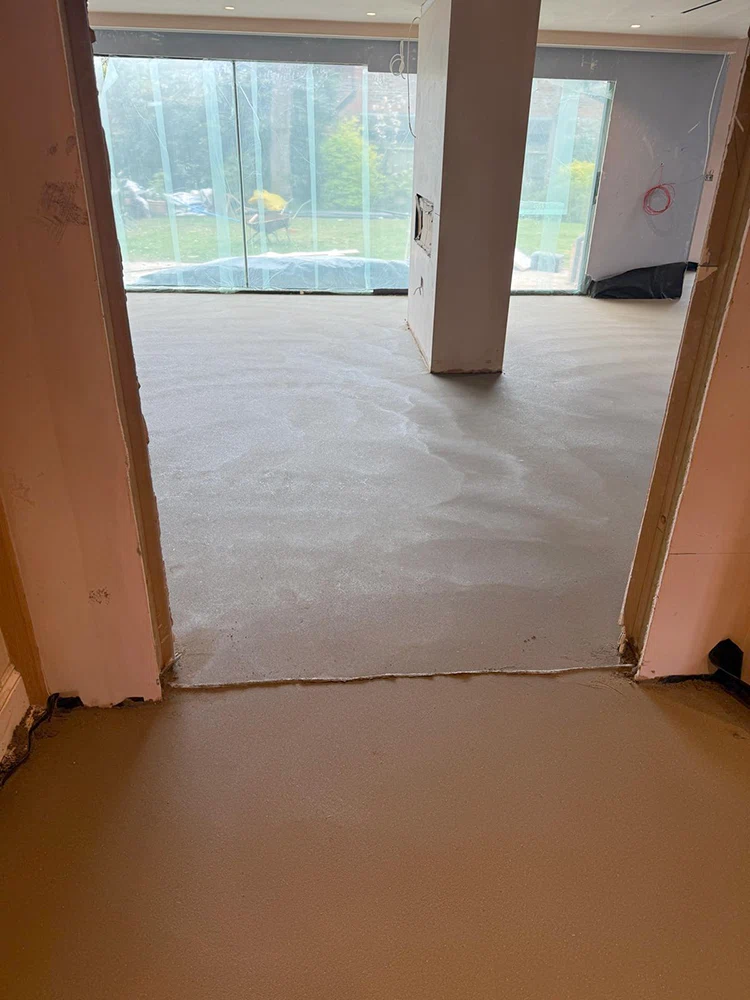
Where an extension meets the older part of a Thame house, the floor joint is another frequent reason to level. The two floors are laid at different times, often to different tolerances, and a slight step or slope across the opening shows up under a continuous run of LVT. Levelling compound feathers that join out.
There is a limit. Compounds are normally poured 2mm to 10mm deep, roughly, and a few products are made for deeper fills. When a floor needs far more than that, pouring compound thick to hide it can crack and debond. A new screed is the honest answer then, and liquid screed for Thame floors explains that route. For very thin smoothing coats, see latex screed. We also carry out floor levelling in Henley-on-Thames.
How we price floor levelling in Thame
A fixed written price within 24 hours, once we know the area and the base. See our floor screeding cost guide.
Who levels your floor in Thame
K & B Screeding’s own team, led by director Donatas Bardisevicius. Founded 2019, company 12298780.
See what customers say in our Google reviews and on our testimonials page.
Floor Levelling from Slough to Thame
Thame is about 20.7 miles north-west of our Slough base as the crow flies, with postcodes including OX9. The nearest towns to it are Aylesbury (8.7 miles), Oxford (11.9 miles), Bicester (12.6 miles) and High Wycombe (12.9 miles).
More on floor levelling, part of our screeding services. Not sure whether you need a thin compound or a full flowing screed? See self levelling screed explained.
