
Getting Oxford home floors flat for thin finishes
Thin finishes show every hollow. Many sheet vinyls and LVT products need SR1, which allows a maximum of 3mm deviation under a 2m straightedge. Carpet copes with the looser classes, SR2 at 5mm and SR3 at 10mm. Floors that feel solid underfoot often fall outside SR1, especially where an old room meets a new one.
That junction is the commonest reason to level in Oxford homes. 32% of the city's homes are semi-detached, and when a Headington, Marston or Cowley semi is extended, the new floor meets the old one at a doorway. Even a few millimetres of step or slope spoils a floor that runs through, and compound feathered across the join gives one flat surface.
Most compound layers in Oxford homes land between roughly 2mm and 10mm, and a handful of products can be built thicker. It dries quickly, so flooring can follow much sooner than after a screed.
Before compound, the base decides the primer. Hard dense concrete, tired sand and cement, sanded calcium sulphate and old tiling each get their own treatment, after every loose bit and trace of old adhesive has been cleared away by our floor preparation service.
Where the floor is crumbling or badly out, compound is the wrong tool. In a period house in Jericho or Osney, a failed solid floor without a membrane needs rebuilding with sand and cement screed.
Levelling for refits at Westgate Oxford and science parks
Commercial refits bring their own pressure: a unit is closed while the work happens, so the floor has to be ready fast. Retail units at Westgate Oxford, laboratories at the Oxford Science Park and Begbroke Science Park, and offices across the city all end up with new flooring laid over an existing base when they are refitted. Fast drying levelling compounds suit that work where the base is sound.
The job starts by stripping old coverings and adhesive, then grinding or cleaning the surface so the primer can bond. Where the slab needs it, grinding the concrete comes first. The floor is then measured against the flatness the new finish requires, primed and levelled.
Production halls, such as those at the Mini plant in Cowley, are another matter. A thin compound is not a wearing surface for heavy traffic, and floors of that kind need a properly specified screed through our commercial screeding service.
We give straight advice on where compound stops being the answer. Trying to save a floor that needs new screed by pouring compound thick tends to end with cracks and the layer coming unstuck, taking the new flooring with it. If a thin layer of a few millimetres is enough, a latex screed may also suit.
How we price floor levelling in Oxford
A fixed written price within 24 hours, once we know the area and the base. See our floor screeding cost guide.
Who levels your floor in Oxford
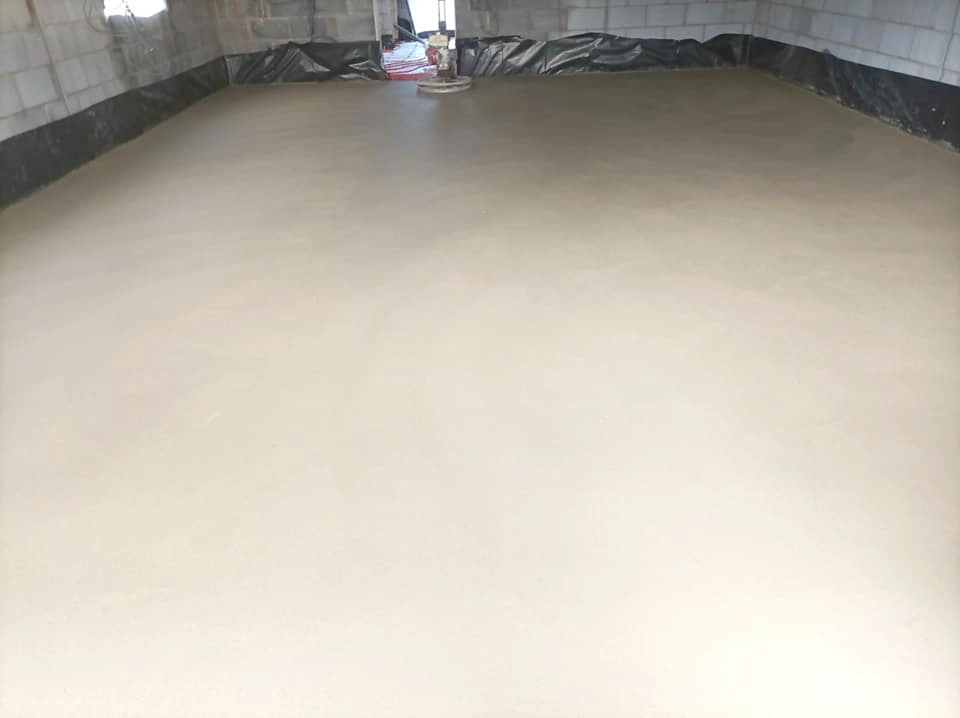
K & B Screeding’s own team, led by director Donatas Bardisevicius. Founded 2019, company 12298780.
See what customers say in our Google reviews and on our testimonials page.
Floor Levelling from Slough to Oxford
As the crow flies, our yard in Slough is about 30.4 miles from Oxford, which lies to the west-north-west. Postcodes here include OX1, OX3, OX4 and OX44, and Kidlington (5 miles), Abingdon-on-Thames (5.7 miles), Witney (10 miles) and Didcot (10.1 miles) are close by.
More on floor levelling, part of our screeding services. Not sure whether you need a thin compound or a full flowing screed? See self levelling screed explained.
