
Heated extensions on Headington and Cowley semis
Between 1919 and 1944, Oxford gained 21% of the homes it has today. Along with the post-war semis beside them, the inter-war houses of Headington, Marston and Cowley make typical extension projects, and the new kitchen at the back often has heating in the floor. The existing floor sets the finished level, so everything underneath, from insulation to pipes to screed, has to fit within that depth.
The screed's depth follows from the pipe cover. Poured liquid must sit 25mm or more above the loops, so a Headington extension normally gets 45 to 50mm in total. With sand and cement, the cover alone is around 45mm, making a deeper floor. A flowing screed surrounds every pipe with no air pockets, warms up faster and spreads heat evenly, so it suits a heated extension well. If a cement base is what the finish wants, sand and cement remains the choice.
Heating an older Oxford house after the fact takes more work. In the Victorian and Edwardian houses of Jericho, Osney and North Oxford, where solid floors often have no membrane, adding heating means excavating first so there is space for membrane, insulation, pipes and screed. That is a bigger job, but it is how heating fits under a period floor without raising it.
For pumped options see liquid screed in Oxford, and if the drawings name a calcium sulphate grade, the Oxford anhydrite screed page explains what it means.
Commissioning heated floors in Oxford homes and flats
The heating waits for the screed. Calcium sulphate can normally be warmed from about a week after pouring, day 7, while sand and cement waits 21 days at the least. Commissioning then begins at a low temperature and rises gradually, and we leave a written schedule so that the heating engineer and flooring fitter work from one plan.
New homes can be designed around a heated floor from the outset. 7% of the city's homes were built from 2015 onwards, and in flats and houses of that age the build-up is normally set by the developer's specification. A garden room in an Oxford back garden works the same way, just smaller.
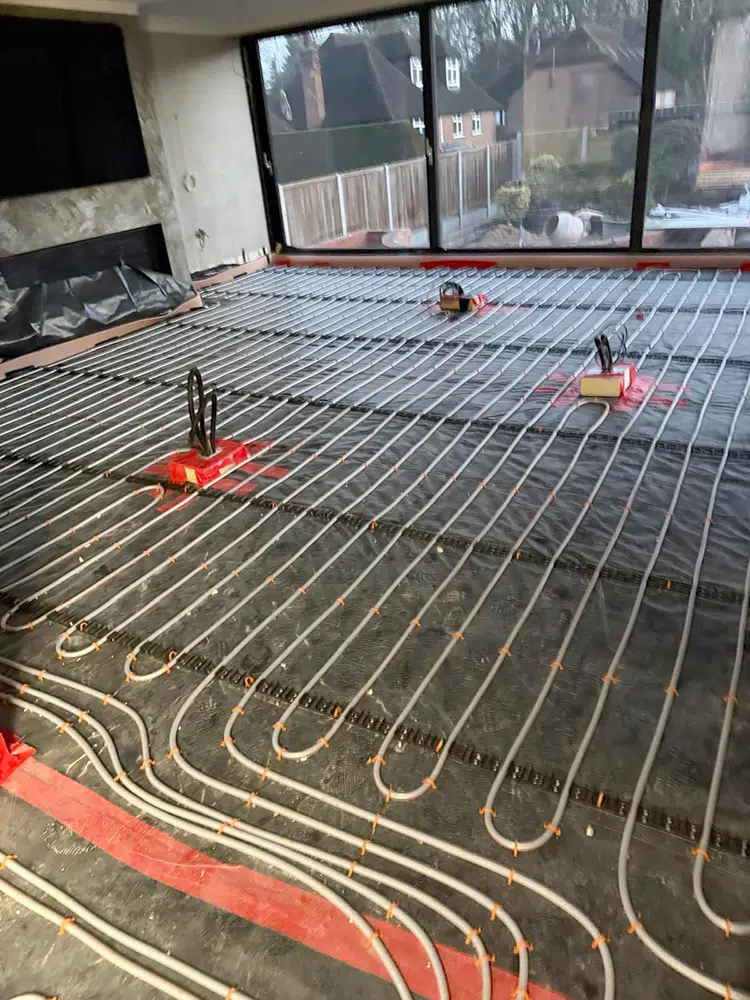
Have the loops clipped and pressure tested over insulation, membrane and edge strip by the time we come. Pipe installation stays with your heating engineer; K & B only screeds. If the insulation or membrane still needs supplying, our insulation and membranes service can do it.
Tiles, LVT and engineered wood all need the screed dry to the maker's limit before they go down, and gentle heating speeds that up once commissioning has started. The screed thickness guide shows the depths for each type of build-up.
Underfloor Heating Screed prices in Oxford
Liquid screed over underfloor heating: £20 to £35 per m² supplied and laid (trade2base, June 2026), so £700 to £1,230 for 35 m². trade2base gives these figures excluding VAT. See our floor screeding cost guide or screed calculator.
Who lays your underfloor heating screed in Oxford
K & B Screeding’s own team, led by director Donatas Bardisevicius. Founded 2019, company 12298780.
See what customers say in our Google reviews and on our testimonials page.
Underfloor Heating Screed from Slough to Oxford
As the crow flies, our yard in Slough is about 30.4 miles from Oxford, which lies to the west-north-west. Postcodes here include OX1, OX3, OX4 and OX44, and Kidlington (5 miles), Abingdon-on-Thames (5.7 miles), Witney (10 miles) and Didcot (10.1 miles) are close by.
More on underfloor heating screed, part of our screeding services.
