
Pipe cover and depth in Wantage floors
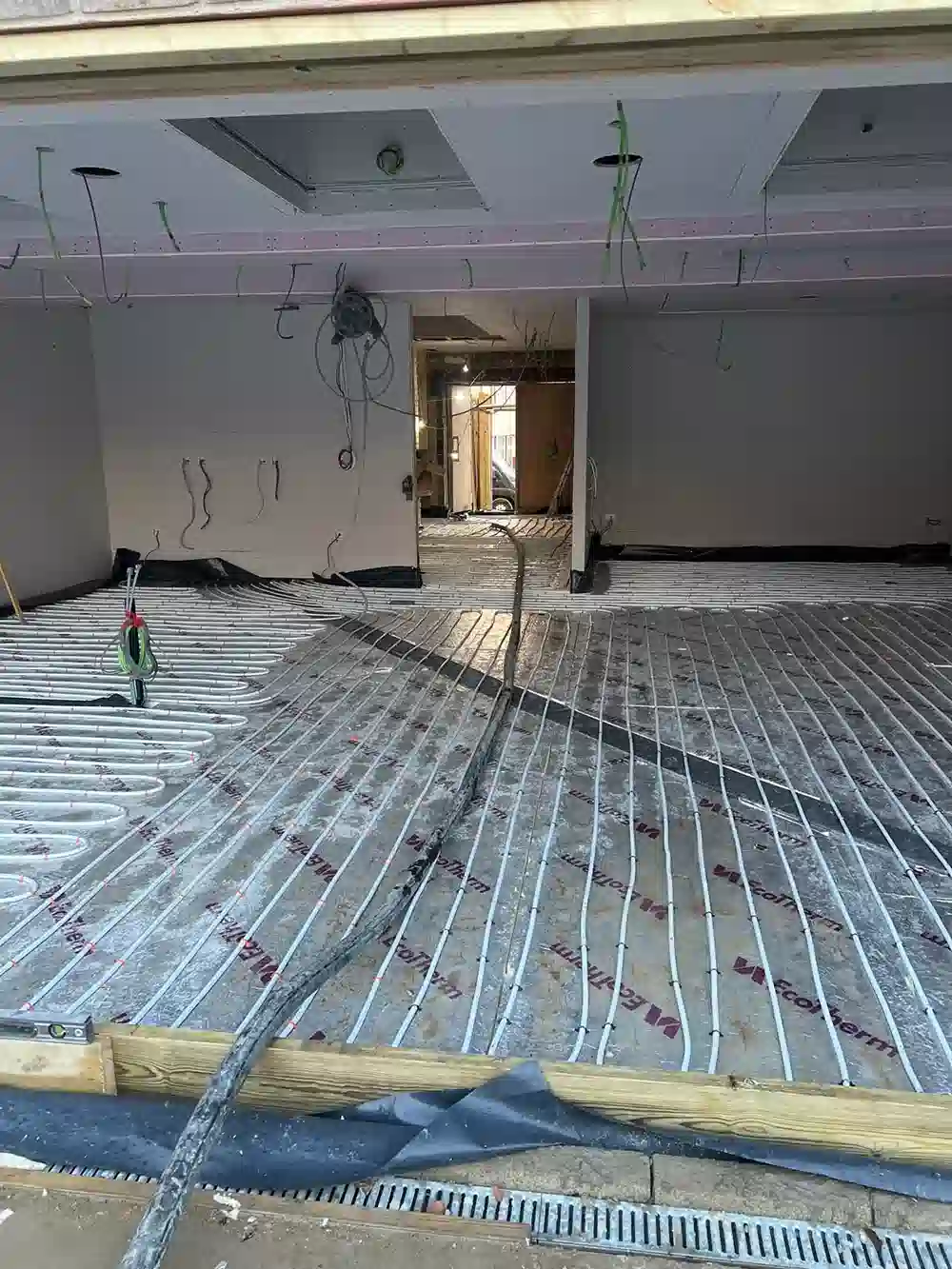
Underfloor heating gives out its heat through the screed, so how the screed is laid decides how well the system works. Every pipe needs wrapping completely, with no trapped air, and the right depth of screed on top.
Liquid screed should bury the pipes by 25mm at the least, so the finished floor is normally 45 to 50mm thick. Hand-laid sand and cement has to bury them deeper, by about 45mm. Less than that and the floor may crack along the pipe runs under load; much more and the room takes longer to warm up.
In the homes Wantage has added this century, including the 15% built between 2000 and 2014, heating can be part of the original design, with the floor build-up set to suit. Heated extensions on older houses are harder. A 1950s or 1960s solid floor rarely has spare height for insulation, pipes and screed, so the old floor may need to come out to fit the build-up without a step at the doorway. A pumped liquid screed around the pipes saves depth there, and it flows under the pipes where a hand-laid mix has to be worked carefully around them.
Before pouring we look over the perimeter strip, damp membrane and insulation boards, or bring them ourselves, and by then the pipes should have passed the heating engineer's pressure test. That strip round the walls gives the warm floor room to expand, so it does not crack at the edges.
Starting the heating in a new Wantage floor
Being able to walk on the new floor is no signal to switch the heating on. For a calcium sulphate floor, 7 days or so is usually the earliest point to start bringing it up to temperature. Sand and cement floors need 21 days at the very least before the system runs. Either way, the warm-up must be gradual, in small steps over several days, so the screed dries evenly and does not crack. Our commissioning guidance goes to both the heating engineer and the homeowner, so nobody works from a different timetable.
Garden rooms and heated kitchens usually go on to take tile, LVT or engineered wood, and all three need a flat, dry base. A heated floor is tested for moisture like any other before the covering goes down; running the heating does not remove the need for a test.
For more on the drying stage, read the screed drying guide. If the insulation or membrane is not yet in place, our insulation and membranes service covers it. We also lay heated floor screed in Abingdon-on-Thames.
Underfloor Heating Screed prices in Wantage
Liquid screed over underfloor heating: £20 to £35 per m² supplied and laid (trade2base, June 2026), so £700 to £1,230 for 35 m². trade2base gives these figures excluding VAT. See our floor screeding cost guide or screed calculator.
Who lays your underfloor heating screed in Wantage
K & B Screeding’s own team, led by director Donatas Bardisevicius. Founded 2019, company 12298780.
See what customers say in our Google reviews and on our testimonials page.
Underfloor Heating Screed from Slough to Wantage
Wantage is about 33.9 miles west of our Slough base as the crow flies, with postcodes including OX12. The nearest towns to it are Didcot (8 miles), Abingdon-on-Thames (8.4 miles), Oxford (13.4 miles) and Newbury (13.7 miles).
More on underfloor heating screed, part of our screeding services.
