
Calcium sulphate grades on Wantage and Grove plots
An anhydrite screed uses a calcium sulphate binder rather than cement, and it is specified by strength class under the European screed standard. The designation reads as compressive then flexural strength in N/mm2. Light domestic floors take CA-C20-F4. Most housing, apartment and office floors are CA-C25-F5. Floors that work harder get CA-C30-F6.
At Grove, as on any new plot, the grade comes from the engineer or architect and we follow it. Flats need the same attention: 19% of Wantage homes are flats, and apartment floors often combine insulation, heating and a tight floor-to-ceiling height, so the chosen grade and depth have to fit all three.
If there is little depth to play with or the programme is short, the designer may switch to an alpha hemihydrate product. They dry faster or go thinner, and each one is laid to its own product sheet, not to the general figures.
Calcium sulphate does not act like cement. There is hardly any shrinkage, so a large open floor needs few joints and keeps its flatness as it cures. We mark out the bays before pumping, with any joints placed across doorways and along heating zone boundaries. If heating pipes are in, the heating can usually be used to force dry it after about 7 days.
It is not for wet areas. For any floor that could get wet once in use, choose a flowing screed made with cement, or for a small wet room, sand and cement laid by hand. There is more on the chemistry in our anhydrite screed explainer.
Before flooring goes down in Wantage
A calcium sulphate floor needs jobs done after drying that a cement floor does not. The first is laitance removal. Curing leaves a soft, powdery crust across the top of the floor, and it has to be sanded away, since adhesive, primer and levelling compound cannot grip it. The second is priming with a product compatible with calcium sulphate, since some cement based adhesives react with the binder.
Moisture testing is the third step, and one that is easy to rush. Many flooring makers set a tighter moisture figure for calcium sulphate than for cement, so a floor that appears dry may still be too damp for wood or vinyl. A hygrometer test gives the figure. We hand the drying and laitance advice over in writing, which helps a site manager at Grove or a homeowner in Charlton plan the flooring date.
The pour itself is carried out with our own pump and team; see screed pumping for how that part of the job is organised. We also supply anhydrite screed in Swindon.
Anhydrite & Flow Screed prices in Wantage
Liquid flowing screed (which includes anhydrite): £24 to £31 per m² supplied and laid (MyJobQuote, August 2026), so £960 to £1,240 for 40 m². MyJobQuote does not say whether these figures include VAT. See our floor screeding cost guide or screed calculator.
Who lays your anhydrite and flow screed in Wantage
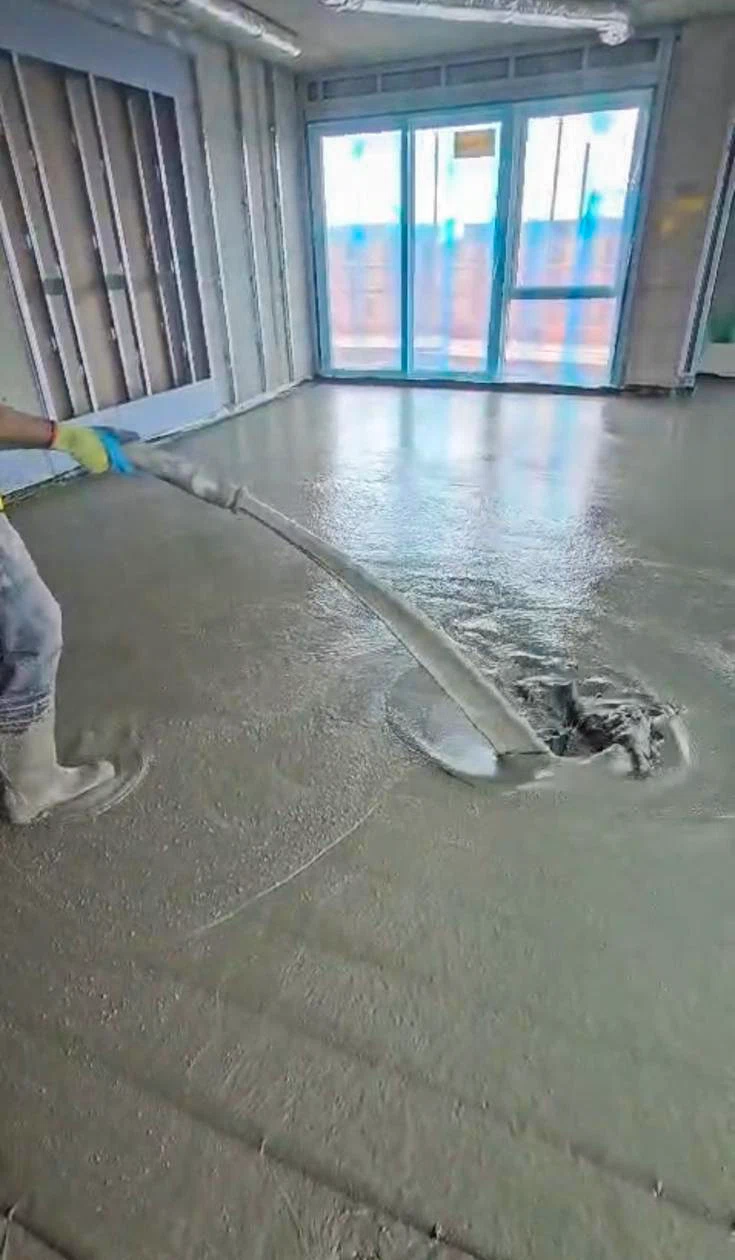
K & B Screeding’s own team, led by director Donatas Bardisevicius. Founded 2019, company 12298780.
See what customers say in our Google reviews and on our testimonials page.
Anhydrite & Flow Screed from Slough to Wantage
Wantage is about 33.9 miles west of our Slough base as the crow flies, with postcodes including OX12. The nearest towns to it are Didcot (8 miles), Abingdon-on-Thames (8.4 miles), Oxford (13.4 miles) and Newbury (13.7 miles).
More on anhydrite screed, part of our screeding services.
