
Specifying grades for North East Thatcham plots
Plans identify calcium sulphate screed by a code that the European screed materials standard defines. The C figure after CA is the compressive strength, the F figure the flexural strength, and both are given in N/mm2. Three grades cover most housing. For lightly used domestic rooms, CA-C20-F4 does the job. A typical house, flat or office floor is poured as CA-C25-F5. CA-C30-F6 is reserved for floors facing more demanding use.
For a housebuilder, the grade is the engineer's choice, and we pour exactly that, never a near alternative. If a plot needs a quick programme or a slim floor, the drawings may call for an alpha hemihydrate product in its place. With one of those, we take the depth and drying time from the manufacturer's own product sheet.
What makes the material attractive on new build is how little it shrinks as it sets. Wide bays go down with hardly any joints, which helps in flats and on open-plan ground floors. Any joints still required, for instance across door thresholds or where heating zones meet, are marked out and agreed ahead of pouring.
Apartments are part of Thatcham already: 11% of its homes are in purpose-built blocks. Those flats have open floors, normally over insulation, and that is where a screed that barely shrinks pays off. If the drawings leave you unsure what has been specified, our guide to anhydrite screed explained is a good place to start.
Laitance, moisture and wet areas in Thatcham
Pouring is just the first stage with calcium sulphate. While it dries, a fragile surface layer known as laitance builds up. Sand it away before any adhesive or compound is put down, or the flooring ends up bonded to that crust and not to the screed beneath. Next comes a primer designed for calcium sulphate, since certain cement primers do not work with it.
Moisture testing comes next. Floor covering makers are often stricter about how damp a calcium sulphate base may be than they are with cement. A reading that would let tiles go onto a cement floor may still be too high here. We test with a hygrometer. On plots with underfloor heating, running it from about 7 days onward normally helps the screed dry.
Anywhere in a Thatcham house that might stay damp should not have calcium sulphate. Where a machine could leak in a utility room, or in any wet room or walk-in shower, use a cement flowing screed, or else a hand-laid cement floor. Specified plots in Basingstoke follow the same rules; see anhydrite screed in Basingstoke.
Anhydrite & Flow Screed prices in Thatcham
Liquid flowing screed (which includes anhydrite): £24 to £31 per m² supplied and laid (MyJobQuote, August 2026), so £960 to £1,240 for 40 m². MyJobQuote does not say whether these figures include VAT. See our floor screeding cost guide or screed calculator.
Who lays your anhydrite and flow screed in Thatcham
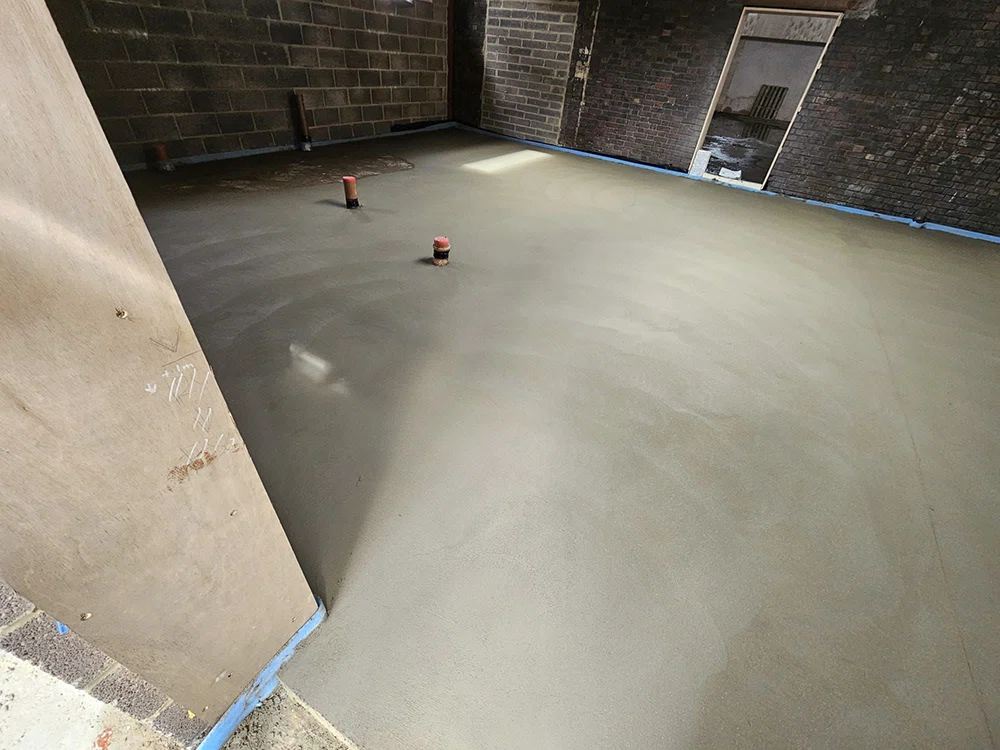
K & B Screeding’s own team, led by director Donatas Bardisevicius. Founded 2019, company 12298780.
See what customers say in our Google reviews and on our testimonials page.
Anhydrite & Flow Screed from Slough to Thatcham
As the crow flies, our yard in Slough is about 27.9 miles from Thatcham, which lies to the west-south-west. Postcodes here include RG19, and Newbury (2.8 miles), Tadley (5.7 miles), Basingstoke (11.9 miles) and Reading (12.8 miles) are close by.
More on anhydrite screed, part of our screeding services.
