
Anhydrite grades on Andover plots and apartment floors
Calcium sulphate screed, usually called anhydrite, is specified by strength. Its code gives compressive strength after the C and flexural strength after the F, measured in N/mm2. A domestic floor with light traffic is usually CA-C20-F4. Ordinary homes and offices, flats included, are normally specified CA-C25-F5. Busy communal areas and other hard-working floors call for CA-C30-F6.
Purpose-built blocks make up 17% of Andover's homes, and apartment floors are one of the natural uses for the material. Because it hardly shrinks, it can go down in big bays with few joints, a good match for long corridors and plot after plot of the same layout. We still mark out bays and joints in advance, paying particular attention to doorways and corners where the floor changes shape.
Alpha hemihydrate products are a faster family. They are chosen where drying time or depth is under pressure, and each follows its own data sheet for minimum thickness and heating, so we work from that sheet. They can help where a heated floor has to be kept shallow or a plot handover date is close.
Keep calcium sulphate out of anywhere water can reach the floor. For bathrooms, wet rooms and plant areas, a cement based flowing screed gives a similar pumped finish without the sensitivity to water.
For the pumped method in general, see Andover liquid screed; for how heating is added under this material, see underfloor heating screed.
Drying, laitance and priming for Andover flooring
Pouring takes no time at all. What follows decides whether the floor covering stays put.
As the screed cures, laitance forms: a weak, thin layer sitting on the surface. After drying, that skin is sanded off and vacuumed up; leave it and the adhesive holds onto the skin, not the screed, and the covering can come away.
Moisture testing comes next. Flooring manufacturers are often stricter about residual moisture in calcium sulphate than in cement, which is how a floor can seem dry to the touch and still fail the test. A hygrometer test gives a reading to compare against the flooring maker's limit. Plenty of fresh air helps, and from around day 7 the heating can normally be run, turned up slowly, to force dry it.
Then the primer. It must be compatible with calcium sulphate, particularly where cement based tile adhesive is going on top, since the two should not be in direct contact.
Your flooring fitter gets our written notes on drying and laitance, showing what is done and what is left. There is more on the material itself in our guide to calcium sulphate screed.
Anhydrite & Flow Screed prices in Andover
Liquid flowing screed (which includes anhydrite): £24 to £31 per m² supplied and laid (MyJobQuote, August 2026), so £960 to £1,240 for 40 m². MyJobQuote does not say whether these figures include VAT. See our floor screeding cost guide or screed calculator.
Who lays your anhydrite and flow screed in Andover
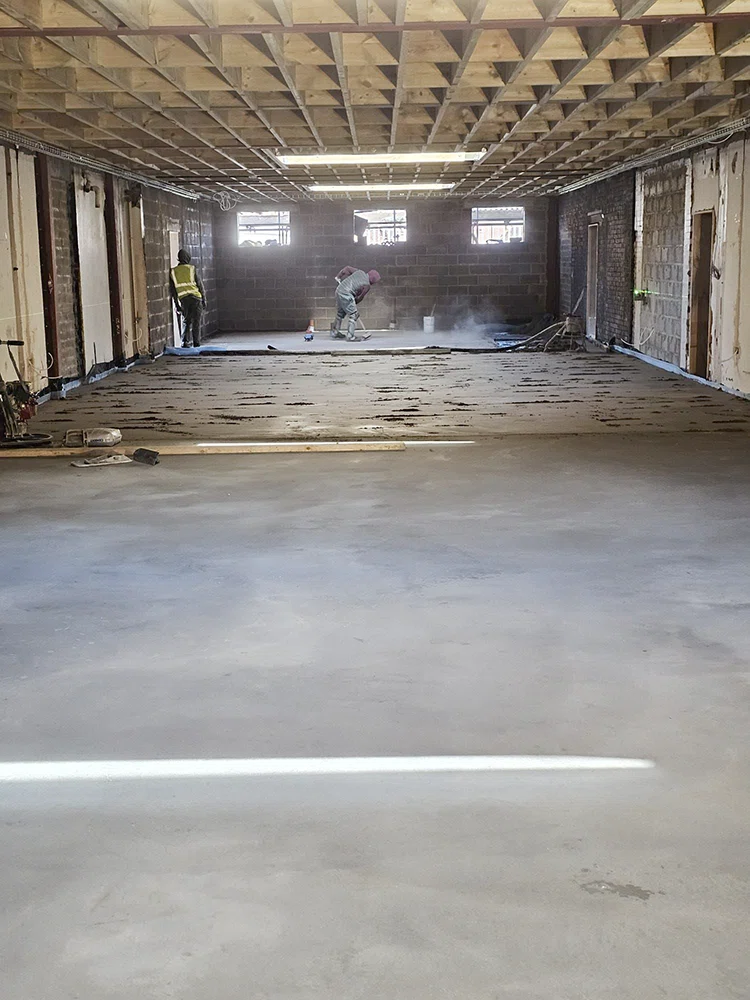
K & B Screeding’s own team, led by director Donatas Bardisevicius. Founded 2019, company 12298780.
See what customers say in our Google reviews and on our testimonials page.
Anhydrite & Flow Screed from Slough to Andover
As the crow flies, our yard in Slough is about 42.5 miles from Andover, which lies to the west-south-west. Postcodes here include SP10 and SP11, and Tidworth (8.4 miles), Winchester (12.4 miles), Amesbury (13.3 miles) and Newbury (14.9 miles) are close by.
More on anhydrite screed, part of our screeding services.