
Reading the grade on a Romsey specification
The code on a drawing for calcium sulphate screed comes from the European standard covering screed materials. C is the compressive figure and F the flexural one, with both quoted in N/mm2. Three grades cover most of the specifications a Romsey house or flat is likely to carry. CA-C20-F4 covers lightly used domestic floors. For a typical Romsey house or flat, or an office, the drawing will usually say CA-C25-F5. Floors expected to take heavier use get CA-C30-F6.
The engineer chooses the grade for a new build, and we pour that exact grade, never a lookalike. A few specifications skip the standard grades and call for an alpha hemihydrate product. These are picked when a floor must dry faster or be laid thinner, and every product has its own sheet for depth, drying and heating, which we work to.
Its main strength is how little it shrinks. Because of that, wide areas pour with few interruptions for joints, which suits flats and the open-plan ground floors of new houses. Joints are not gone entirely: door thresholds and the line between heating zones can still need them, and we draw up the bays and joints before the pour.
Where calcium sulphate would be the wrong choice, a cement based flowing screed can be pumped in its place. There is a fuller introduction to the material in our anhydrite screed guide.
Laitance and moisture checks before Romsey floors are finished
Pouring a calcium sulphate floor is only the first stage. As the screed dries, laitance, a thin and weak surface skin, builds up on top. Unless it is sanded away before adhesive or levelling compound goes down, the flooring ends up bonded to that crust and not to the screed. Once it is dry enough, the surface is sanded back and primed with a product that suits calcium sulphate.
Moisture is the next check. Many flooring manufacturers are stricter about moisture in calcium sulphate than in cement screed, so this floor can fail a test that a sand and cement one of the same age would pass. We measure with a hygrometer instead of going by the calendar. With heating laid in the floor, running it from roughly day 7 normally hurries the drying along.
Calcium sulphate is the wrong material wherever water could reach it, such as a wet room or a utility at risk of leaks. Use a cement based screed there instead; our Romsey sand and cement page covers that work. The same anhydrite service is available in Southampton.
Anhydrite & Flow Screed prices in Romsey
Liquid flowing screed (which includes anhydrite): £24 to £31 per m² supplied and laid (MyJobQuote, August 2026), so £960 to £1,240 for 40 m². MyJobQuote does not say whether these figures include VAT. See our floor screeding cost guide or screed calculator.
Who lays your anhydrite and flow screed in Romsey
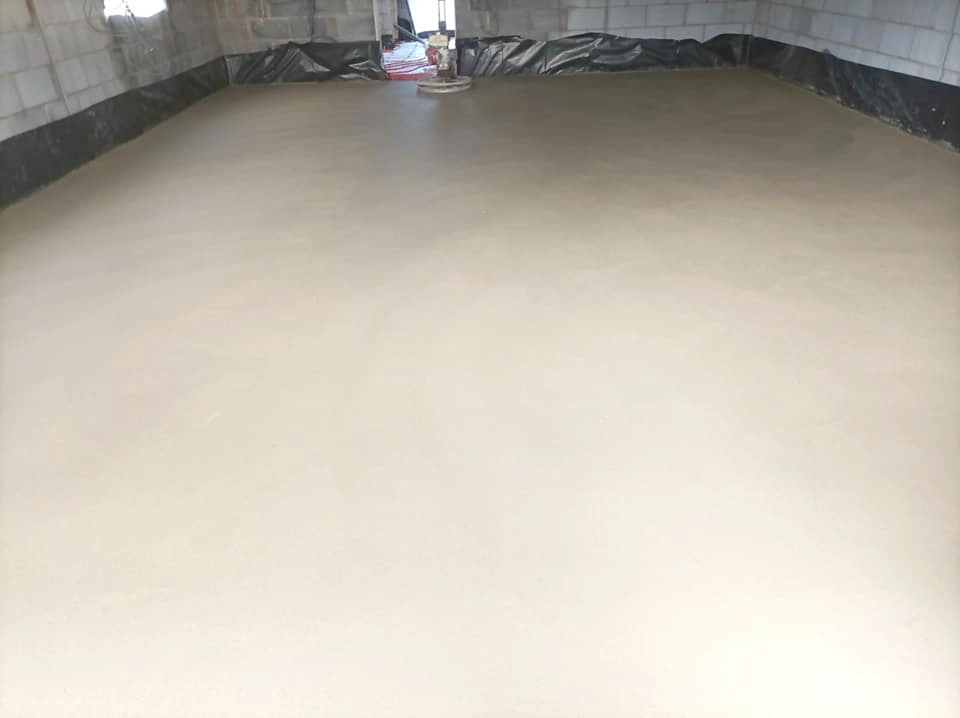
K & B Screeding’s own team, led by director Donatas Bardisevicius. Founded 2019, company 12298780.
See what customers say in our Google reviews and on our testimonials page.
Anhydrite & Flow Screed from Slough to Romsey
Romsey is about 52.7 miles south-west of our Slough base as the crow flies, with postcodes including SO51 and SO16. The nearest towns to it are Totton (4.9 miles), Eastleigh (6.5 miles), Southampton (7.2 miles) and Winchester (9.6 miles).
More on anhydrite screed, part of our screeding services.
