
Choosing the right anhydrite grade in Tidworth
Calcium sulphate screeds carry a designation that tells you their strength. Under the European screed materials standard, the number after C gives compressive strength and the number after F gives flexural strength, measured in N/mm2. Three grades cover most building work.
Lightly trafficked domestic floors take CA-C20-F4. For the bulk of homes, apartments and offices, CA-C25-F5 is used. Communal corridors, commercial areas and other hard-working floors get CA-C30-F6. When an engineer has set the grade for a new plot, that grade is what we pour, with no substitutes. For an extension or a self-build, we will suggest one to suit the rooms and the finish going on top.
An alpha hemihydrate product is sometimes named instead. Those are picked when a floor must dry sooner or be laid thinner, and depth and drying for each come from its own product sheet.
The reason calcium sulphate is chosen for flats is its low shrinkage. A whole floor plate can be poured as one large bay with very few joints, over insulation or heating. If a floor needs joints, say at doorways between flats or where two heating zones meet, we plan where they go before pouring.
For fuller background, read anhydrite screed explained. If the specification calls for a pumped screed but not calcium sulphate, our liquid screed page for Tidworth covers the cement based option.
Laitance and moisture checks on Tidworth floors
Two steps separate a calcium sulphate pour from a finished floor. The first is removing laitance. As the screed dries, a weak, powdery layer forms on top, and adhesives and smoothing compounds will not grip it. When the screed has dried sufficiently, we sand that layer away and prime with a product made to work on calcium sulphate.
The second is moisture testing. Plenty of flooring makers allow calcium sulphate less moisture than cement screed, which is how a floor that looks dry can still fail. A hygrometer reading settles it, not the number of days gone by. Heated floors can normally be force dried from about 7 days, cutting the wait.
Calcium sulphate is the wrong choice anywhere that may stay wet. For a wet room, a shower area or a utility floor that could see leaks, use a cement based flowing screed or hand-laid sand and cement.
Where a calcium sulphate floor meets a cement based one, such as at a shower threshold, the join is planned before the pour and each side gets the primer that suits it. Further afield, we also pour anhydrite screed in Salisbury.
Anhydrite & Flow Screed prices in Tidworth
Liquid flowing screed (which includes anhydrite): £24 to £31 per m² supplied and laid (MyJobQuote, August 2026), so £960 to £1,240 for 40 m². MyJobQuote does not say whether these figures include VAT. See our floor screeding cost guide or screed calculator.
Who lays your anhydrite and flow screed in Tidworth
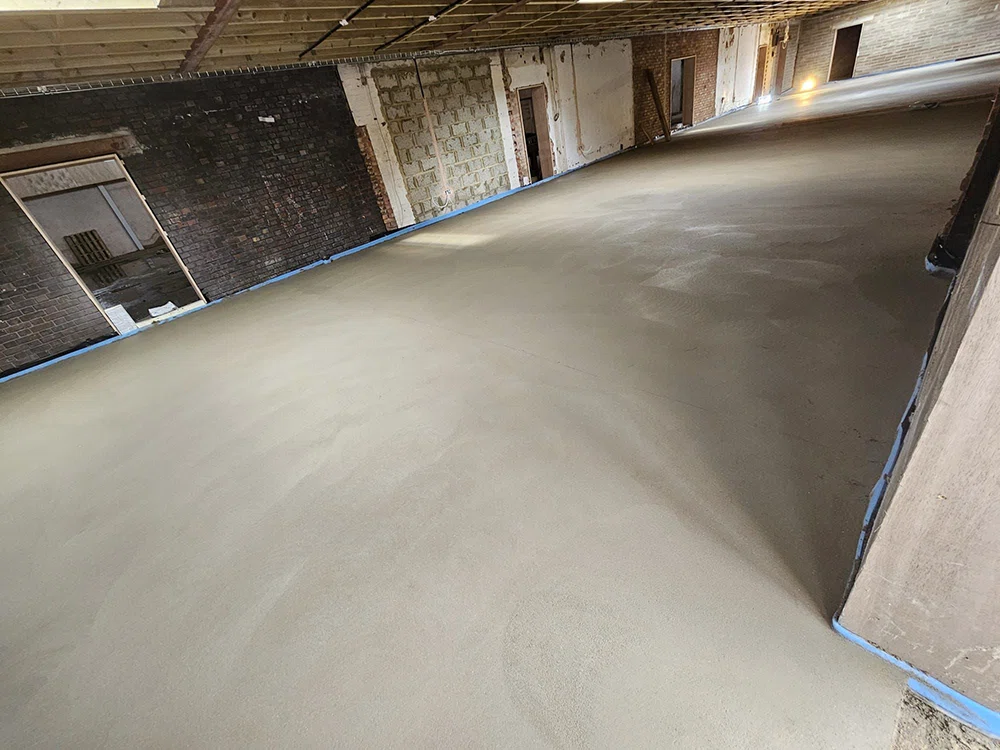
K & B Screeding’s own team, led by director Donatas Bardisevicius. Founded 2019, company 12298780.
See what customers say in our Google reviews and on our testimonials page.
Anhydrite & Flow Screed from Slough to Tidworth
As the crow flies, our yard in Slough is about 48.4 miles from Tidworth, which lies to the west-south-west. Postcodes here include SP9 and SP11, and Amesbury (7 miles), Andover (8.4 miles), Salisbury (13.1 miles) and Devizes (16.2 miles) are close by.
More on anhydrite screed, part of our screeding services.