
Reading the grade on an Amesbury plot specification
Since 1939 the ground running from the old centre out towards the Boscombe Down airfield has largely been built over, and 18% of Amesbury's homes date from 2000 to 2014 alone. Plot specifications on developments like these often name a calcium sulphate flow screed by its grade.
The code tells you what is wanted. In that code, CA is the calcium sulphate binder, the C figure gives compressive strength and the F figure flexural strength, each measured in N/mm2 to the European standard for screeds. A house floor that sees little wear can be CA-C20-F4. CA-C25-F5 is the general-purpose grade, covering houses, flats and offices alike. Harder working floors step up to CA-C30-F6. Purpose-built flats are 9% of Amesbury's homes, so most floors here are in houses, which CA-C20-F4 or CA-C25-F5 usually covers.
Now and then the drawings name an alpha hemihydrate screed by product instead of a grade. Designers reach for those when drying speed or a slimmer layer counts; each comes with its own product sheet for depth and heat-up, and we pour to it rather than to general rules.
The material itself suits new houses well. Shrinkage is slight, so even a big Archers Gate ground floor needs only a few joints, set out in bays that we plan before pumping starts. Our guide to anhydrite screed goes deeper into how it cures.
Calcium sulphate has no place in a utility with a floor gully or under a level access shower, where water will reach it. Those areas take a pumped screed made with cement.
Laitance, moisture tests and failed Amesbury floors
Two steps after the pour decide whether a calcium sulphate floor succeeds.
The first is laitance. Curing leaves a skin of laitance on top, thin and soft. With the floor dry, that skin is sanded away until hard screed shows, the dust is hoovered up and a primer suited to calcium sulphate goes on. Adhesive laid over laitance can let go, taking the tiles or LVT with it. Our floor preparation work covers sanding and priming.
The second is moisture. Plenty of flooring brands allow less moisture in anhydrite than in cement, so one reading can be a pass on a cement floor and a fail on this one. A hygrometer test shows where the floor stands. Switching the underfloor heating on from about 7 days usually forces the drying along and cuts the wait.
When a new floor has already cracked, curled or failed its moisture test, the cause should be found before anything is laid over it. Some can be put right with remedial levelling over the screed; others need part of the floor replaced. For projects nearby, see anhydrite screed in Tidworth.
Anhydrite & Flow Screed prices in Amesbury
Liquid flowing screed (which includes anhydrite): £24 to £31 per m² supplied and laid (MyJobQuote, August 2026), so £960 to £1,240 for 40 m². MyJobQuote does not say whether these figures include VAT. See our floor screeding cost guide or screed calculator.
Who lays your anhydrite and flow screed in Amesbury
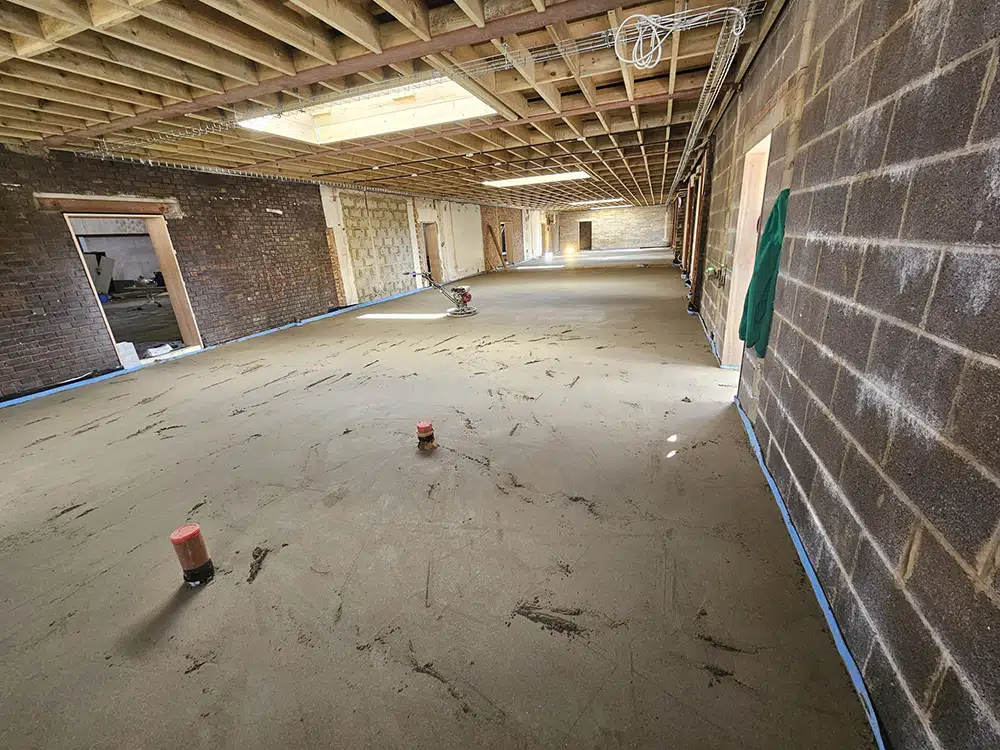
K & B Screeding’s own team, led by director Donatas Bardisevicius. Founded 2019, company 12298780.
See what customers say in our Google reviews and on our testimonials page.
Anhydrite & Flow Screed from Slough to Amesbury
As the crow flies, our yard in Slough is about 55.1 miles from Amesbury, which lies to the west-south-west. Postcodes here include SP4, and Tidworth (7 miles), Salisbury (7 miles), Andover (13.3 miles) and Devizes (15.5 miles) are close by.
More on anhydrite screed, part of our screeding services.