
Heated floors on Amesbury new build plots
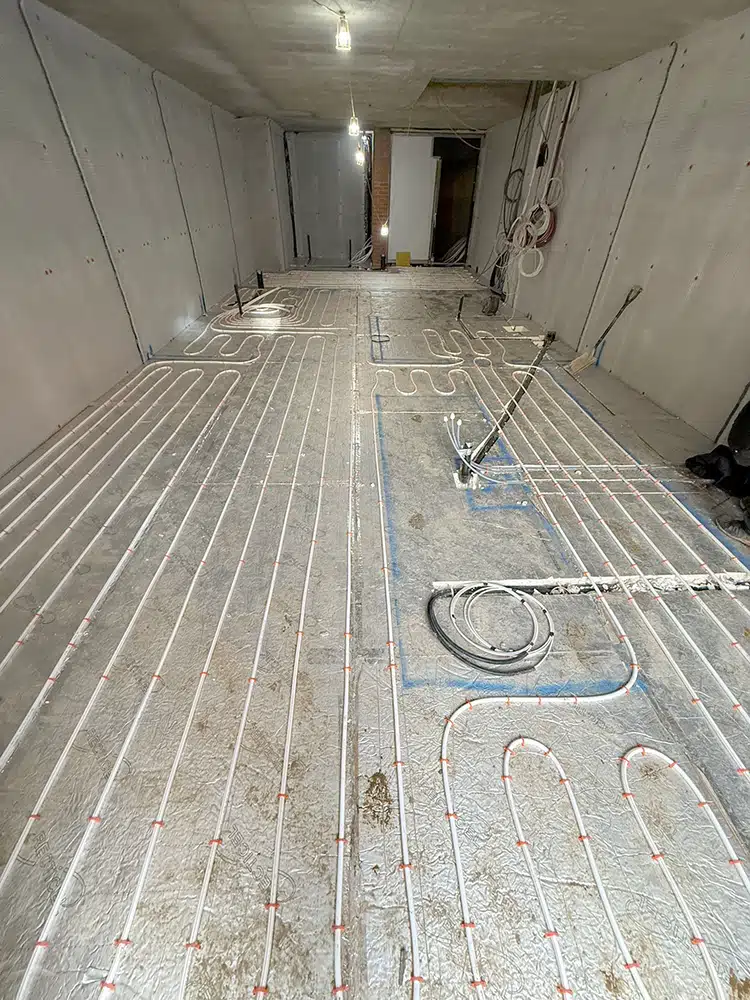
On a new plot the heated floor is designed from the slab up. Insulation boards go down first, then a membrane and edge strip, then the heating pipes, which are laid and pressure tested by the heating installer. That part is not ours. We check what is beneath them before pouring, and we can supply the boards and membrane through our insulation and membranes service.
The screed has two jobs over the pipes: to carry load and to spread heat. That needs cover. Over the loops a pumped screed needs 25mm at the very least, which works out at about 45 to 50mm of floor. A hand-laid mix wants nearer 45mm above them and makes a thicker floor.
Liquid screed is the usual choice on new plots, partly for depth and partly because it flows fully around the pipes with no air pockets. With no air trapped round the loops, the floor warms faster and wastes less heat. Amesbury plot drawings often call for a calcium sulphate screed, and the grades are decoded on our Amesbury anhydrite page.
On a run of plots, each floor is checked before its pour: pipes filled and under pressure, insulation joints tight, edge strip continuous. A gap in any of those shows up later as cracks or cold spots, and it is far easier to fix before the screed goes on. For depths in more detail, see our screed thickness guide.
Extensions and first heat-up in Amesbury
Detached homes make up 26% of Amesbury's housing, and on an older house of any type, underfloor heating often goes into a new extension rather than the whole house. With no old floor to dig out, the build-up can be set from the start to match the existing floor level.
When the heating goes on matters as much as the depth. Anhydrite is normally ready for its first heat after about 7 days, whereas a traditional mix has to wait a minimum of 21. The first warm-up is slow: a low flow temperature at first, raised a little each day, held, then lowered again. Rushing it can crack the screed or cause floor coverings to fail later.
That warm-up helps drying, but it does not replace it. Test the screed before laying tiles, LVT or engineered wood, each of which has its own moisture limit. A written record of the heat-up and the test result also helps if a flooring supplier later asks how the floor was prepared.
We also lay underfloor heating screed in Andover, about 13 miles away.
Underfloor Heating Screed prices in Amesbury
Liquid screed over underfloor heating: £20 to £35 per m² supplied and laid (trade2base, June 2026), so £700 to £1,230 for 35 m². trade2base gives these figures excluding VAT. See our floor screeding cost guide or screed calculator.
Who lays your underfloor heating screed in Amesbury
K & B Screeding’s own team, led by director Donatas Bardisevicius. Founded 2019, company 12298780.
See what customers say in our Google reviews and on our testimonials page.
Underfloor Heating Screed from Slough to Amesbury
As the crow flies, our yard in Slough is about 55.1 miles from Amesbury, which lies to the west-south-west. Postcodes here include SP4, and Tidworth (7 miles), Salisbury (7 miles), Andover (13.3 miles) and Devizes (15.5 miles) are close by.
More on underfloor heating screed, part of our screeding services.