
Underfloor heating screed in Southern Extension homes
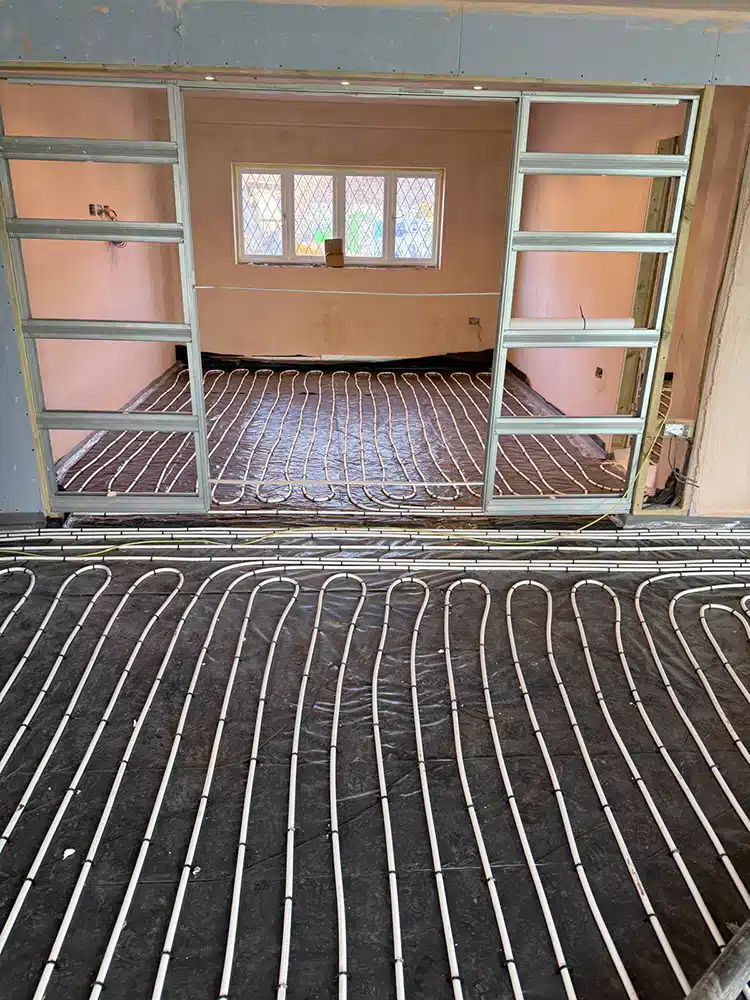
Since 2000, 27% of Gillingham's homes have been built, and the Southern Extension south of Ham is where most of the town's new housing is planned. A common layout in houses like these is heating across the whole ground floor, with pipes clipped down onto insulation and liquid screed poured over the top.
Getting the depth over the pipes right comes first. With liquid screed, at least 25mm has to sit above them, usually making the floor 45 to 50mm thick in total. Hand-laid mixes want more, about 45mm. Too thin, and lines of cracking can follow the pipes. Too thick, and you wait ages for warmth.
Second is encapsulation, meaning the screed must touch the pipe all the way round. Because a pumped mix wraps each loop of pipe completely, no trapped air slows the heat down, and the room warms evenly and sooner. That explains why heated ground floors so often get a pumped Gillingham liquid screed.
Before pouring, we make sure the insulation lies flat, the membrane is lapped and taped, edge strip runs around every wall, and the heating installer has pressure tested the pipes. If the spec names a particular calcium sulphate grade, our page on anhydrite flow screed explains what follows from that. For liquid screed laid over underfloor heating, published 2026 UK figures run from £20 to £35 per m².
Retrofitting heated floors in older Gillingham houses
Older houses are trickier, because doors, stairs and thresholds fix how high the floor can go. In the brick terraces around the town centre, fitting insulation, pipes and screed often means removing the old solid floor first. Liquid screed is useful in that situation, as it needs less depth over the pipes than sand and cement.
With an extension, the heated floor must end up at the same height as the existing house. We start from that finished level and work down to the screed depth.
Most heated floor problems start at commissioning, the first time the system is run. Bring the heating up slowly and in steps, and never run it flat out on the first day. Gentle heat can usually go into a calcium sulphate floor from around a week, 7 days, whereas a sand and cement one has to sit cold for 21 days or more. We give you clear guidance on the heat-up schedule, so both you and your heating engineer know each step and when to take it.
Typical build-ups are shown in our guide to screed depths, and we lay heated floor screed in neighbouring Warminster as well.
Underfloor Heating Screed prices in Gillingham
Liquid screed over underfloor heating: £20 to £35 per m² supplied and laid (trade2base, June 2026), so £700 to £1,230 for 35 m². trade2base gives these figures excluding VAT. See our floor screeding cost guide or screed calculator.
Who lays your underfloor heating screed in Gillingham
K & B Screeding’s own team, led by director Donatas Bardisevicius. Founded 2019, company 12298780.
See what customers say in our Google reviews and on our testimonials page.
Underfloor Heating Screed from Slough to Gillingham
Gillingham is about 78.5 miles west-south-west of our Slough base as the crow flies, with postcodes including SP8. The nearest towns to it are Warminster (12.3 miles), Frome (13.5 miles), Westbury (15.9 miles) and Trowbridge (19.7 miles).
More on underfloor heating screed, part of our screeding services.
