
Heated screeds at Old Sarum and Longhedge
Since 2015, 8% of Salisbury's homes have been built, and newer houses at Longhedge and Old Sarum have underfloor heating set into the screed.
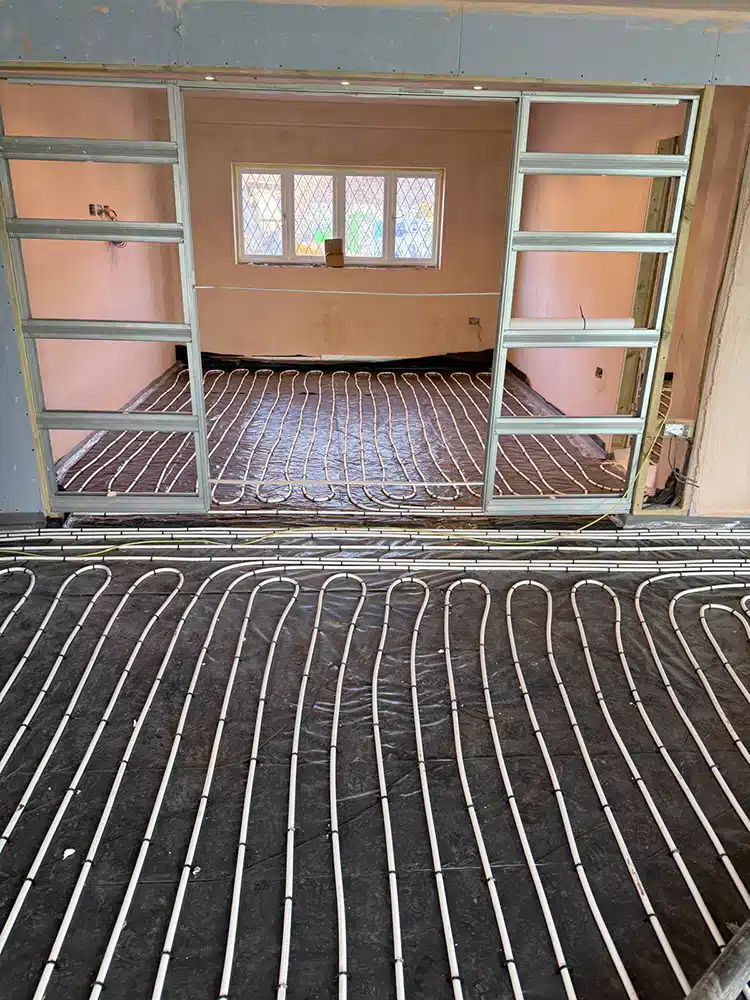
It is the screed that makes a heated floor perform. It carries heat outwards across the room from the pipework, so it has to enclose them fully at the correct depth. A liquid screed needs 25mm or more above the pipes, normally 45 to 50mm overall, and because it flows into every gap no air gets trapped, so the floor warms faster. Sand and cement needs roughly 45mm over the pipes, giving a deeper floor that has to be packed carefully round them by hand.
Before we pour, the perimeter edge strip, the membrane and the insulation are checked, and we supply any that are missing. The edge strip allows the screed to expand as it heats; without it, heated floors often crack.
Pipe installation is outside what K & B does. Your heating installer puts the pipes in and runs the pressure test before our visit, and then we screed over them.
If a new-build plot specifies a calcium sulphate grade, the anhydrite screed page for Salisbury explains what that means for sanding and moisture tests. UK price figures for 2026 put liquid screed laid over heating pipes at £20 to £35 per m², with the final figure set by area and depth.
Heated extensions to Salisbury's suburban semis
Some 26% of Salisbury's homes date from 1945 to 1972, and inter-war and post-war semis in the outer suburbs are regularly extended. A heated kitchen extension is a common way to do it, with the original rooms keeping their radiators.
The extension floor must end up flush with the existing one, so insulation, pipes and screed all have to fit the height available, which is often simpler with a slimmer liquid floor. Digging out the old floor at the same time gives more depth to play with. Where the new floor meets the old, any small step left can be skimmed out with compound.
Hold off on the heating at first: calcium sulphate needs around 7 days, sand and cement 21 or more. Bring the first warm-up on gradually, nudging the water temperature up bit by bit across several days. We set that schedule out in writing for your heating installer.
For a heated extension further afield, we also lay heated floor screed in Andover. If tiles need the finished floor flatter, see levelling floors before tiling.
Underfloor Heating Screed prices in Salisbury
Liquid screed over underfloor heating: £20 to £35 per m² supplied and laid (trade2base, June 2026), so £700 to £1,230 for 35 m². trade2base gives these figures excluding VAT. See our floor screeding cost guide or screed calculator.
Who lays your underfloor heating screed in Salisbury
K & B Screeding’s own team, led by director Donatas Bardisevicius. Founded 2019, company 12298780.
See what customers say in our Google reviews and on our testimonials page.
Underfloor Heating Screed from Slough to Salisbury
On the map, Salisbury sits west-south-west of Slough, about 59.2 miles from our base in a straight line (postcodes including SP1, SP2 and SP5), next to Amesbury (7 miles), Tidworth (13.1 miles), Verwood (13.5 miles) and Romsey (14.1 miles).
More on underfloor heating screed, part of our screeding services.
