
Relaying solid floors in Salisbury's period terraces
Salisbury's homes are 26% terraced, and the period terraces near the centre are where hand-laid sand and cement is most often the answer. Many of their solid floors went down with no membrane at all. Damp comes up through them, finishes lift and timber skirtings rot, and patching seldom cures it.
What lasts is breaking the old floor out, digging deep enough for insulation, laying a damp proof membrane and finishing with fresh screed. On top of insulation, a domestic floating screed in sand and cement measures 65mm, so the dig has to allow for that plus the insulation under it. The layers beneath the screed are handled by our insulation and damp proofing service.
There are practical reasons sand and cement suits this work. Each batch is mixed on site for its area, so a floor meeting thresholds at different heights can be built up room by room. Compacting by hand works in narrow rooms, round chimney breasts and along short stretches between doorways. Some adhesives and finishes specify a cement substrate, and this gives them one.
Drying is the cost. A 65mm screed takes weeks, at around one day per millimetre up to 40mm and slower past that. Fibres can go into the mix to resist cracking, at £1 to £3 per m², and a rapid drying additive cuts the wait. On UK price figures for 2026, sand and cement runs at £18 to £25 per m².
Inter-war houses, wet rooms and garages in Salisbury
Inter-war houses, built from 1919 to 1944, are 14% of Salisbury's stock. Where one of their original floors has failed, the same dig-out approach applies, with sand and cement usually forming the new floor.
Wet rooms call for sand and cement however old the house. In a walk-in shower, the floor must fall towards the drain, and that slope is formed by hand. Calcium sulphate should be kept away from any floor that may stay wet. Tiles then go on over a tanking layer, so the screed below stays dry in use.
Then there are garage conversions. The slab sits lower than the house, so it is built up with insulation, a membrane and new screed; the levels are set out in our guide to garage floor screeding. Floating on insulation, that new screed is the usual 65mm for a home.
When floor height is short and the slab underneath is in good order, 25 to 40mm of bonded screed can be laid straight onto it. For wider, newer floors, go to pumped liquid floors in Salisbury. We lay the same hand-mixed floors in Romsey as well.
Sand and Cement Screed prices in Salisbury
Sand and cement screed: £18 to £25 per m² supplied and laid (MyJobQuote, August 2026), so £450 to £630 for 25 m². MyJobQuote does not say whether these figures include VAT. See our floor screeding cost guide or screed calculator.
Who lays your sand and cement screed in Salisbury
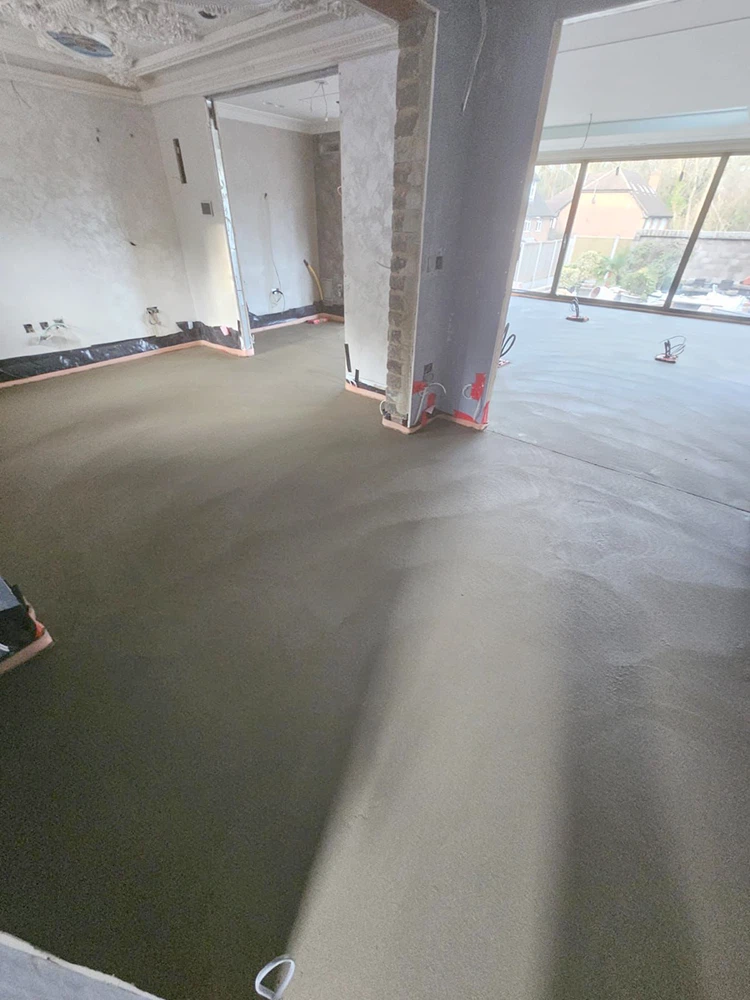
K & B Screeding’s own team, led by director Donatas Bardisevicius. Founded 2019, company 12298780.
See what customers say in our Google reviews and on our testimonials page.
Sand and Cement Screed from Slough to Salisbury
On the map, Salisbury sits west-south-west of Slough, about 59.2 miles from our base in a straight line (postcodes including SP1, SP2 and SP5), next to Amesbury (7 miles), Tidworth (13.1 miles), Verwood (13.5 miles) and Romsey (14.1 miles).
More on sand & cement screed, part of our screeding services.
