
Relaying old floors near the Ringwood Market Place
Ringwood's history goes back to a grant of land by King Edgar in 961, and a market still trades in the Market Place. Homes built before 1919 are 15% of the town's stock, and the older cottages and town houses near the Market Place are the ones most likely to have a solid floor with no damp proof membrane beneath it.
A floor like that can feel cold, show damp at the edges or break up under new flooring. Laying a new covering over it rarely solves anything. The lasting fix is to dig the floor out, then build it back up with insulation and a membrane before screeding. In a house, the floating sand and cement layer on top is normally about 65mm thick.
Mixing and laying by hand fits old Market Place houses well. Rooms in older houses are often small, the walls are rarely square, and floor depths can vary between rooms. Mixing on site lets us lay each area to the depth it needs, and there is no pump to position in a busy town centre.
Where a concrete slab is still sound, digging out may not be necessary. Instead, the slab can be cleaned up and primed and a bonded screed of 25 to 40mm fixed straight onto it, keeping the door thresholds where they are. And if the existing floor only has cracks or hollow patches, screed repairs may be enough.
Ringwood garages, wet rooms and early load floors
In a few rooms, only a cement floor will do. Wet rooms are the clearest example, because we can slope a sand and cement floor towards the drain and it shrugs off water that would damage calcium sulphate. Utility rooms and ground floor shower rooms fall into the same category.
Garages are another. A sand and cement floor can take load early and be built up to the house level if the garage is being converted. Our garage floor screed guide goes through insulation, height and damp proofing for conversions.
Homes built between 1919 and 1944 make up 10% of Ringwood's housing, and a solid floor of that age may be tired or uneven after decades of use. Where one is dug out, a traditional screed is often the simplest replacement.
Its drawback is the wait. Up to 40mm deep it loses moisture at around a millimetre a day, and below that it slows further, so a 65mm floor near the Market Place is several weeks off taking tiles. A faster drying sand and cement mix helps where the builder's programme has no slack. A moisture test, rather than the calendar, should decide when tiles or wood go down, because a cold, unheated ground floor in winter dries more slowly than the rule suggests.
Sand and Cement Screed prices in Ringwood
Sand and cement screed: £18 to £25 per m² supplied and laid (MyJobQuote, August 2026), so £450 to £630 for 25 m². MyJobQuote does not say whether these figures include VAT. See our floor screeding cost guide or screed calculator.
Who lays your sand and cement screed in Ringwood
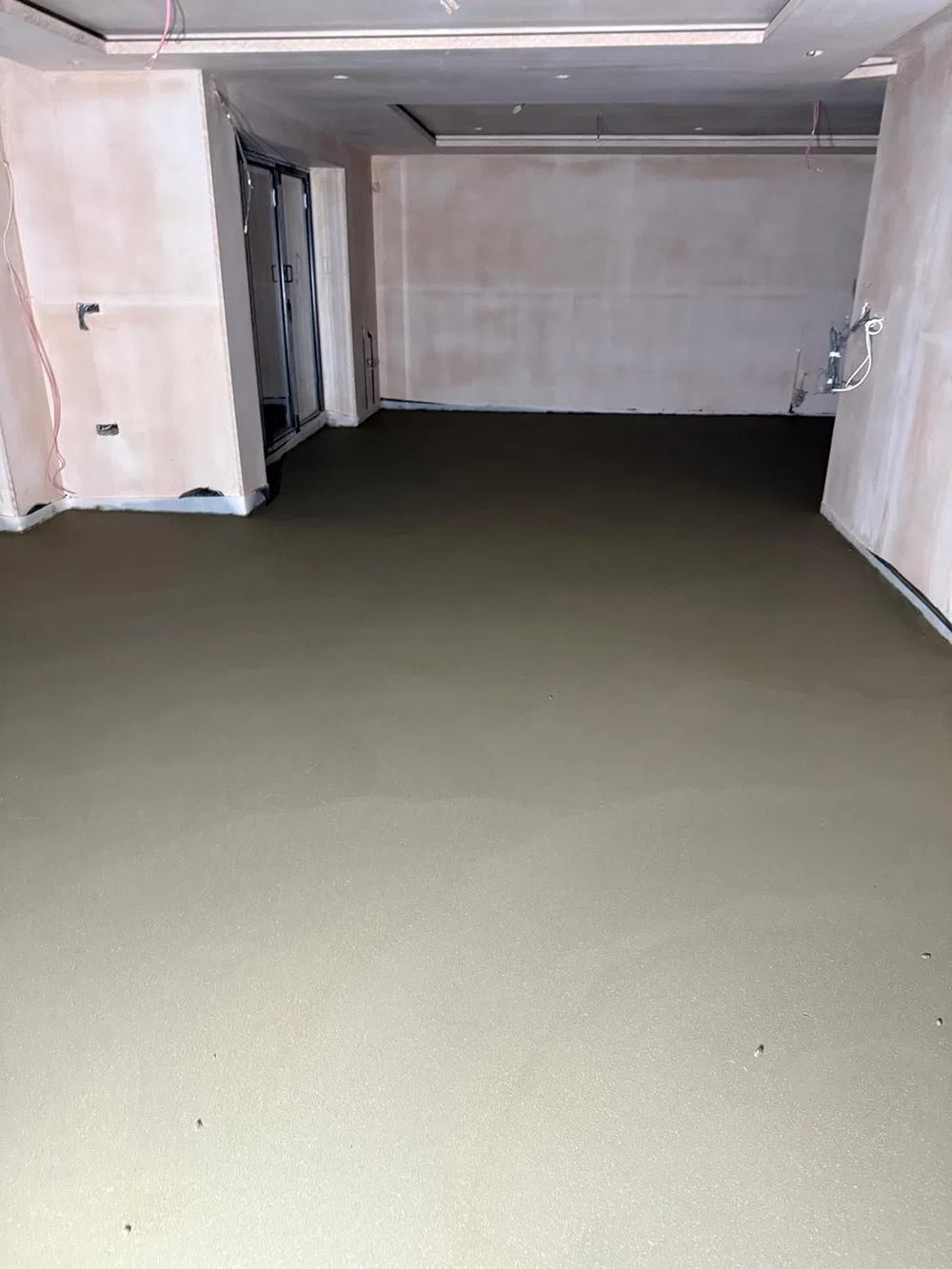
K & B Screeding’s own team, led by director Donatas Bardisevicius. Founded 2019, company 12298780.
See what customers say in our Google reviews and on our testimonials page.
Sand and Cement Screed from Slough to Ringwood
On the map, Ringwood sits south-west of Slough, about 68.7 miles from our base in a straight line (postcodes including BH24), next to Verwood (4.6 miles), Ferndown (5.3 miles), Christchurch (7.5 miles) and New Milton (8.8 miles).
More on sand & cement screed, part of our screeding services.
