
Why liquid screed suits Poulner extensions and conservatories
Houses in Poulner and the suburbs ringing Ringwood's centre, mostly built after 1945, are where extensions, open plan kitchens and conservatory replacements happen. All three leave you with a broad new floor whose surface has to sit flush with the original rooms beside it.
Liquid screed helps in three ways. First, depth. Over insulation in a post-war Poulner house, a floating liquid floor starts near 35mm against roughly 65mm for the hand-laid kind, and the height saved goes into thicker boards beneath instead of a raised threshold. Second, flatness: it settles to its own level, so SR1 or SR2 is well within reach. And it barely shrinks, so a long kitchen and living space needs far fewer joints.
Replacing a conservatory with a solid extension is a good example. The old base often comes out, a new insulated slab goes in, and the screed is poured to match the house floor height precisely.
Newer houses are designed around a flowing screed. Only 11% of Ringwood's homes date from 2000 or later, but on those plots the insulated ground floor is usually intended for exactly this kind of floor.
Two chemistries sit under the liquid screed name: calcium sulphate and cement. The calcium sulphate version, with the sanding and testing it needs, has its own page on anhydrite flow screed, and our liquid or sand and cement guide compares the two approaches in more depth.
Getting the pump to a Ringwood room
We park the mixer and pump outdoors and run a hose in to wherever the floor is. Where the house is detached or semi-detached with its own drive, that is rarely any trouble. Near the Market Place and The Furlong, or on market days, the lorry needs a place to stand, so tell us about restrictions early.
Flats need different planning. Flats make up 16% of Ringwood's homes, and upper floor pours mean running the hose up a staircase. We need the route, the floor level and any rules from the building's managing agent.
By pour day the room should have its perimeter strip fixed, sheeting over the insulation with every seam taped, and a stop across each door opening. We look all of that over before the hose goes in, and if the insulation and sheeting are not yet laid, we can provide them under insulation and membranes.
Drying needs planning into the programme. A day per millimetre for the first 40mm is a fair guide, slower beyond that. Read our guide on screed drying times before you give the carpet or LVT fitter a date.
Liquid Screed prices in Ringwood
Liquid screed: £24 to £31 per m² supplied and laid (MyJobQuote, August 2026), so £960 to £1,240 for 40 m². MyJobQuote does not say whether these figures include VAT. See our floor screeding cost guide or screed calculator.
Who lays your liquid screed in Ringwood
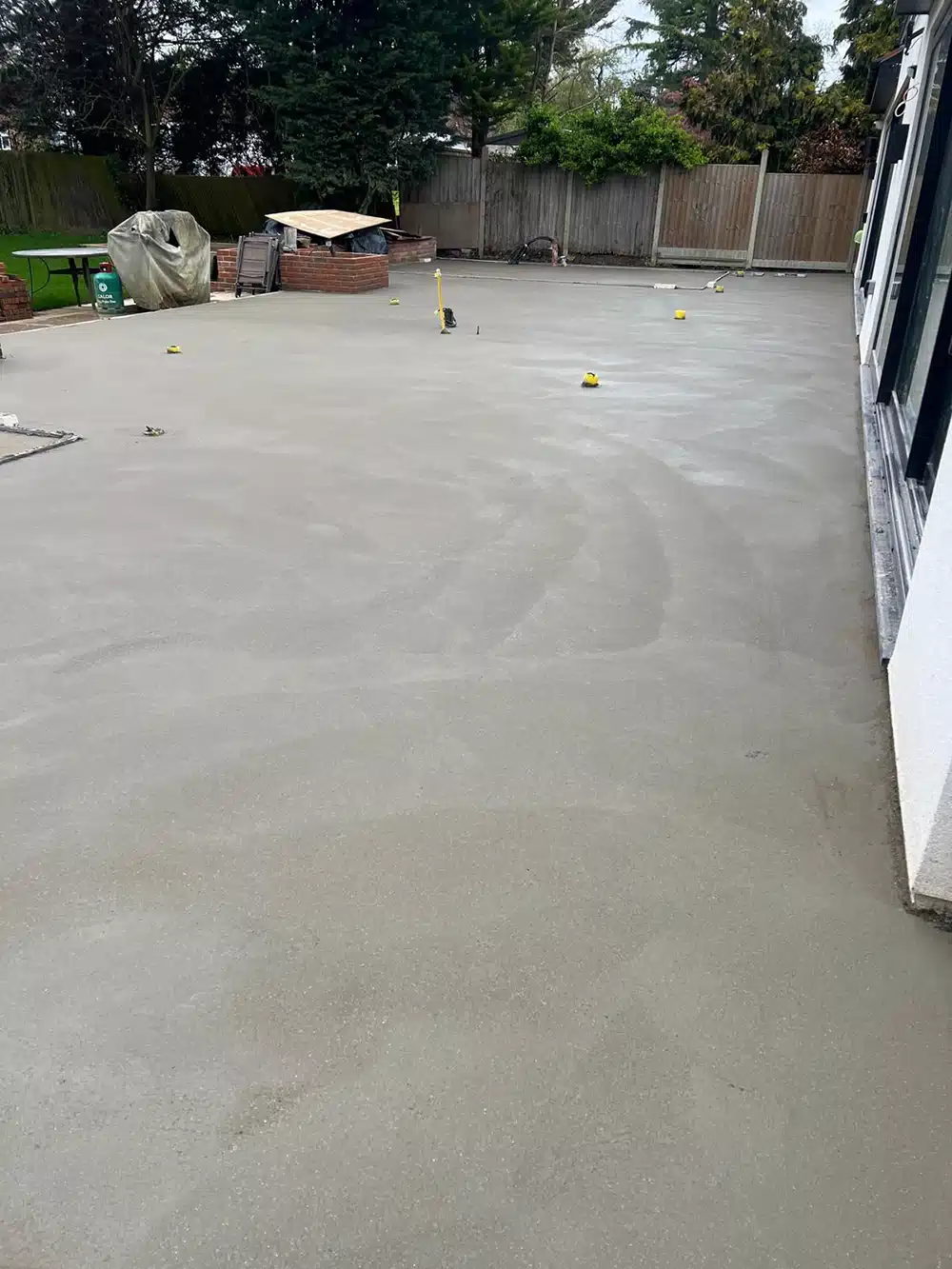
K & B Screeding’s own team, led by director Donatas Bardisevicius. Founded 2019, company 12298780.
See what customers say in our Google reviews and on our testimonials page.
Liquid Screed from Slough to Ringwood
On the map, Ringwood sits south-west of Slough, about 68.7 miles from our base in a straight line (postcodes including BH24), next to Verwood (4.6 miles), Ferndown (5.3 miles), Christchurch (7.5 miles) and New Milton (8.8 miles).
More on liquid screed, part of our screeding services.
