
Anhydrite grades for Ringwood flats and new plots
Anhydrite screed is specified by a code, and the code tells you what the floor can take. At the light end, CA-C20-F4 serves house floors that see little wear. In the middle, CA-C25-F5 is what you would expect to see written for ordinary houses, flats and office space. CA-C30-F6 is the step up for harder working floors. Strength is what the numbers measure: C for crushing and F for bending, both in N/mm2 under the European screed standard.
Newer homes are where these grades turn up. Only 5% of Ringwood's homes were built since 2015, but new plots and apartment floors are commonly designed around a calcium sulphate screed over insulation and underfloor heating.
A designer wanting a floor that dries sooner, or one that can be poured thinner, may choose an alpha hemihydrate product instead. Those come with their own data sheets for depth and heating, and on site those sheets govern what we do.
Calcium sulphate barely moves as it sets, and that is what makes it attractive. A cement screed has to be broken into smaller bays, whereas this one lets a whole apartment or open plan ground floor go down with hardly a joint. We still draw up where joints go before pouring, looking hardest at door openings and at the lines between heating zones.
An office specification would normally say CA-C25-F5, going to CA-C30-F6 if heavier use is expected. How the screed gets from lorry to room is covered under pumped liquid screed, and anhydrite screed explained goes deeper into the material itself.
Laitance and moisture checks before Ringwood floors are laid
Calcium sulphate screed needs finishing work before any floor covering goes on.
The first step is laitance removal. As it cures, a feeble film collects on the surface. Once the floor is dry, a sander takes it off back to firm screed. If it stays, adhesives bond to that weak layer and tiles or vinyl can come loose later. Our floor preparation service includes sanding and cleaning.
The second is moisture testing. Flooring makers frequently set a tighter moisture limit for calcium sulphate than for cement, so look up the figure for the exact product going down. In a heated Ringwood flat, running the system gently from about a week after the pour usually speeds the drying.
The third is priming. Use a primer compatible with calcium sulphate before adhesives or levelling compound.
Finally, keep anhydrite out of wet areas. Wet rooms, utilities and anywhere water could end up on the floor need something else. A cement based flowing screed is the alternative there, with the same pumped, self-levelling benefits. We can advise on the switch before the specification is finalised.
Anhydrite & Flow Screed prices in Ringwood
Liquid flowing screed (which includes anhydrite): £24 to £31 per m² supplied and laid (MyJobQuote, August 2026), so £960 to £1,240 for 40 m². MyJobQuote does not say whether these figures include VAT. See our floor screeding cost guide or screed calculator.
Who lays your anhydrite and flow screed in Ringwood
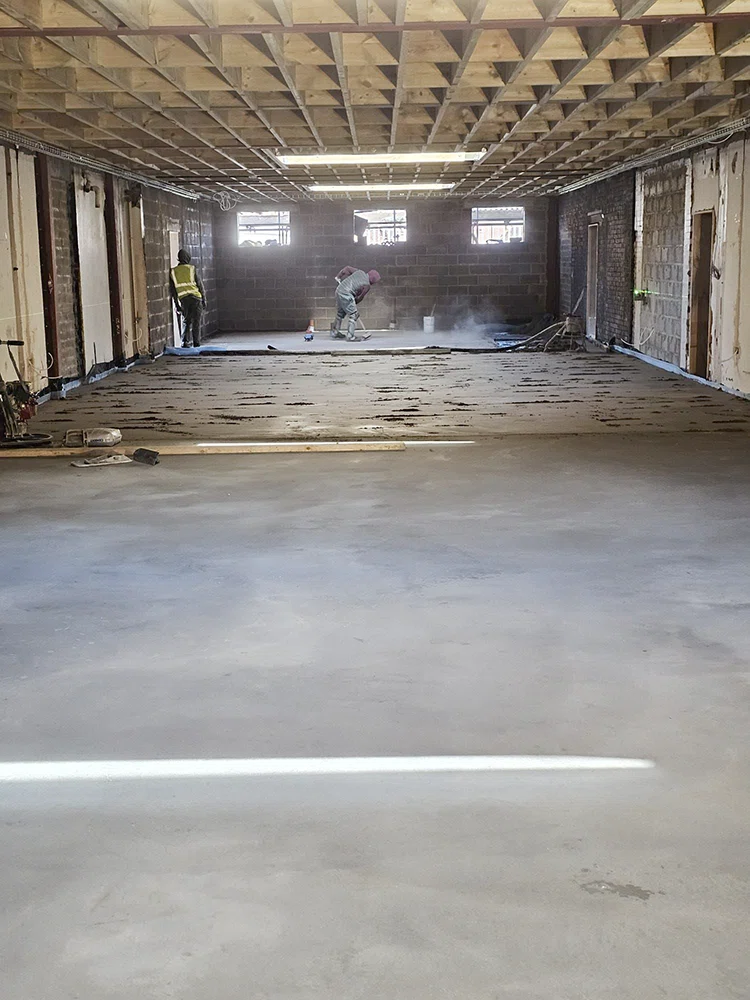
K & B Screeding’s own team, led by director Donatas Bardisevicius. Founded 2019, company 12298780.
See what customers say in our Google reviews and on our testimonials page.
Anhydrite & Flow Screed from Slough to Ringwood
On the map, Ringwood sits south-west of Slough, about 68.7 miles from our base in a straight line (postcodes including BH24), next to Verwood (4.6 miles), Ferndown (5.3 miles), Christchurch (7.5 miles) and New Milton (8.8 miles).
More on anhydrite screed, part of our screeding services.
