
Specifying anhydrite screed for Christchurch flats and retirement blocks
Look at the screed line on a Christchurch retirement block specification and you will find a grade set by the European standard for screed materials. Take CA-C25-F5: the CA says calcium sulphate, and the numbers say 25 N/mm2 in compression and 5 N/mm2 in bending, the flexural figure. A lighter domestic floor might carry CA-C20-F4 on the drawing instead, and somewhere with heavier use CA-C30-F6. CA-C25-F5 itself is what most homes, apartments and offices get.
On a block of flats, the grade is written into the specification by the designer, and we pour exactly that. An alpha hemihydrate product sometimes replaces it when time is short or there is little depth to play with. Those dry faster or work at reduced depth, and each follows its own product sheet.
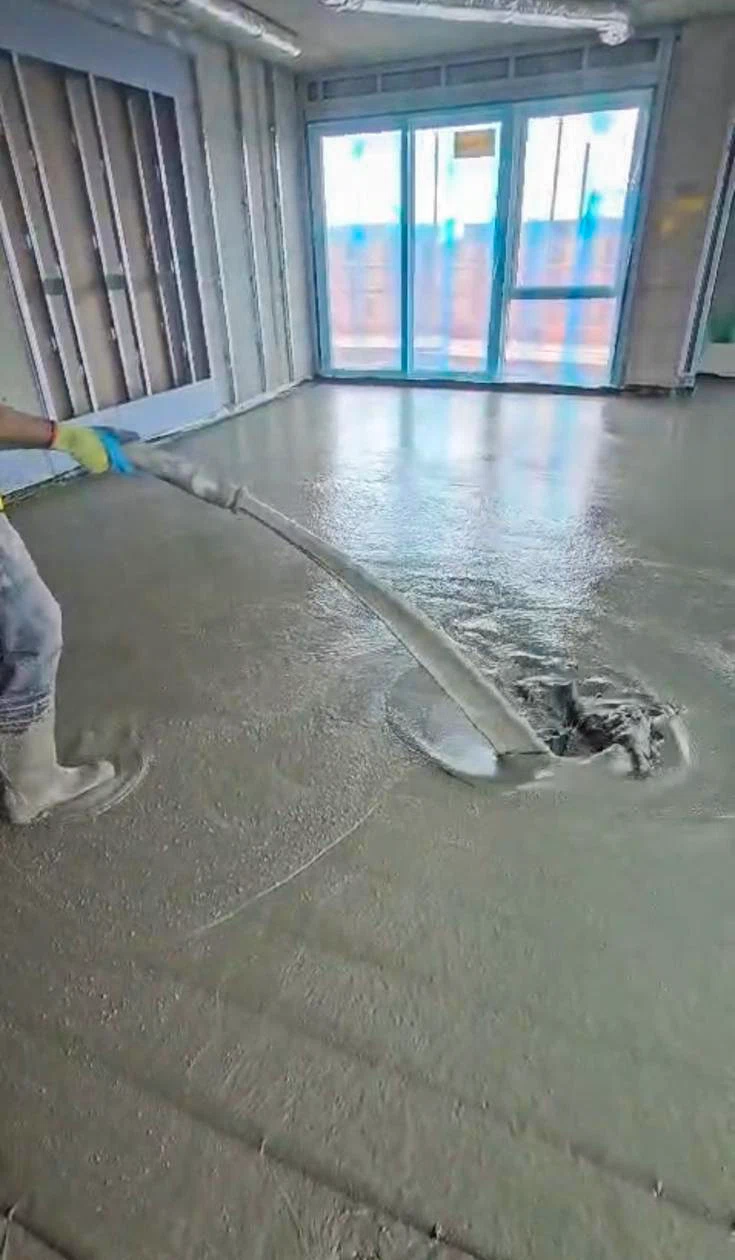
With so little shrinkage, wide bays need hardly any joints. Across a whole flat that means one pour, with joints planned only at doorways and between heating zones. We set out the bays before pouring and prepare the full build-up with our own team: insulation, acoustic layer where needed, edge strip and membrane.
In a retirement block, flat and even floors matter for residents moving between rooms, and a flowing screed readily achieves SR1 or SR2 flatness for the finish on top, whether that is vinyl, carpet or tiles. For the full background, read our guide to anhydrite screed explained.
Moisture and laitance near Christchurch Harbour
Calcium sulphate has one weakness: prolonged water. That matters in a town where the Avon and Stour meet Christchurch Harbour, and where floors near the harbour and floodplains should be chosen with damp in mind. On a ground floor at risk, or in any shower room, wet room or utility, a cement based flowing screed is the alternative, or sand and cement screed for wet areas.
Once poured, the surface forms laitance, a weak skin that must be sanded off. Next comes a primer made to work with calcium sulphate, and only then adhesive or levelling compound.
Moisture testing comes before flooring. Flooring manufacturers frequently set a tighter moisture limit for calcium sulphate, so on a Christchurch block we take a hygrometer reading and let that, rather than a date on the wall planner, say when the finish can go down. If the flats have underfloor heating, it can normally be switched on to force dry the screed once about 7 days have passed. For the factors that hurry drying along or hold it back, see screed drying times explained.
Anhydrite & Flow Screed prices in Christchurch
Liquid flowing screed (which includes anhydrite): £24 to £31 per m² supplied and laid (MyJobQuote, August 2026), so £960 to £1,240 for 40 m². MyJobQuote does not say whether these figures include VAT. See our floor screeding cost guide or screed calculator.
Who lays your anhydrite and flow screed in Christchurch
K & B Screeding’s own team, led by director Donatas Bardisevicius. Founded 2019, company 12298780.
See what customers say in our Google reviews and on our testimonials page.
Anhydrite & Flow Screed from Slough to Christchurch
Christchurch is about 73.8 miles south-west of our Slough base as the crow flies, with postcodes including BH23. The nearest towns to it are Bournemouth (4.3 miles), New Milton (5.6 miles), Ferndown (6.4 miles) and Ringwood (7.5 miles).
More on anhydrite screed, part of our screeding services.
