
Calcium sulphate grades for Verwood extensions and plots
Anhydrite is sold by code. Under the European standard for screed materials, the number after C tells you how much crushing load it takes and the number after F how much bending, each in N/mm2. Three of these codes cover nearly all work:
CA-C20-F4 is for domestic floors with light traffic.
CA-C25-F5 is what most Verwood homes, flats and offices would be poured in.
CA-C30-F6 steps up for floors that take harder wear.
An architect's drawing or an engineer's specification normally sets the grade. We pour what is written rather than substituting, and if nothing is specified on a small extension, we recommend one for the rooms and floor finish.
Now and then a designer names an alpha hemihydrate product, usually to get a quicker dry or a slimmer floor. Each brand publishes its own depths and drying times, and we stick to them.
Only 5% of Verwood's homes date from 2015 or later, so here it is more likely to go into extensions and renovations than whole new estates. The material suits that work well. With hardly any shrinkage, a big open-plan room can go down as a single bay, and if heating pipes run through it, they can help dry it from roughly day 7. Any joints at doorways or between heating zones get marked out with you in advance. Our plain guide to anhydrite goes deeper into the material, and the Verwood liquid screed page covers pumping in general.
Sanding and testing anhydrite floors in Verwood
Looking dry and being ready for flooring are two different things with anhydrite. Two steps come first.
The laitance has to go. Drying leaves a thin, weak crust across the surface. Glue and compound cannot grip that crust, so when the floor has dried enough we sand it back and clear the dust away. Then it is primed, using a product meant for calcium sulphate and not a cement primer.
The moisture has to be checked. Flooring brands are often fussier about moisture in anhydrite than in sand and cement. A humidity reading that would pass on sand and cement can therefore still be too high on anhydrite, so the number matters more than how the surface looks. A hygrometer gives us the number, and you get the drying and sanding advice written down. Our screed drying guide explains what affects the timing.
Anhydrite is not for wet places. Shower rooms, utility floors and any converted garage at risk of damp want cement, poured as a flowing screed or laid by hand. Down the road in Wimborne Minster, we pour the same material.
Anhydrite & Flow Screed prices in Verwood
Liquid flowing screed (which includes anhydrite): £24 to £31 per m² supplied and laid (MyJobQuote, August 2026), so £960 to £1,240 for 40 m². MyJobQuote does not say whether these figures include VAT. See our floor screeding cost guide or screed calculator.
Who lays your anhydrite and flow screed in Verwood
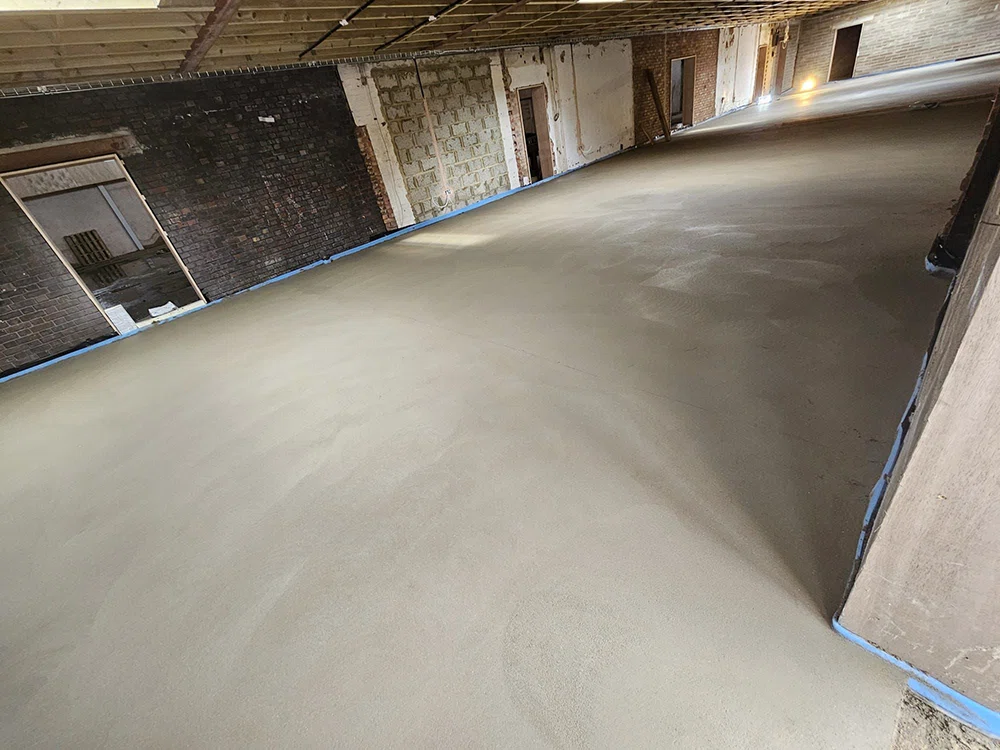
K & B Screeding’s own team, led by director Donatas Bardisevicius. Founded 2019, company 12298780.
See what customers say in our Google reviews and on our testimonials page.
Anhydrite & Flow Screed from Slough to Verwood
Verwood is about 69.9 miles south-west of our Slough base as the crow flies, with postcodes including BH31 and BH21. The nearest towns to it are Ringwood (4.6 miles), Ferndown (5.6 miles), Wimborne Minster (7.4 miles) and Christchurch (10.8 miles).
More on anhydrite screed, part of our screeding services.
