
Levelling tired floors in Verwood's 1970s to 1990s houses
A floor that has been down for thirty or forty years is rarely flat. A sand and cement screed from that period may have hollows, patched areas and the ridges left by old adhesive. A chipboard deck may have sagged between joists or lifted at the joints. Neither shows much under carpet, but both show under LVT, sheet vinyl, large tiles or engineered wood.
Our test is a 2m straightedge laid across your Verwood floor, noting the biggest gap under it. BS 8204 puts a 3mm maximum gap at SR1, 5mm at SR2 and 10mm at SR3, and thin sheet flooring often will not accept anything worse than SR1.
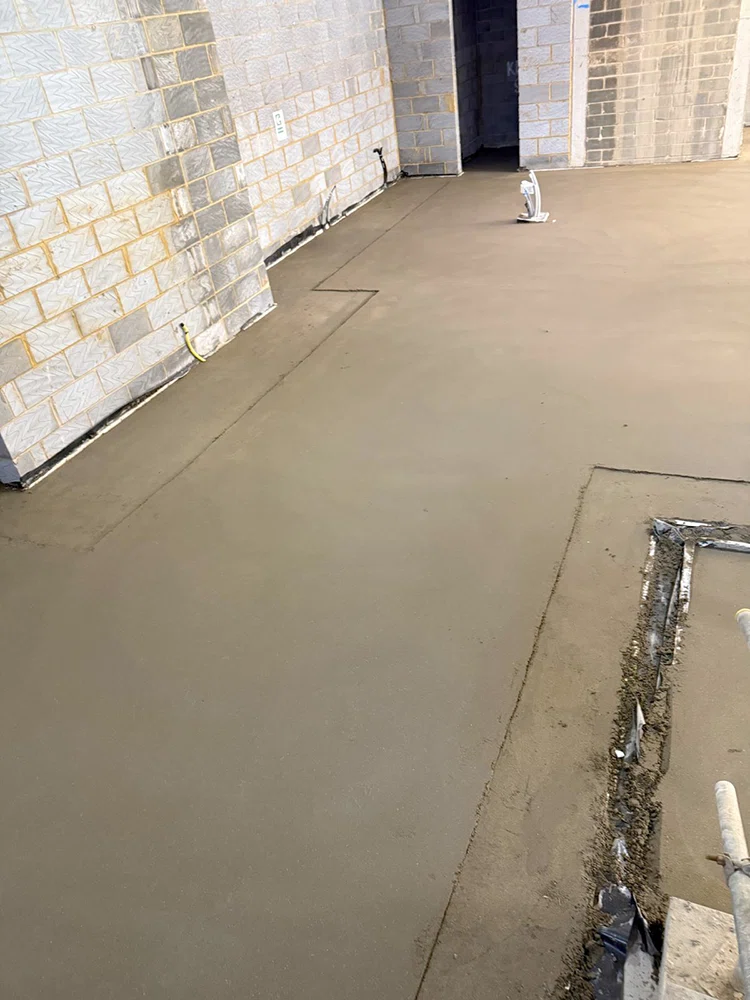
On a sound screed or concrete base, the job is to clean it, repair any loose patches, prime it with the product that suits that base and pour self levelling compound, usually from about 2mm up to around 10mm. Fast drying compounds let LVT or tiles follow without a long wait. For the thinnest smoothing coats, see our latex screed service.
A chipboard floor needs more thought. It moves, so we check whether the deck is sound and stiff before recommending anything, and if compound is not the right answer we say so plainly.
Some floors are too far gone for compound at all. Deep pours to fill a big dip can crack and debond. If the original screed is crumbling, the honest answer is to replace it with new hand-laid sand and cement.
Remedial levelling at Potters Wood and Ebblake units
Potters Wood is one of Verwood's more recent housing developments, and newer homes there are more likely to need small repairs or remedial levelling than a full new floor. Typical examples are a screed with a slight dip that shows through new LVT, a patch that sounds hollow, or a threshold where two rooms finish at slightly different heights. A thin compound, applied after proper priming, usually sorts these out.
The joins where an extension meets an older house are another common spot. The two floors were laid decades apart and rarely line up exactly, and a compound feathered across the joint gives one flat surface for the new flooring.
At the Ebblake Industrial Estate, unit floors can need repairs, levelling or a new hard wearing screed. When a unit is refitted as an office, showroom or trade counter, the slab may need old coatings and adhesive removed, cracks repaired and a levelling coat before the new floor. Our concrete floor repair service handles damaged slabs before levelling starts. The same levelling service runs in nearby Christchurch.
How we price floor levelling in Verwood
A fixed written price within 24 hours, once we know the area and the base. See our floor screeding cost guide.
Who levels your floor in Verwood
K & B Screeding’s own team, led by director Donatas Bardisevicius. Founded 2019, company 12298780.
See what customers say in our Google reviews and on our testimonials page.
Floor Levelling from Slough to Verwood
Verwood is about 69.9 miles south-west of our Slough base as the crow flies, with postcodes including BH31 and BH21. The nearest towns to it are Ringwood (4.6 miles), Ferndown (5.6 miles), Wimborne Minster (7.4 miles) and Christchurch (10.8 miles).
More on floor levelling, part of our screeding services. Not sure whether you need a thin compound or a full flowing screed? See self levelling screed explained.
